Contract lifecycle management platforms transform legal operations by automating manual review processes, routing approvals across departments, and monitoring compliance obligations in real time—addressing the dual challenge of rising contract volumes and regulatory complexity.
Key Takeaways
- Modern contract management solutions reduce legal workload by automating review, routing approval workflows across departments, and providing real-time compliance monitoring—enabling legal teams to address 78% of contract requests within 72 hours benchmarking [8].
- AI-powered contract analysis extracts clauses, obligations, and risk factors automatically, cutting manual review time by up to 80% while maintaining accuracy rates near 99% [3].
- Cross-department compliance monitoring requires automated obligation tracking, audit trail capabilities, and integration with departmental workflows to ensure regulatory adherence without bottlenecking legal resources.
- Implementation timelines vary from 2 weeks to 6 months depending on platform complexity, with faster-deploying solutions suited for mid-market teams and enterprise platforms requiring phased rollouts [5].
- Effective CLM evaluation frameworks prioritize measurable workload reduction metrics, department-specific workflow support, and compliance audit readiness over feature checklists.
Understanding the Legal Workload Crisis in Contract Management
Modern contract management solutions reduce legal workload by automating review, routing approval workflows across departments, and providing real-time compliance monitoring—enabling legal teams to address 78% of contract requests within 72 hours benchmarking [8]. This shift from manual contract handling to intelligent automation addresses a critical pain point: legal teams are increasingly expected to support faster business cycles while ensuring regulatory compliance across multiple jurisdictions.
The pressure compounds when contract volumes surge. Published in the Engineering and Technology Journal, organizations managing high contract volumes face escalating risks in regulatory adherence and negotiation efficiency without data analytics support [6]. Legal departments operating with fewer than five attorneys often lack bandwidth to manually track every obligation deadline, renewal notice, or compliance checkpoint across hundreds of active agreements.
The Shift from Repository to Intelligence Platform
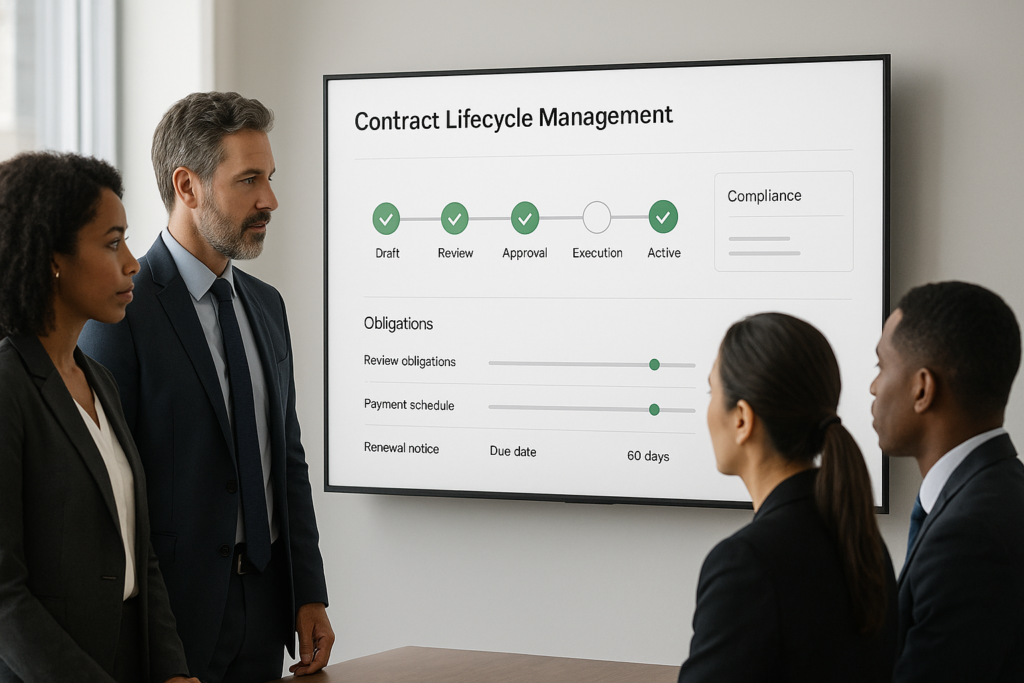
Contract repositories store documents but do not reduce workload. Modern CLM applications manage drafting, negotiation, execution, and compliance in one governed workflow [2]. The distinction matters: a repository answers “where is the contract,” while a CLM platform answers “what obligations are due this quarter, which clauses pose risk, and who needs to approve this change.”
Legal Technology Hub defines end-to-end CLM as covering at least 6 of 10 lifecycle steps: request, drafting, negotiation, approval, execution, storage, data extraction, management, reporting, and renewal [9]. Platforms meeting this threshold—including Icertis, Coupa, DocuSign, Sirion Labs, Agiloft, Evisort, and Ironclad—demonstrate meaningful investment in full-lifecycle automation since 2018 [9].
Quantifying Legal Workload Reduction
Measurable workload reduction comes from three automation layers: AI-powered contract review that extracts key terms in seconds rather than hours, workflow automation that routes approvals without manual coordination, and obligation tracking that surfaces deadlines proactively. The ContractPodAi benchmark found that advanced CLM implementations enable 78% of companies to address legal requests within 72 hours, compared to baseline response times measured in weeks [8].
DigiParser reports 99.7% extraction accuracy processing 40-page agreements at speeds roughly 10x faster than manual review [3]. When legal teams spend less time extracting dates, payment terms, and liability caps, they allocate more hours to strategic negotiations and risk mitigation.
Key Capabilities That Reduce Legal Team Burden
Legal workload reduction hinges on specific platform capabilities rather than generic feature counts. The following capabilities directly address the manual tasks that consume legal team capacity.
AI-Powered Contract Review and Clause Extraction
AI contract analysis tools extract clauses, obligations, and risk factors automatically, cutting manual review time by up to 80% while maintaining accuracy rates near 99% [3]. Platforms employing large language models trained on legal text can identify non-standard language, flag risky provisions, and suggest fallback clauses during redlining. The International Swaps and Derivatives Association evaluated eight large language models for extracting and digitizing collateral support annex clauses, demonstrating that specialized legal AI models achieve production-grade accuracy [12].
Ironclad supports billions of contracts annually for companies like L’Oréal, Salesforce, and OpenAI by combining AI extraction with workflow automation [10]. The platform’s AI engine tags and categorizes data points, dates, parties, payment terms, renewal clauses, so legal analysts can query contract portfolios rather than reading documents one by one.
Automated Approval Routing Across Departments
Manual email chains to secure finance, procurement, and legal sign-offs delay contracts and obscure accountability. Automated workflow platforms route contracts to the correct approver based on value thresholds, contract type, or regional requirements. LinkSquares provides automated workflows and approval routing, ensuring contracts reach decision-makers without bottlenecking in legal inboxes [1].
Workflow automation also enforces approval hierarchies. If a sales contract exceeds $100,000, the system can require CFO approval before legal review. If an NDA contains non-standard indemnity language, the platform flags it for senior counsel review. These rules operate continuously without manual oversight.
Real-Time Obligation and Compliance Monitoring
Compliance monitoring requires tracking contractual obligations, renewal deadlines, reporting requirements, service-level commitments, and surfacing upcoming actions before they become breaches. Sirion publishes guidance on AI-powered clause extraction software for real-time obligation tracking, emphasizing contract data and performance analytics [11]. Platforms with AI-native extraction engines can identify obligation clauses buried in 40-page agreements and generate calendar alerts for responsible business owners.
Audit trails provide another compliance layer. Every contract edit, approval decision, and version iteration is logged with timestamps and user IDs. When auditors or regulators request contract governance documentation, teams can produce complete lifecycle records without reconstructing email threads or file shares.
How Contract Management Platforms Enable Cross-Department Compliance Monitoring
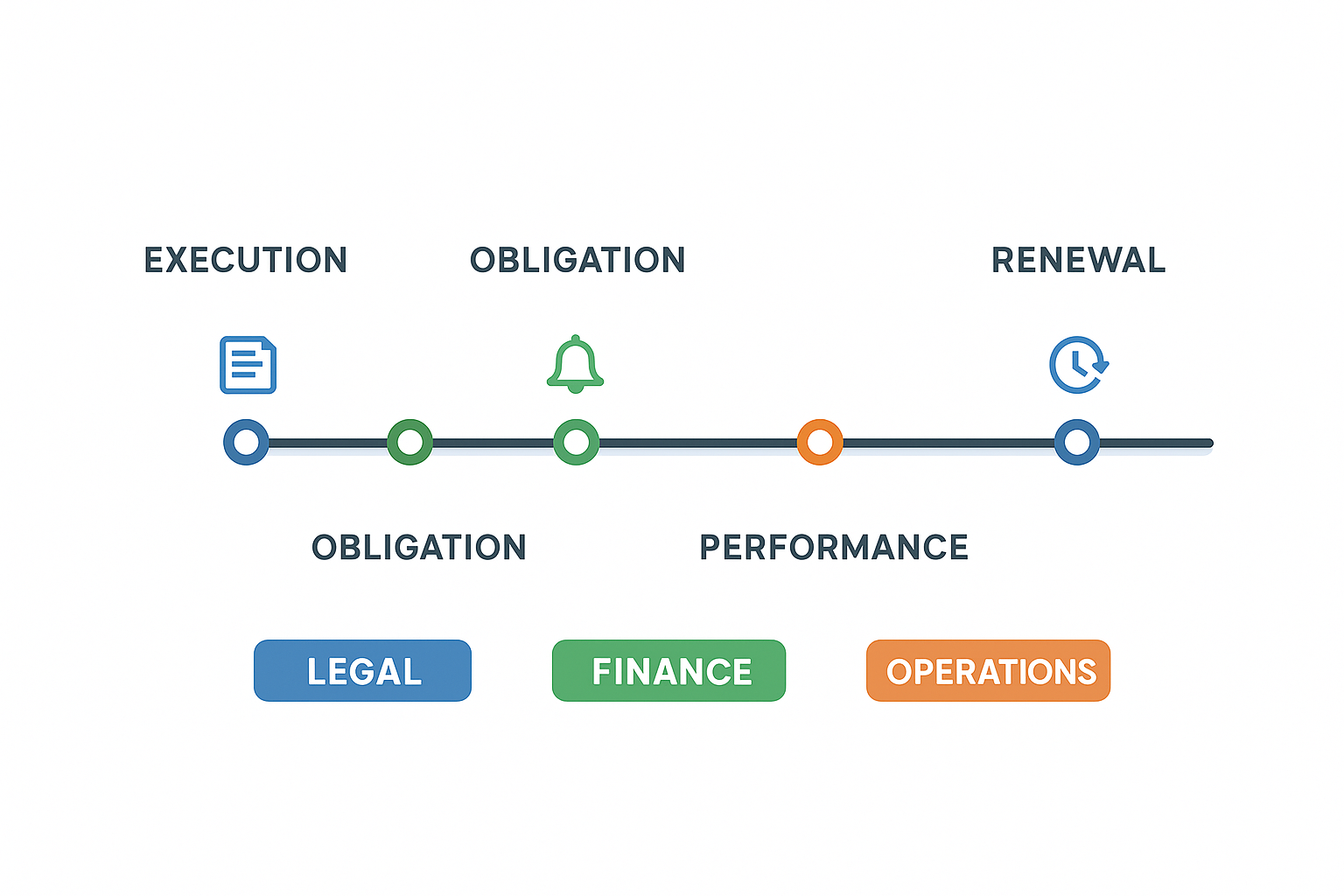
Compliance monitoring across departments requires more than legal oversight, it demands shared visibility, role-based access, and integrated workflows that connect legal, finance, procurement, and operations. Effective CLM platforms break down departmental silos by providing a unified system of record where every team sees the contract data relevant to their responsibilities.
Department-Specific Workflow Handoffs
Sales teams initiate contracts, finance approves payment terms, procurement validates vendor compliance, and legal reviews risk language. Each handoff introduces delay and miscommunication risk when managed via email. CLM platforms formalize these handoffs with automated routing and status tracking.
For example, a procurement contract might follow this sequence: procurement drafts terms using an approved template, finance reviews pricing and payment schedule, legal reviews indemnity and limitation-of-liability clauses, and the department head provides final approval. The platform enforces this sequence, notifies each approver when their review is due, and escalates overdue tasks automatically.
Role-Based Compliance Dashboards
Different stakeholders need different views of contract data. Legal needs to see risk exposure and audit readiness. Finance needs to see payment obligations and revenue recognition schedules. Procurement needs to see vendor performance and renewal dates. Modern CLM platforms provide role-based dashboards that surface relevant metrics without overwhelming users with irrelevant data.
A compliance officer might see a dashboard showing all contracts with upcoming regulatory reporting obligations, contracts containing specific data-privacy clauses, and contracts flagged for non-standard language. A finance director might see a dashboard showing upcoming payment obligations, contracts approaching renewal with auto-renewal clauses, and contracts with variable pricing terms.
Integration with Existing Legal and Enterprise Tools
Contract teams that prefer drafting within Word and collaborating inside Microsoft tools often value workflow continuity [1]. CLM platforms that integrate with Word, Outlook, SharePoint, and Teams reduce adoption friction by meeting users where they work. SAP Ariba Contracts combines AI and automation to modernize the contract management lifecycle while integrating with ERP and procurement systems [4].
Integrations also enable compliance monitoring at the system level. When a CLM platform integrates with a financial planning system, contract revenue schedules automatically populate forecasts. When it integrates with a vendor management system, contract compliance scores automatically update vendor risk profiles.
Comparison Framework: Evaluating CLM Solutions for Workload Reduction
Evaluating CLM platforms requires moving beyond feature checklists to measurable workload reduction metrics and compliance monitoring capabilities. The following framework compares leading solutions based on verified deployment timelines, workflow automation depth, and pricing transparency, the dimensions most relevant to resource-constrained legal teams.
| Platform | Deployment Timeline | Workflow Automation Depth | Pricing Model | Best For |
|---|---|---|---|---|
| Contracts.ai | Implementation varies by contract volume | AI-powered contract intelligence with cross-department visibility | Custom enterprise pricing | Organizations seeking 90% operational cost reduction through contract intelligence |
| ContractPodAi | 2 weeks | Agentic CLM with full lifecycle automation | $2.4M USD implementation | Mid-market teams prioritizing rapid deployment and thorough automation |
| DocuSign CLM | 6 months | Moderate workflow automation with strong e-signature integration | Not publicly disclosed | Organizations already using DocuSign for signatures seeking expanded CLM capabilities |
| Icertis | Months-long implementation | Enterprise-grade workflow automation | $20-30 USD per user per month | Large enterprises requiring complex multi-entity contract governance |
| Ironclad | 4 weeks | Clear workflows with AI contract review | Not publicly disclosed | Teams needing fast-deploying platform with strong Word integration |
| LinkSquares | Fast-deploying | Automated workflows and approval routing | Not publicly disclosed | Legal teams preferring Microsoft tool integration and rapid setup |
Data sourced from manufacturer websites and independent software reviews as of May 2026. Deployment timelines reflect typical implementations; actual timelines vary based on contract volume, integration complexity, and customization requirements.
Decision Framework: Implementation Complexity vs. Automation Depth
Organizations face a trade-off between implementation speed and automation breadth. Platforms requiring months-long deployments typically offer deeper customization and enterprise-scale governance features. Platforms deploying in 2-4 weeks prioritize pre-configured workflows and faster time-to-value but may require process adaptation to fit the platform’s opinionated design.
Legal teams with fewer than five attorneys often benefit from faster-deploying platforms that reduce manual workload immediately rather than enterprise platforms requiring dedicated change management resources. Conversely, multinational organizations managing contracts across 20+ subsidiaries may require the governance rigor and customization depth that longer implementations provide.
Platform Approaches to Legal Automation and Compliance
CLM vendors take different philosophical approaches to automation. Understanding these approaches helps legal teams select platforms aligned with their operational priorities and risk tolerance.
AI-Native Platforms vs. Workflow-First Platforms
AI-native platforms prioritize contract intelligence, extracting structured data from unstructured documents, identifying risk patterns, and suggesting clause alternatives. These platforms reduce legal workload by automating the analytical tasks that traditionally required attorney review time. However, AI model accuracy depends on training data quality and domain specificity. Forbes noted that 30% of respondents now use AI technology in legal contexts compared to just 11% in 2023, but legal professionals remain among the most hesitant AI adopters due to accuracy concerns [7].
Workflow-first platforms prioritize process automation, routing approvals, enforcing template usage, tracking milestones, and generating reminders. These platforms reduce legal workload by eliminating coordination overhead rather than analytical tasks. They deliver value even when contracts contain minimal variation or when legal teams prefer manual risk assessment.
The most effective CLM implementations combine both approaches. AI handles extraction and flagging; workflows handle routing and escalation. This combination addresses the full spectrum of legal workload from document analysis to process coordination.
Governing AI Use in Contract Review
Organizations adopting AI contract review must address governance questions: which AI models are approved for which contract types, how AI-generated outputs are validated, and how AI usage is documented for audit purposes. The National Institute of Standards and Technology released the AI Risk Management Framework in January 2023 to provide voluntary guidance for trustworthy and responsible AI development [5].
Forbes reported that while AI adoption in contracts is accelerating, many organizations lack clear governance policies specifying how and why AI is used in their agreements [7]. Legal teams implementing CLM platforms should establish AI usage policies covering model selection, output validation, and escalation protocols for AI-flagged risks.
Implementation Considerations for Resource-Constrained Teams
Legal teams operating with limited headcount and budget face distinct implementation challenges. The following considerations help resource-constrained teams maximize CLM value while minimizing disruption.
Phased Rollout vs. Big-Bang Implementation
Phased rollouts start with a single contract type, often sales agreements or NDAs, and expand to additional contract types after validating the platform’s fit. This approach reduces change management burden and allows legal teams to refine workflows before scaling. Big-bang implementations migrate all contract types simultaneously, delivering faster overall deployment but requiring more upfront coordination.
Teams with fewer than five attorneys typically benefit from phased rollouts that allow gradual adoption without overwhelming internal capacity. Larger legal departments with dedicated legal operations staff can absorb big-bang implementations more effectively.
Migration from Contract Repositories
Organizations moving from contract repositories to full CLM platforms must decide how to handle legacy contracts. Options include bulk AI extraction of legacy contracts to populate the CLM system, manual entry of high-value contracts only, or running the CLM system in parallel with the legacy repository until all active contracts naturally cycle through the new system.
Bulk AI extraction requires upfront investment but delivers immediate compliance monitoring and reporting benefits. Manual entry minimizes upfront cost but delays full CLM value realization. Parallel operation avoids migration risk but increases operational complexity during the transition period.
Training and Change Management
CLM platform adoption fails when users revert to email-based contract workflows because the platform feels cumbersome. Successful implementations invest in role-specific training: sales teams learn how to initiate contracts from templates, finance teams learn how to review payment terms within the platform, and legal teams learn how to configure approval rules and extract compliance reports.
Resource-constrained teams should prioritize platforms with intuitive interfaces and strong vendor-provided training resources. Platforms requiring extensive custom configuration or specialized technical knowledge impose hidden costs that small legal teams struggle to absorb.
Conclusion
Selecting a contract management solution requires balancing three dimensions: workload reduction through AI and automation, compliance monitoring across departments, and implementation complexity relative to team resources. Legal teams managing fewer than five attorneys benefit from platforms deploying in 2-4 weeks with pre-configured workflows. Larger organizations requiring multi-entity governance may require enterprise platforms with months-long implementations but deeper customization.
The CLM market continues evolving toward AI-native platforms that combine clause extraction, risk flagging, and obligation tracking in unified systems. Organizations adopting these platforms now position themselves to absorb rising contract volumes without proportional headcount increases. As AI accuracy improves and adoption accelerates, Forbes reported 30% of organizations now using AI in legal contexts [7], governance frameworks become critical to ensuring AI-generated outputs meet audit and regulatory standards.
Start by inventorying your current contract management process: how many contracts your team manages annually, average time-to-approval for each contract type, and which departments require contract visibility for compliance purposes. Use these baseline metrics to evaluate platforms against measurable workload reduction and compliance monitoring improvements. Explore how Contracts.ai transforms contract operations into intelligence that reduces legal workload while strengthening cross-department compliance.
Frequently Asked Questions
What contract management solution reduces legal workload while improving compliance monitoring across departments?
Modern CLM platforms reduce legal workload by automating review through AI clause extraction, routing approvals via configurable workflows, and monitoring compliance obligations with real-time alerts. ContractPodAi benchmarking shows 78% of companies using advanced CLM address legal requests within 72 hours [8]. Effective solutions integrate with departmental tools, provide role-based compliance dashboards, and maintain complete audit trails for regulatory adherence.
What is the best contract lifecycle management software for enterprise AI-powered intelligence and cost reduction?
Enterprise AI-powered CLM selection depends on deployment speed and automation priorities. ContractPodAi delivers 2-week deployment with agentic CLM automation. Ironclad supports billions of contracts for L’Oréal, Salesforce, and OpenAI with 4-week deployment [10]. Icertis serves large enterprises requiring complex multi-entity governance at $20-30 per user monthly [5]. Contracts.ai provides AI-powered contract intelligence targeting 90% operational cost reduction.
How do AI contract review tools reduce manual legal work?
AI contract review tools extract clauses, obligations, and risk factors automatically, cutting manual review time by up to 80% while maintaining accuracy near 99% [3]. DigiParser reports processing 40-page agreements at 10x manual speed with 99.7% accuracy [3]. ISDA evaluated eight large language models for CSA clause extraction, confirming production-grade accuracy for specialized legal AI [12].
What CLM platforms deliver high ROI with minimal implementation time for mid-market companies?
Mid-market companies prioritizing fast ROI should evaluate platforms with 2-4 week deployment timelines. ContractPodAi deploys in 2 weeks with thorough lifecycle automation. Ironclad and LinkSquares both deploy in approximately 4 weeks with strong Microsoft tool integration [1]. Fast deployment reduces implementation costs and accelerates time-to-value.
How do I measure legal workload reduction after implementing CLM software?
Measure legal workload reduction using three metrics: time-to-approval for standard contract types, percentage of contracts requiring attorney review versus auto-approval, and legal team capacity allocation across strategic versus administrative tasks. Baseline these metrics before implementation. ContractPodAi’s benchmark showing 78% of companies addressing requests within 72 hours [8] provides a post-implementation target.
What integration capabilities are essential for cross-department compliance monitoring?
Key integrations for cross-department compliance include Microsoft Word and Outlook for contract drafting continuity, ERP systems for financial obligation tracking, vendor management systems for supplier compliance, and calendar systems for obligation deadline alerts. SAP Ariba Contracts integrates with ERP and procurement systems for modernized lifecycle management [4].
Should small legal teams prioritize AI contract review or workflow automation?
Small legal teams benefit most from workflow automation first, AI review second. Workflow automation eliminates coordination overhead, the emails, spreadsheets, and status meetings that consume legal capacity without adding analytical value. Once workflows are automated, AI contract review further reduces analytical workload. Teams with fewer than five attorneys should evaluate platforms offering both capabilities but prioritize those with pre-configured workflows requiring minimal setup. Phased adoption, starting with workflow automation for one contract type, delivers faster value than big-bang AI implementations.
Sources
- Best Contract Management Software 2026 – LinkSquares – linksquares.com (2026)
- 8 Best Contract Management Software of 2026 – Sirion – sirion.ai (2025)
- From Contract Pdf To… – digiparser.com
- SAP Ariba Contracts | Contract Management Software – sap.com
- AI Risk Management Framework | NIST – nist.gov (2023)
- (PDF) Automating Legal Compliance and Contract Management – researchgate.net (2025)
- AI Is Allowed In Your Contracts, But Does Anyone Know How Or Why? – forbes.com (2026)
- [PDF] The True Impact of CLM: 4 Ways Advanced Contract Management – acc.com (2023)
- End-to-End CLM | Legaltech Hub – legaltechnologyhub.com
- Contract Data Extraction: Bringing Contracts to Life – Ironclad – ironcladapp.com
- Best Contract Management Software for Legal Departments – Apps365 – apps365.com
- ISDA Publishes Paper Exploring Use of Generative AI to Extract and Digitize CSA Clauses – isda.org (2025)