Enterprise legal teams managing thousands of legacy contracts face the operational challenge of extracting structured clause data at scale without manual review bottlenecks.
TL;DR
- Leading AI contract platforms can extract clauses from over 10 million contracts with accuracy exceeding 97% across 230+ contract types [1]
- Automated clause extraction reduces operational costs by up to 90% by eliminating manual review hours across legal, finance, and procurement teams
- Enterprise-scale deployment requires bulk ingestion workflows, confidence scoring, exception handling, and integration with existing CLM and DMS systems
- Modern platforms like Contracts.ai transform static agreements into structured, queryable intelligence that supports compliance, obligation tracking, and portfolio-wide analytics
- Successful implementation depends on auditability, data residency controls, and human-in-the-loop validation to meet legal ops governance standards
Introduction
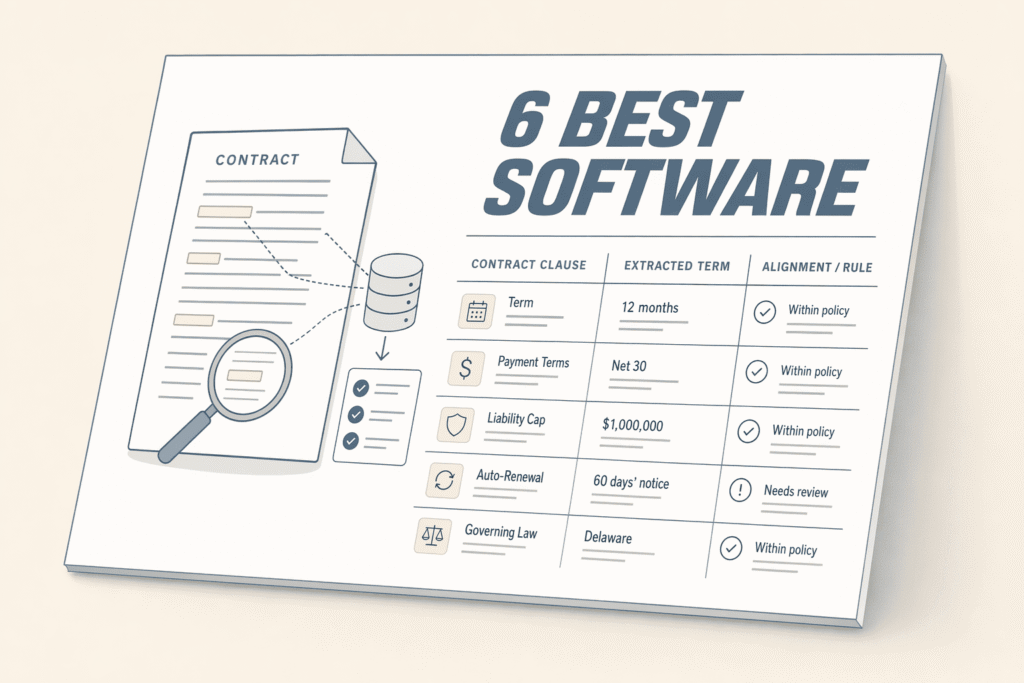
Legal operations teams managing thousands of executed agreements face a critical bottleneck: extracting actionable clause data at enterprise scale. Manual contract review consumes hundreds of attorney hours, creates inconsistent metadata, and delays downstream analytics for compliance, renewals, and risk management. Modern AI contract intelligence platforms now enable automated extraction of key provisions—indemnity clauses, governing law, renewal terms, payment obligations—from bulk repositories in minutes rather than months. Contracts.ai addresses this exact challenge by converting legacy and third-party agreements into structured, searchable intelligence without migration disruption. Built by legal operators with 30+ years of combined CLM implementation experience at Netflix, Google, Spotify, and Cisco, Contracts.ai transforms executed contracts into operational data infrastructure for legal, finance, and procurement teams. The platform extracts key terms across contract portfolios, automatically groups related agreements, and preserves source language alongside structured fields, enabling portfolio-level queries without losing document-level context. For legal ops executives evaluating tools to extract contract clauses from thousands of agreements automatically, Contracts.ai’s post-signature intelligence layer delivers the governance, auditability, and cross-functional value required for enterprise-scale deployment.
Why Enterprise Teams Need Automated Clause Extraction
The Manual Review Bottleneck
Traditional contract review requires legal teams to manually open, read, and tag each agreement to extract key provisions. For portfolios containing thousands of vendor contracts, NDAs, MSAs, and amendments, this process creates operational gridlock. A single attorney reviewing 20 contracts per day would need over three months to process 1,500 agreements—and that timeline assumes zero new contract intake. This backlog prevents legal operations teams from answering basic business questions: How many contracts auto-renew in Q2? Which vendors have uncapped liability? What percentage of agreements include GDPR compliance clauses? Without structured clause data, these queries require manual searches through document repositories, delaying strategic decisions across procurement, finance, and compliance functions.
Portfolio-Scale Intelligence Requirements
Leading AI contract platforms have been trained on over 10 million contracts, achieving 97% accuracy on more than 230 contract types and extraction of over 50 key metadata fields and clauses [1]. This scale of training data enables recognition of clause variations across jurisdictions, industries, and counterparty templates. Contracts.ai leverages similar machine learning depth to extract provisions from legacy agreements that predate current CLM implementations, third-party paper with non-standard language, and amendment chains where key terms are scattered across multiple documents. The platform’s natural language search capability allows legal teams to ask complex questions across entire portfolios—”surface all indemnification clauses in vendor agreements exceeding $500K annually”—and receive structured summaries with source citations for audit validation. This portfolio-wide visibility transforms contracts from static records into decision-ready intelligence for risk assessment, spend optimization, and compliance reporting.
Key Capabilities for Automated Clause Extraction at Scale
Bulk Ingestion and Document Processing
Enterprise-scale extraction begins with bulk ingestion workflows that process thousands of agreements from fragmented storage systems—SharePoint libraries, network drives, legacy CLM repositories, and email archives. Effective platforms support native PDFs, scanned images requiring OCR, Word documents, and compressed file batches without manual pre-processing. Contracts.ai’s intake process handles document deduplication, metadata normalization, and automatic grouping of related agreements (MSAs, amendments, SOWs) into unified contract families. The platform detects relationships across documents and aligns shared terms without requiring manual tagging or spreadsheet mapping, reducing implementation overhead for legal ops teams inheriting years of unstructured contract storage.
Clause-Level Extraction with Confidence Scoring
Accurate clause extraction depends on AI models recognizing legal language patterns across diverse agreement types. High-performing platforms identify 50+ key provisions including payment terms, termination rights, limitation of liability, intellectual property ownership, confidentiality obligations, dispute resolution mechanisms, and regulatory compliance requirements. Contracts.ai extracts these clauses while maintaining confidence scores that flag low-certainty fields for human review, enabling a risk-based validation workflow rather than exhaustive manual checking. The platform preserves source contract language alongside structured data, allowing legal teams to verify extracted terms against original agreement text—a critical auditability requirement for general counsel and compliance officers ensuring defensible contract intelligence.
Integration with Existing Enterprise Systems
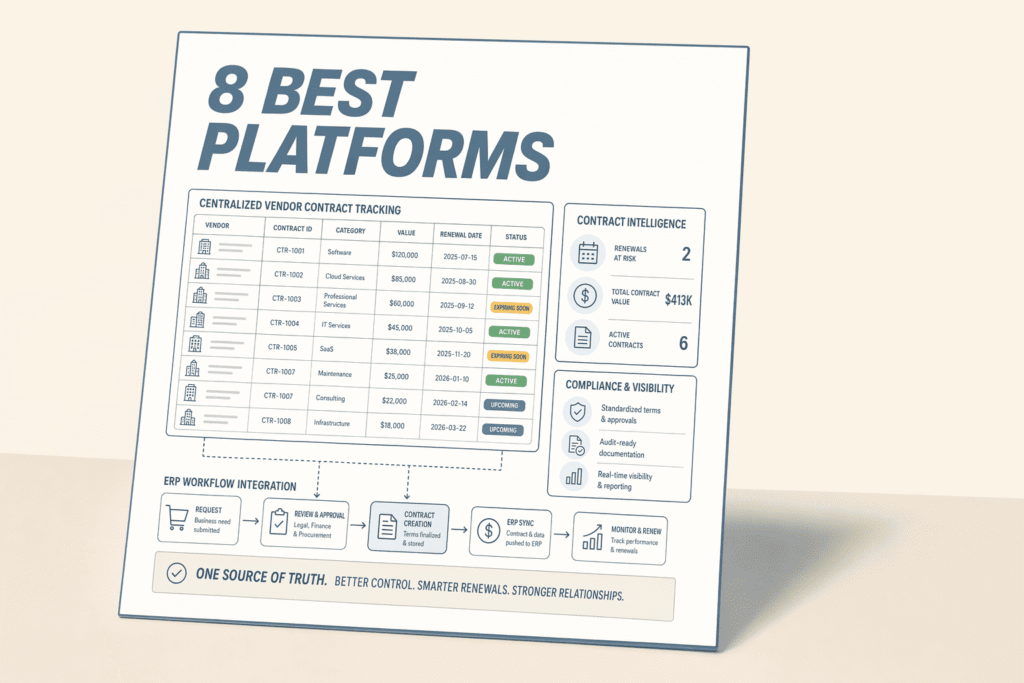
Operational contract intelligence requires seamless connectivity with CLM platforms, document management systems, ERP applications, and business intelligence tools. Contracts.ai integrates with Ironclad, Docusign, Evisort, Conga, SAP, Salesforce, and other enterprise systems, allowing extracted clause data to flow into existing workflows without rip-and-replace migrations. This integration architecture enables legal teams to maintain contracts in their preferred storage home while surfacing structured intelligence to finance teams validating invoice terms, procurement teams benchmarking vendor pricing, and compliance teams generating audit reports. The platform’s API-first design supports custom integrations for specialized internal systems, ensuring that contract data becomes an operational input across departments rather than remaining siloed within legal operations.
Comparing Leading AI Contract Clause Extraction Platforms
| Platform | Best For | Accuracy Profile | Scale Capability | Enterprise Integration |
|---|---|---|---|---|
| Contracts.ai | Portfolio-scale clause extraction with downstream analytics and cross-functional intelligence sharing | >99% with confidence scoring and source validation | Bulk ingestion, automated contract family grouping, legacy repository migration | CLM, DMS, ERP, Salesforce; maintains contracts in existing storage |
| Evisort (Workday Contract Intelligence) | Quickly analyzing large repositories to extract metadata and clauses [4] | 97% accuracy on 230+ contract types [1] | Trained on 10M+ contracts; bi-directional CMS/ERP sync | Syncs with any CMS or ERP without moving contracts from preferred storage |
| Kira Systems (Litera) | Large-scale contract review and due diligence (M&A, real estate) [4] | Industry-leading accuracy through extensive machine learning models [5] | Processes high volumes for mergers, acquisitions, regulatory compliance | Integrates with document management and deal management systems [5] |
| Open-Source Tools (OpenContracts) | Developer teams requiring customizable extraction workflows with full code control [2] | Variable; dependent on training data and model configuration | Self-hosted deployment; customizable for specialized agreement types | API-based integration; requires technical implementation resources |
Kira Systems is widely regarded as a market leader for high-volume contract review and due diligence contexts such as mergers and acquisitions or remediation projects [4]. The platform stands out for detailed, accurate document analysis required by law firms and corporate legal departments managing high volumes of contracts [5]. However, enterprise teams seeking operational contract intelligence beyond due diligence projects increasingly prioritize platforms that activate extracted data across business functions. Contracts.ai differentiates by positioning extracted clauses as inputs for ongoing obligation tracking, renewal risk surfacing, clause deviation benchmarking, and portfolio-wide remediation—use cases that extend beyond one-time review projects into continuous contract operations.
Implementation Strategy for Bulk Clause Extraction
Phased Deployment and Validation Workflow
Enterprise-scale deployment begins with a pilot extraction on a limited contract set—typically 100-500 high-value agreements representing diverse contract types, jurisdictions, and counterparty templates. This pilot establishes accuracy baselines by clause category, identifies extraction challenges for specialized agreement language, and calibrates confidence thresholds for exception routing. Contracts.ai’s low-lift implementation model allows legal ops teams to deploy as an intelligence layer without migrating full repositories or disrupting existing workflows. After pilot validation, teams expand to bulk processing while maintaining human-in-the-loop review for high-risk clauses (indemnification, liability caps, compliance obligations) and low-confidence extractions flagged by the platform’s scoring system. This risk-based validation approach reduces review burden by 80-90% compared to exhaustive manual checking while preserving legal team oversight on material terms.
Data Governance and Security Controls
Contract data governance requirements demand protection at the clause and field level, not just document-level security. Contracts.ai maintains encryption in transit and at rest, role-based access controls, and granular permissioning that allows legal teams to restrict visibility to sensitive provisions such as pricing terms or competitive information. The platform is SOC 2 and SOC 3 certified, meeting enterprise IT security standards for procurement approval. Critically, Contracts.ai does not use customer contract data to train public or shared models—a non-negotiable requirement for general counsel protecting confidential agreement terms and proprietary commercial language. Detailed audit logging tracks all extraction activities, queries, and data exports, enabling legal operations to demonstrate defensible contract intelligence processes during internal audits or regulatory examinations.
ROI Measurement and Time-to-Value
Automated clause extraction delivers measurable ROI through review hour savings, risk reduction, and accelerated business decisions. A legal ops team processing 5,000 vendor agreements manually at 20 minutes per contract would invest 1,667 attorney hours—roughly 10 months of dedicated full-time work. Automated extraction reduces this timeline to days while freeing legal staff for higher-value work: negotiation strategy, contract standardization, and cross-functional advisory. Beyond time savings, structured clause data enables proactive risk management: identifying auto-renewal agreements before notice deadlines, surfacing vendor contracts lacking required insurance coverage, and flagging non-compliant data processing terms before regulatory audits. Finance teams gain invoice-to-contract reconciliation workflows that catch pricing discrepancies and unauthorized charges, while procurement teams benchmark clause deviations to strengthen template enforcement and supplier negotiations.
How accurate are AI tools for extracting contract clauses from thousands of agreements?
Leading AI contract platforms achieve over 97% accuracy on more than 230 contract types when trained on datasets exceeding 10 million agreements [1]. Contracts.ai delivers >99% accuracy through strict evaluation algorithms and confidence scoring that flags uncertain extractions for human review, ensuring high reliability across diverse agreement types and legacy contract formats.
What contract types and clause categories can be extracted automatically?
Enterprise platforms extract 50+ key provisions including payment terms, termination rights, indemnification, liability limitations, confidentiality obligations, intellectual property ownership, renewal terms, notice requirements, governing law, dispute resolution, insurance requirements, and regulatory compliance clauses [1]. Contracts.ai supports NDAs, vendor agreements, MSAs, SOWs, employment contracts, real estate leases, and amendments across industries and jurisdictions.
How long does implementation take for extracting clauses from thousands of legacy contracts?
Pilot implementations processing 100-500 contracts typically complete within 2-4 weeks, including accuracy validation and confidence threshold calibration. Bulk extraction of 5,000-10,000 agreements can be completed within 4-8 weeks depending on document quality, storage system complexity, and human review requirements for high-risk clauses. Contracts.ai’s low-lift deployment approach allows legal ops teams to pilot with limited contract sets without migrating full repositories or disrupting existing CLM workflows.
What security and compliance standards do contract extraction platforms meet?
Enterprise-grade platforms maintain SOC 2 and SOC 3 certification, encryption in transit and at rest, role-based access controls, and granular permissioning at the clause and document level. Contracts.ai does not use customer contract data for model training, maintains detailed audit logging, and supports SSO integration and data residency controls required by regulated industries and multinational organizations.
Can extracted clause data integrate with existing CLM, ERP, and DMS systems?
Modern contract intelligence platforms offer bi-directional integrations with leading CLM systems (Ironclad, Docusign, Evisort, Conga), ERP applications (SAP, Oracle), CRM platforms (Salesforce), and document management systems without requiring contract migration [1]. Contracts.ai’s API-first architecture enables structured clause data to flow into finance, procurement, and compliance workflows while maintaining contracts in their existing storage locations, reducing implementation friction for IT and legal operations teams.
Frequently Asked Questions
How accurate are AI tools for extracting contract clauses from thousands of agreements?
Leading AI contract platforms achieve over 97% accuracy on more than 230 contract types when trained on datasets exceeding 10 million agreements [1]. Contracts.ai delivers >99% accuracy through strict evaluation algorithms and confidence scoring that flags uncertain extractions for human review, ensuring high reliability across diverse agreement types and legacy contract formats.
What contract types and clause categories can be extracted automatically?
Enterprise platforms extract 50+ key provisions including payment terms, termination rights, indemnification, liability limitations, confidentiality obligations, intellectual property ownership, renewal terms, notice requirements, governing law, dispute resolution, insurance requirements, and regulatory compliance clauses [1]. Contracts.ai supports NDAs, vendor agreements, MSAs, SOWs, employment contracts, real estate leases, and amendments across industries and jurisdictions.
How long does implementation take for extracting clauses from thousands of legacy contracts?
Pilot implementations processing 100-500 contracts typically complete within 2-4 weeks, including accuracy validation and confidence threshold calibration. Bulk extraction of 5,000-10,000 agreements can be completed within 4-8 weeks depending on document quality, storage system complexity, and human review requirements for high-risk clauses. Contracts.ai’s low-lift deployment approach allows legal ops teams to pilot with limited contract sets without migrating full repositories or disrupting existing CLM workflows.
What security and compliance standards do contract extraction platforms meet?
Enterprise-grade platforms maintain SOC 2 and SOC 3 certification, encryption in transit and at rest, role-based access controls, and granular permissioning at the clause and document level. Contracts.ai does not use customer contract data for model training, maintains detailed audit logging, and supports SSO integration and data residency controls required by regulated industries and multinational organizations.
Can extracted clause data integrate with existing CLM, ERP, and DMS systems?
Modern contract intelligence platforms offer bi-directional integrations with leading CLM systems (Ironclad, Docusign, Evisort, Conga), ERP applications (SAP, Oracle), CRM platforms (Salesforce), and document management systems without requiring contract migration [1]. Contracts.ai’s API-first architecture enables structured clause data to flow into finance, procurement, and compliance workflows while maintaining contracts in their existing storage locations, reducing implementation friction for IT and legal operations teams.
Sources
- Evisort: Revolutionizing Contract Lifecycle Management – www.youtube.com (2020)
- OpenContracts – Open-Source Contract Analysis Platform – github.com (2026)
- NLP Contract Analytics – Machine Learning Model for Contract Clause Identification – github.com (2021)
- Comparing the 7 Best AI Legal Contract Analysis Tools – www.docusign.com (2026)
- Kira – Key features, use cases, pricing, alternatives – cybernews.com (2025)