








Introduction
In September 2026, a builders merchants firm issued a blunt letter to every customer: our suppliers are raising prices, and some increases you will not see listed. You will just pay them. That letter, from Murdock Builders Merchants, warned of hikes between 3% and 16% across the range, with the acknowledgment that some charges would change without notice. If that letter landed on an accounts payable desk without a detection system in place, those overcharges would simply become the new cost of doing business.
This is not a hypothetical vulnerability. When Dutchess BOCES let a single electricity contract lapse, it paid approximately $85,000 in excess charges over 28 months, simply because nobody caught the post-expiration rate hike.
The financial threat is not a one-off error. It is compounded cost creep. A supplier who knows their invoices are not rigorously checked will embed above-contract pricing as the permanent baseline. The UK Ministry of Defence now faces a £1.5 billion annual fraud risk, a number that dwarfs any single audit finding and makes the point: systemic overbilling is an enterprise-level threat, not a clerical nuisance.
Manual spot-checks cannot keep up. The City of Charlotte reviewed 30 contracts and found that invoices did not align with contract pricing in 14 of them. Nearly half. And that audit only examined $333.9 million in spend. Scale that failure rate across a larger portfolio, and the leakage becomes material fast.
You need a structured, automated detection process. The seven steps below take you from a pile of disconnected documents to a rhythmic, technology-driven audit cadence that catches discrepancies the moment an invoice lands, builds an evidence trail for recovery, and signals to every supplier that your rates are verified, every time.
Key Takeaways
Overcharge detection works only when it runs continuously. Here is what drives every step that follows.
- Centralize first, automate second: Without a single structured contract-invoice repository, detection software has no source of truth to enforce.
- Real-time intelligence beats retrospective audits: AI-powered contract intelligence flags a price discrepancy the moment the invoice is submitted, preventing the supplier’s rate from becoming the de facto standard.
- Audit beyond the unit price: The biggest hits often hide in duplicate invoices, unagreed surcharges, or incorrect quantities, areas a simple rate check completely misses.
- Expiration dates are a primary attack vector: A lapsed contract cost one public entity $85,000; automated rollover alerts close that door before the first overcharged invoice arrives.
- Evidence turns detection into recovery: A flag is useless without a line-item-level evidence trail linking the overcharge to the specific contract clause, which is the only thing that gets your money back.
- Cadence creates deterrence: When suppliers know every invoice faces a quarterly automated audit and a 12-month deep review, the incentive to test the rate card evaporates.
Step 1: Centralize Your Source of Truth, The Unified Contract-Invoice Repository
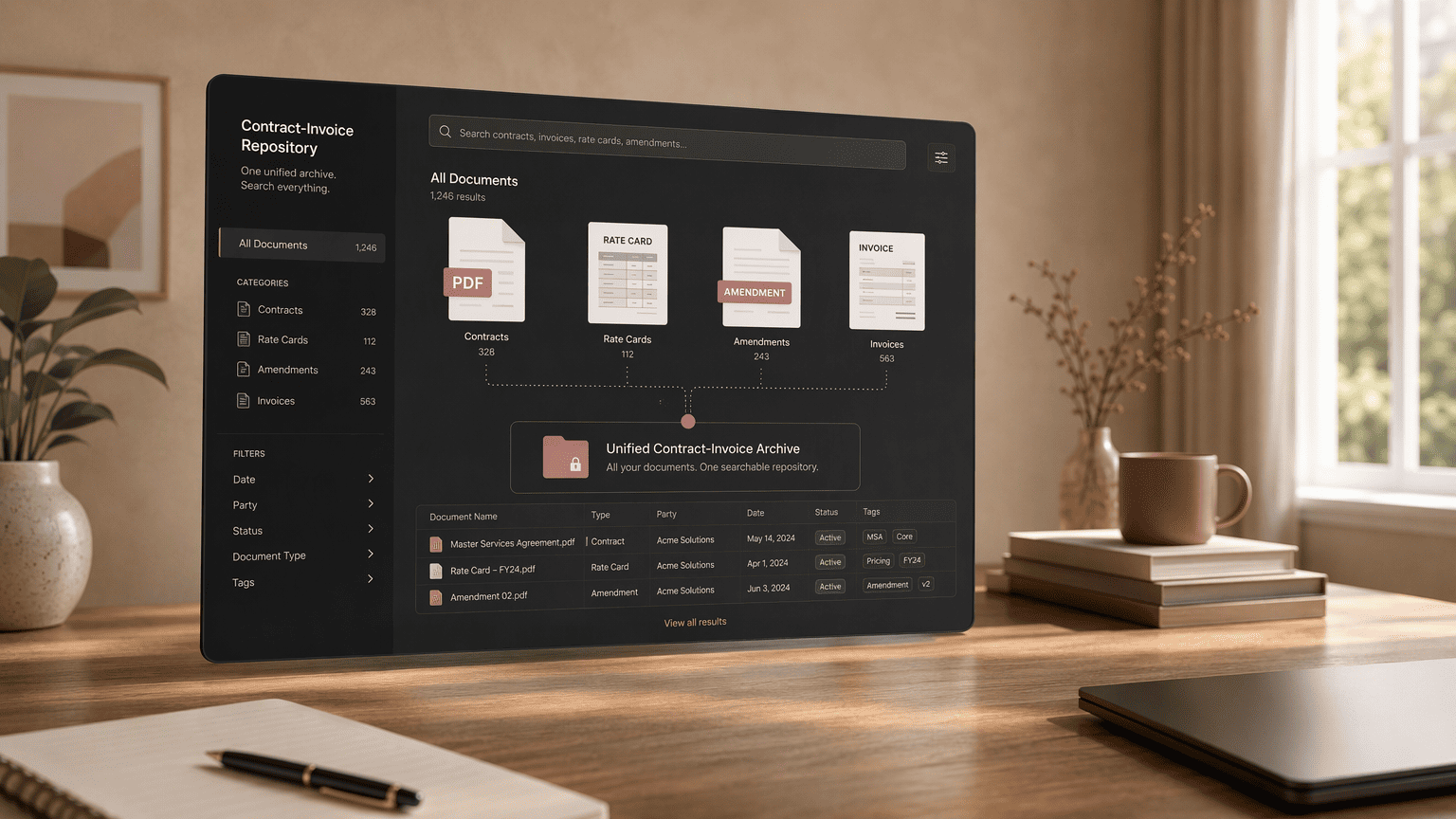
You cannot catch a rate discrepancy if the agreed rate lives in a PDF on someone’s desktop and the invoice sits in an ERP queue. The first step is the most unglamorous, and it is non-negotiable: aggregate every signed contract, rate card, amendment, and supplier invoice into one searchable, structured system.
At Dutchess BOCES, officials did not monitor electricity rates at all. The contract expired, the rate changed, and $85,000 walked out the door. Nobody had the old contract and the new invoice visible in the same place at the same time, so the overcharge became invisible.
A digital repository does more than store files. It transforms contracts into machine-readable data: rate tables, effective dates, renewal triggers, and amendment logs, all extracted and indexed. With that structure in place, the system can answer the question “what price should this line item carry right now?”
in real time, against the specific contract that governs it. Without this foundation, every subsequent step collapses into a manual hunt through shared drives and email attachments.
You can run a pilot on a limited contract set to prove the concept without disrupting your existing workflows. A tool like Contracts.ai, for instance, can group related agreements and align shared terms across them, surfacing variation and reinforcing contracting standards before you ever compare a single invoice.
The data architecture matters: you need every amendment linked to its parent agreement, every rate card version-dated, and every contract tagged by supplier, category, and expiration window. Do not let perfect be the enemy of done. Start with your top 20 suppliers by spend, centralize those, and expand from there.
Step 2: Deploy Automated Contract Intelligence as a Real-Time Detection Layer
The Dutchess BOCES audit found that manual processes missed $86,958 in billing discrepancies, and the Charlotte audit showed that standardized procedures for comparing contract to invoice pricing simply did not exist. When humans review hundreds of line items against dozens of rate cards, fatigue sets in, and the errors that survive become your permanent cost baseline.
Automated contract intelligence software extracts rates, terms, and pricing structures from your centralized repository and cross-references them against every incoming invoice line the moment it is submitted. The Murdock letter warns of price changes across product ranges, including increases the supplier “may not list.” An automated layer flags any deviation from the contracted rate immediately, before the invoice is approved. You see the discrepancy in the original terms, the invoice amount, and the gap between them.
This technology sits on top of your existing systems as an intelligence layer and reads the contract language, understands the rate structure, and applies it to the invoice data, surfacing only the exceptions. When labor is billed as a lump sum instead of the contracted hourly rate, as happened in eight of the 30 contracts Charlotte reviewed, the system catches it because the expected value is known and the submitted value deviates.
Without this real-time layer, you are auditing history. By the time a quarterly review finds the error, the overcharge has already been paid, the cash is gone, and recovery becomes a negotiation rather than a correction.
Step 3: Implement a Continuous Three-Way Match (Invoice vs. Contract vs. PO)
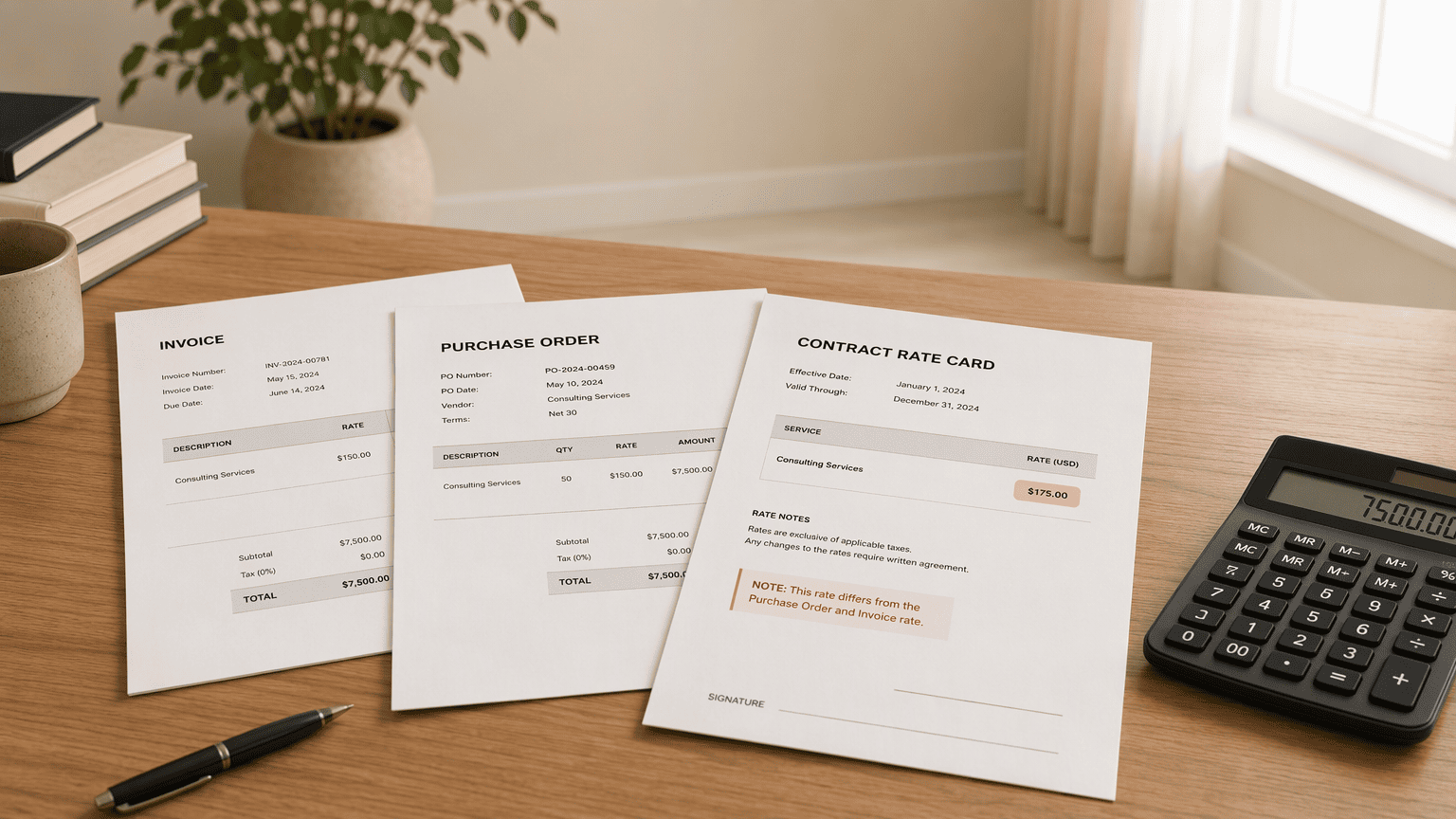
Most finance teams run a two-way or three-way match: invoice against purchase order, and sometimes against the goods receipt. Sitting completely outside that process is the signed contract rate card. A purchase order reflects an agreed scope and a price at a moment in time. The contract defines what price is legally permitted for the duration of the agreement. When suppliers raise prices unilaterally, the PO match alone will not catch it.
Extending the match to include the contract rate card closes the loophole that enables most overcharges. The Murdock letter spells out the exact threat: “across the range” pricing changes effective on a given date, some with no specific percentage provided. A PO created before the price change for a delivery after it will match on total, but it will fail against the contract unless the amendment was agreed and signed. The contract is the control. It has to sit inside the matching loop.
To implement this, your system needs to compare every invoice line item against three reference points simultaneously: the PO quantity and approved rate, the goods receipt confirmation, and the current effective rate under the governing contract. When the contract rate is lower than the invoiced rate, the system blocks the payment or routes it for review, depending on your configured tolerance thresholds. This runs on every invoice, every time. In high-volume environments, continuous validation is the only defense that scales.
Step 4: Hunt for Hidden Overcharges, Spotting Discrepancies Beyond the Line Item
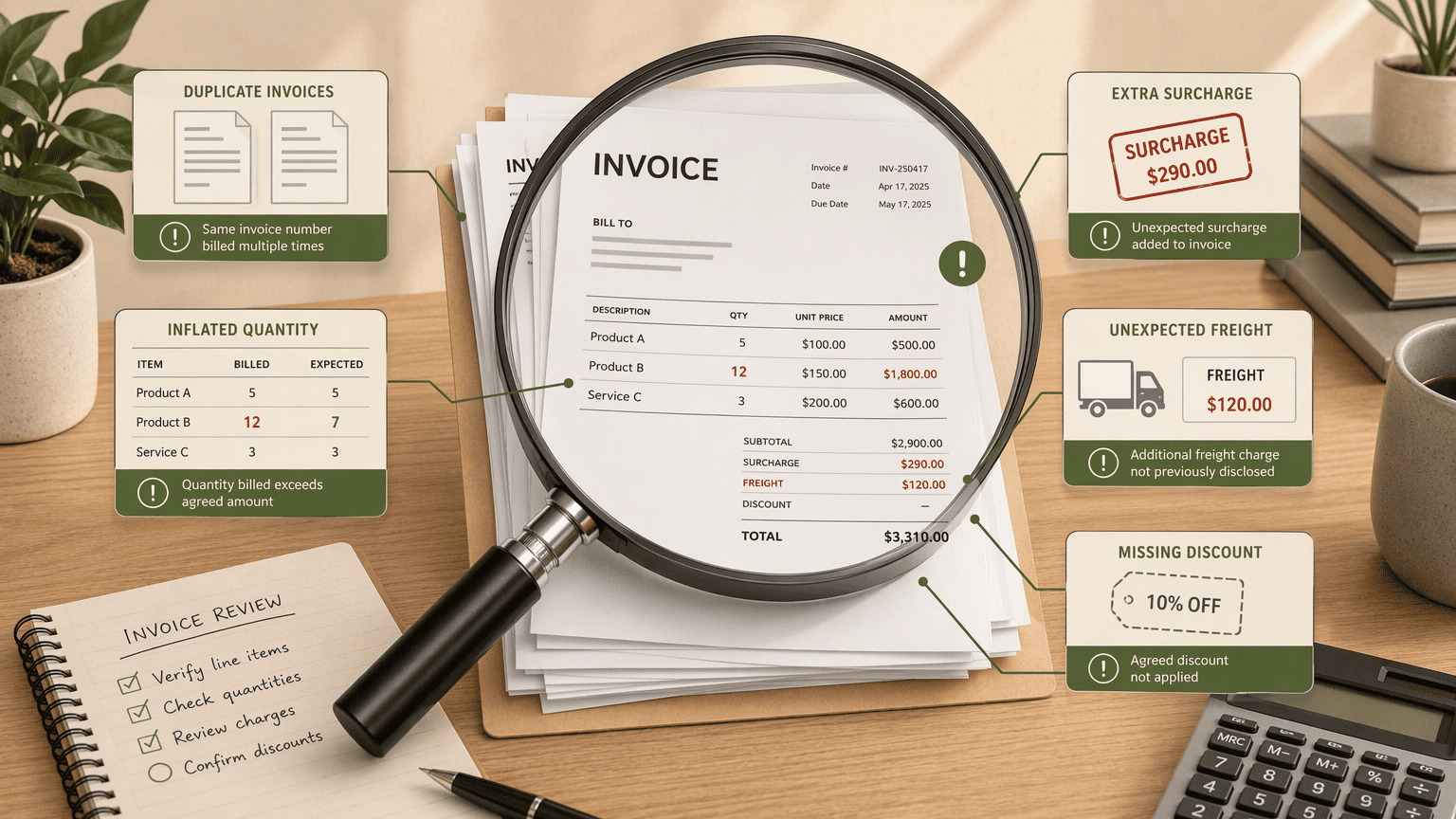
The most damaging overcharges often hide off the rate card entirely. A line-item price comparison catches one type of error. It misses duplicate invoices, quantity inflation, unapproved surcharges, freight charges never agreed to, and early-payment discounts that were earned but not applied. The Washington State Auditor’s office found a contractor who submitted 180 altered invoices with $155,779 in inflated amounts to a public commission, on top of $473,000 in invoices for services never provided. A unit price audit would have found none of it.
Your detection scope must widen to include every financial dimension on an invoice.
| Discrepancy Type | What It Looks Like | Detection Approach |
|---|---|---|
| Duplicate invoice | Same invoice number, date, and amount submitted twice | Fuzzy matching on invoice number, date, amount, and line-item detail; flag exact and near-duplicate submissions |
| Quantity inflation | 110 units billed, 100 units received per goods receipt | Three-way match with receiving data; tolerance thresholds trigger review |
| Unagreed surcharges | Fuel surcharge, “account management fee,” or site fee added to invoice | Contract extraction flags any fee not enumerated in the rate card; surcharges can consume up to 10% of annual category spend |
| Early-payment discount failure | 2% net-10 discount earned but full amount paid | Payment date vs. discount window calculation; automated recovery note when discount is missed due to internal processing delay |
| Non-contract items billed | Items or services not listed in any contract rate card or amendment | Line-item cross-reference against all active contract catalogs; any unrecognized SKU or service code triggers a hold |
These categories matter because they represent real cash. In the Charlotte audit, one landscaping vendor invoiced for cost of materials instead of the contracted unit price per tree and shrub installed. A simple rate comparison on the invoice total would have passed. Only a structural comparison of how the contract expected to be billed versus how the vendor actually billed flagged the discrepancy.
Step 5: Lock Down Expiration Dates and Rate Rollover Triggers

An expired contract is an open checkbook. At Dutchess BOCES, the energy supplier contract lapsed, and officials continued paying the higher post-expiration rate for 28 months. The audit found they could have saved approximately $85,000 from July 2021 through October 2022 simply by moving to the new bid winner or the local utility. The overcharge was a governance failure.
Your system must generate automated alerts well before any contract expires or any evergreen renewal clause triggers. Each contract should carry a date-stamped field for the end of the initial term, the notice period required to prevent auto-renewal, and any price escalation or rollover language. At 90 days, 60 days, and 30 days out, the system notifies procurement and legal. No invoice is paid against an expired agreement without a proactive review and a documented amendment. The technology exists to make this automatic; leaving it to a calendar reminder is what costs you $85,000.
Step 6: Build an Audit-Ready Evidence Trail for Overpayment Recovery
Detection without recovery is just expensive observation. To turn a flagged discrepancy into a recovered dollar, you need an evidence trail, linked at the line-item level, that ties the overcharge to a specific contract clause.
The trail serves two purposes: internal discipline and external enforcement. When you issue a supplier debit note, attach the contract section that sets the rate, the invoice line that exceeded it, and the calculation of the difference. Without that package, the supplier disputes, and the overpayment ages into a write-off.
Build your evidence package in this order.
- Capture the governing clause: Link the flagged invoice line directly to the specific contract section, rate card item, or amendment that sets the permissible price.
- Document the deviation: Show the invoiced amount, the contract amount, and the variance, including dates, quantities, and any applied surcharges.
- Calculate the overpayment: Produce a clean, replicable dollar figure per line item, aggregated across the billing period, with a clear audit trail showing how you arrived at it.
- Issue a formal debit memo: Generate a debit note within your AP system that references the evidence package and demands credit or repayment within your standard terms.
- Escalate unresolved items: For any debit memo not resolved within the agreed window, route the package to legal for formal dispute or recoupment action under the contract’s governing law. A 30-day window is common for fees.
This rigor turns your audit function into a profit-recovery engine. It also creates a deterrent: suppliers who know every overcharge will be documented, linked to their contract, and pursued systematically are far less likely to test your controls.
Step 7: Embed Governance and Turn Detection into a Rhythmic Audit Cadence

Technology catches individual overcharges. Governance prevents them from recurring. The Dutchess BOCES audit recommended, at minimum, quarterly audits supplemented by thorough 12-month reviews. That cadence is not arbitrary. Quarterly reviews are frequent enough to catch an emerging pattern before it compounds into a material loss, and the annual deep review forces a full reconciliation of every active contract against every invoice paid.
Define the roles clearly. Accounts payable owns the first line of defense: the real-time three-way match and discrepancy flagging at invoice receipt. Procurement owns the quarterly contract-level audit, comparing aggregate spend against contracted rates and identifying trends. Legal owns the recovery of unresolved overpayments and the contract amendment process when pricing disputes arise. This separation ensures no single function both creates and checks the payment.
The £1.5 billion annual fraud risk at the UK Ministry of Defence makes the case for systemic control. A risk that large is not caused by one bad actor; it is caused by the absence of predictable, automated oversight that makes overbilling reliably detectable. When your audit cadence is known, publicized internally, and executed without exception, suppliers adjust their behavior.
Active monitoring produces measurable returns: a typical Fortune 1000 company can reduce overall procurement costs by about 5% through consistent contract performance tracking. That is not a minor operational gain; it is margin protection at a scale that matters to the C-suite.
Conclusion
Supplier overcharging drains measurable cash from organizations every billing cycle. The BOCES audit found a single contract lost $85,000 after expiration because nobody caught the continued charges. Charlotte’s review flagged pricing failures in 14 of 30 contracts. Those are not anomalies. They are what happens when detection relies on manual spot-checks instead of automated controls.
The path from scattered data to automated intelligence to steady governance determines whether you catch an overcharge before the payment clears or learn about it months afterward, when recovery is harder and often partial.
Unannounced supplier price increases hit faster than most AP processes can react. Automation is the counterweight. It catches discrepancies the same day they appear and keeps your cash with you.
Frequently Asked Questions
What are the most common ways suppliers try to charge above contracted rates, and how can I detect them?
Suppliers commonly bill at unapproved higher rates after contract expiration, apply unagreed surcharges or fees, alter unit prices on invoices against fixed rate cards, submit duplicate invoices, or bill contracted services as lump sums instead of the agreed unit rate. Detection requires two capabilities working together:
- Automated line-item matching: compare every invoice line against active contract rate cards in real time
- Structured audit cadence: execute regular reviews to catch patterns that one-off matching might miss
How does automated contract intelligence software compare to manual audits for catching billing discrepancies?
Two approaches exist for catching pricing discrepancies, and they differ in both timing and effectiveness:
- Automated software: flags discrepancies in real time, before payment, by cross-referencing every invoice line against extracted contract terms
- Manual audits: retrospective sample-based reviews that can miss significant amounts, one public audit found $86,958 in discrepancies went undetected, and another found standardized contract-to-invoice comparison procedures simply did not exist
What steps should my finance team take to match supplier invoices against contract terms?
Your team should extend the standard PO-invoice match to include the contract rate card as a mandatory control. Every invoice line must pass a three-way validation: PO quantity and rate, goods receipt confirmation, and the current effective rate per the signed contract. Automate this; do not rely on manual line-by-line checks.
What does a post-signature contract audit process look like, and how often should it be performed?
A post-signature audit process includes quarterly automated reviews of all invoices against active contracts, supplemented by thorough 12-month deep-dive reconciliations. Each review must compare line-item pricing to the signed rate card and flag any structural billing deviations, not just total invoice amounts.
What are the financial risks to a US enterprise of uncaught supplier overbilling beyond the immediate invoice difference?
The primary risk has two escalating levels, each compounding the last:
- Compounded cost creep: Once a supplier knows overbilling is undetected, the inflated rate becomes the permanent baseline, eroding margin year after year
- Material enterprise risk: This escalates to systemic exposure, the UK MoD identified a £1.5 billion annual fraud exposure, showing how undetected overbilling becomes catastrophic at scale
What role does AI play in 2026 in flagging supplier overcharges in real time?
AI acts as a real-time detection layer that extracts pricing and terms from contracts and cross-references them against incoming invoices instantly. Leading organizations in 2026 connect these AI-driven checks across the full supplier lifecycle, from onboarding validation to ongoing post-payment audit, preventing overcharges before payment is released.
Sources
- Dutchess Board of Cooperative Educational Services – Electricity Contract Monitoring and Billing (2023M-45) – www.osc.ny.gov
- INVESTIGATION REPORT Investigation Summary Background – portal.sao.wa.gov
- 25-09 Contract Pricing Review Audit Report – www.charlottenc.gov
- High-Impact Contract Review: Maximizing Value from Supplier Agreements – www.gep.com
- 16 Supplier Performance Management KPIs to Track in 2026 – www.apexanalytix.com
- Failure to Prevent Fraud: One Year On — What MoD Suppliers Must Do Now | ECCTA & CPA 2026 | Crowell & Moring LLP – www.crowell.com






