






Introduction
Your procurement team negotiated a 12% discount. The vendor’s ERP system billed you at list price. It happens every month, and each time it quietly drains the profit margins your leadership team counted on.
This gap between agreed terms and received invoices is contract leakage. Businesses lose millions in overpayments each year that no one catches in time. An invoice discrepancy is a mismatch between the information on a vendor invoice and the related documents that should support it: purchase orders, receiving reports, and the contract itself.
Price deviations on a single supplier relationship might feel too small to chase. Scale the same error across a hundred active contracts and the annual financial impact gets material enough to affect hiring plans, capital projects, or cash reserves. The answer is not hiring more AP clerks. It requires a detection strategy that moves from periodic spot checks to always-on, automated verification.
This guide runs through seven steps. You will learn how to define leakage in the procure-to-pay lifecycle, categorize the billing discrepancies that do the most harm, and combine manual three-way matching with AI-powered contract intelligence for real-time reconciliation. You will also see how to structure your data for automated auditing, harden your supplier resolution workflow, and run root-cause analysis that prevents the next overcharge before it reaches your inbox.
Key Takeaways
Six moves shift supplier billing from a recurring risk into a controlled, verifiable process.
- Price-discrepancy detection first: The most frequent overcharge is a vendor billing the list rate instead of the negotiated discount, so your scanning should flag line-item price gaps before anything else.
- Three-way matching is the non-negotiable baseline: Comparing the invoice against the purchase order, goods receipt, and contract line by line catches quantity mismatches and charges for unreceived goods.
- Discrepancy taxonomy sharpens the team: Price deviations, quantity gaps, duplicate invoices, missing PO references, and unauthorized add-on fees are distinct problems that each need their own catch rule.
- AI contract intelligence makes verification continuous: Ramp identified $5M+ in fraud before invoices were sent off for approval, proving that systems scanning line-item rates and quantities in real time catch leakage no spreadsheet will find.
- Machine-readable contract fields close the data gap: Unit prices, discount tiers, volume thresholds, and service dates must live as discrete, structured data points inside your contract management system, not as paragraphs in a PDF.
- Resolution workflow stops payment, not the relationship: The moment a discrepancy is confirmed, you place the invoice on hold, notify the supplier with specific evidence, request a corrected credit note, and document the outcome before approving anything.
- Root-cause analysis turns a recovery event into a preventive control: Vague pricing clauses, manual data entry, and uncontrolled add-on fees cause repeat overcharges; updating your templates and approval gates kills them at the source.
Step 1: Define contract leakage and its root causes in the procure-to-pay lifecycle

Contract leakage is the gap between the price, quantity, and terms locked in your executed agreement and what a supplier actually bills you. It is not a single error. It is a category of failure that touches multiple stages of the procure-to-pay lifecycle.
A price deviation fires when procurement loads a negotiated discount into a shared drive but AP receives a legacy rate from the vendor’s billing engine. Quantity mismatches start at receiving, where the dock count never reconciles against the purchase order before data hits your ERP. Missing PO references happen when end users buy off-catalog. Each cause has a distinct address inside the lifecycle, and catching them means tracing the symptom backward to its origin.
Step 2: Categorize the most common billing discrepancies to sharpen detection
Most AP teams don’t need better software on day one. They need a short list of what they’re actually looking for. When you name the discrepancy types that matter, the invoices stop being a blur.
- Price discrepancies hit the hardest. A vendor bills the standard list rate instead of your contracted price, or drops you into a lower volume-discount tier than your actual order. It’s the most common overcharge.
- Quantity mismatches are simpler but just as frequent: the invoice says twelve pallets, your receiving report says ten. A counting error, a drop-shipment that ghosted, or a packing slip that doesn’t match the dock count.
- Duplicate invoices sneak through when both sides lose patience. The original sits in an approval queue too long, the vendor sends a second copy, and suddenly the same invoice number and dollar amount is queued up twice.
- PO-number gaps are the administrative equivalent of a car without plates. No valid purchase order reference on the invoice means nobody can trace the charge back to an authorization or a negotiated price.
- Unauthorized add-ons arrive quietly, usually in the fine print: a fuel surcharge nobody agreed to, a handling fee with no rate cap, storage costs tacked onto a shipment that never sat.
- Tax errors close out the list. A wrong rate, a misapplied exemption certificate, or a jurisdiction assumption that doesn’t match the ship-to location inflates the line just enough to clear and just enough to cost you.
Step 3: Implement manual three-way matching as a foundational control
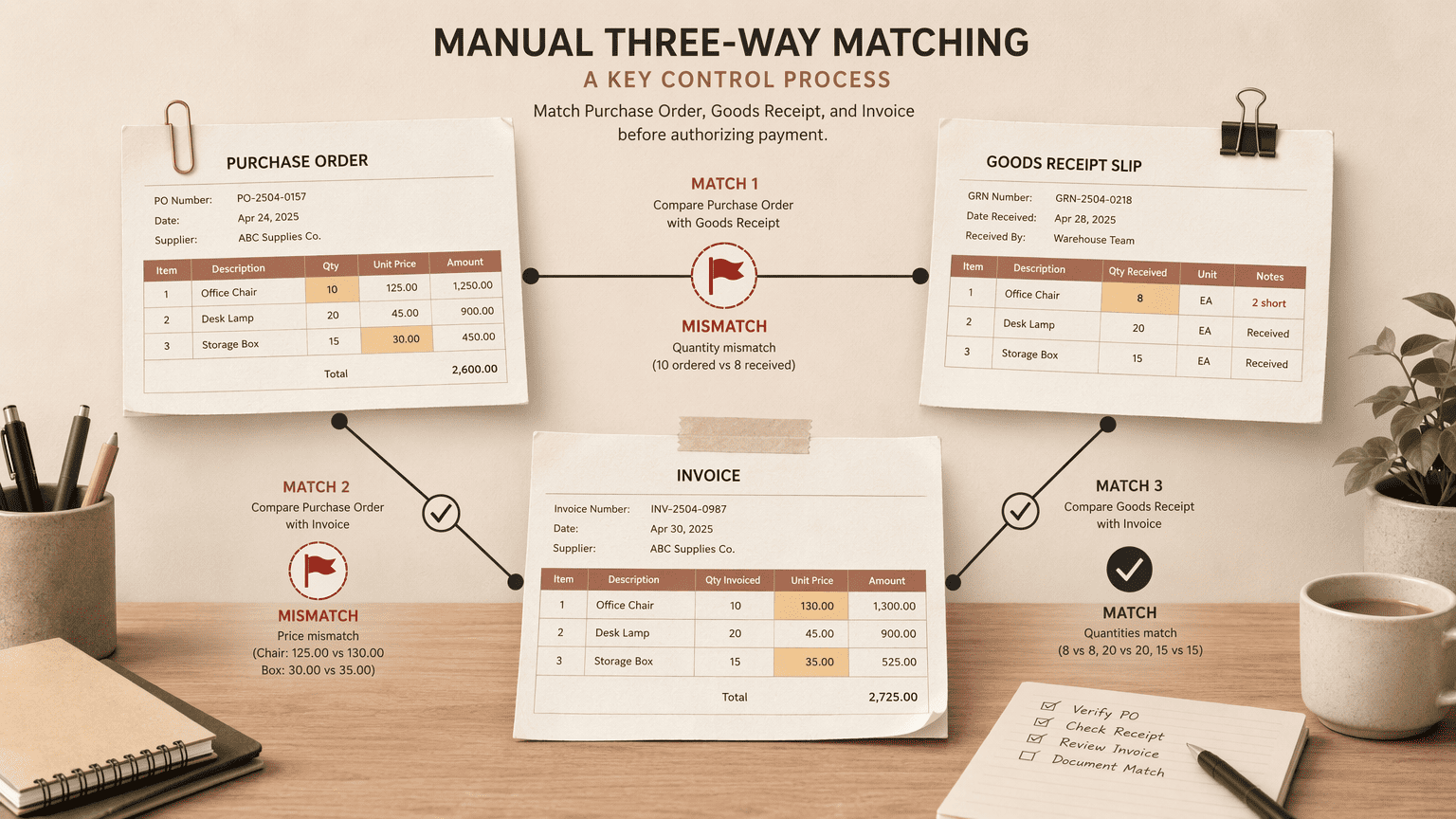
You can stop the majority of overcharges before they hit your payment run by enforcing one discipline: never approve an invoice that has not been matched against the three documents that justify every line. Skip this step, and you pay for goods you never ordered and quantities you never received.
Invoice matching catches two problems. First, the obvious overcharge where a unit price on the invoice is higher than the PO. Second, the subtler bleed where excess quantities, freight markups, or unapproved fees inflate the total by 3% to 5% across months of transactions.
The table below defines the matching sequence and what to do when a check fails.
| Matching Stage | Document Compared | What You Verify | Exception Action |
|---|---|---|---|
| Invoice against Purchase Order | Vendor invoice line items and the approved PO | Unit price, quantity ordered, part number or SKU, and total amount match the PO exactly | Place the invoice on hold and request a corrected invoice from the supplier referencing the correct PO |
| Invoice against Goods Receipt | Vendor invoice quantities and the receiving report | Quantity billed does not exceed the quantity confirmed as received in acceptable condition | Short-pay or reject the excess quantity; never pay for goods you cannot prove you received |
| Invoice against Contract | Invoice rates and terms and the signed contract master pricing schedule | Negotiated unit rates, volume discount tiers, and special payment terms are applied; no unauthorized fees appear | Withhold payment until the supplier issues a credit note for the overcharged amount and resubmits at the contract rate |
Step 4: Deploy AI-powered contract intelligence for real-time reconciliation
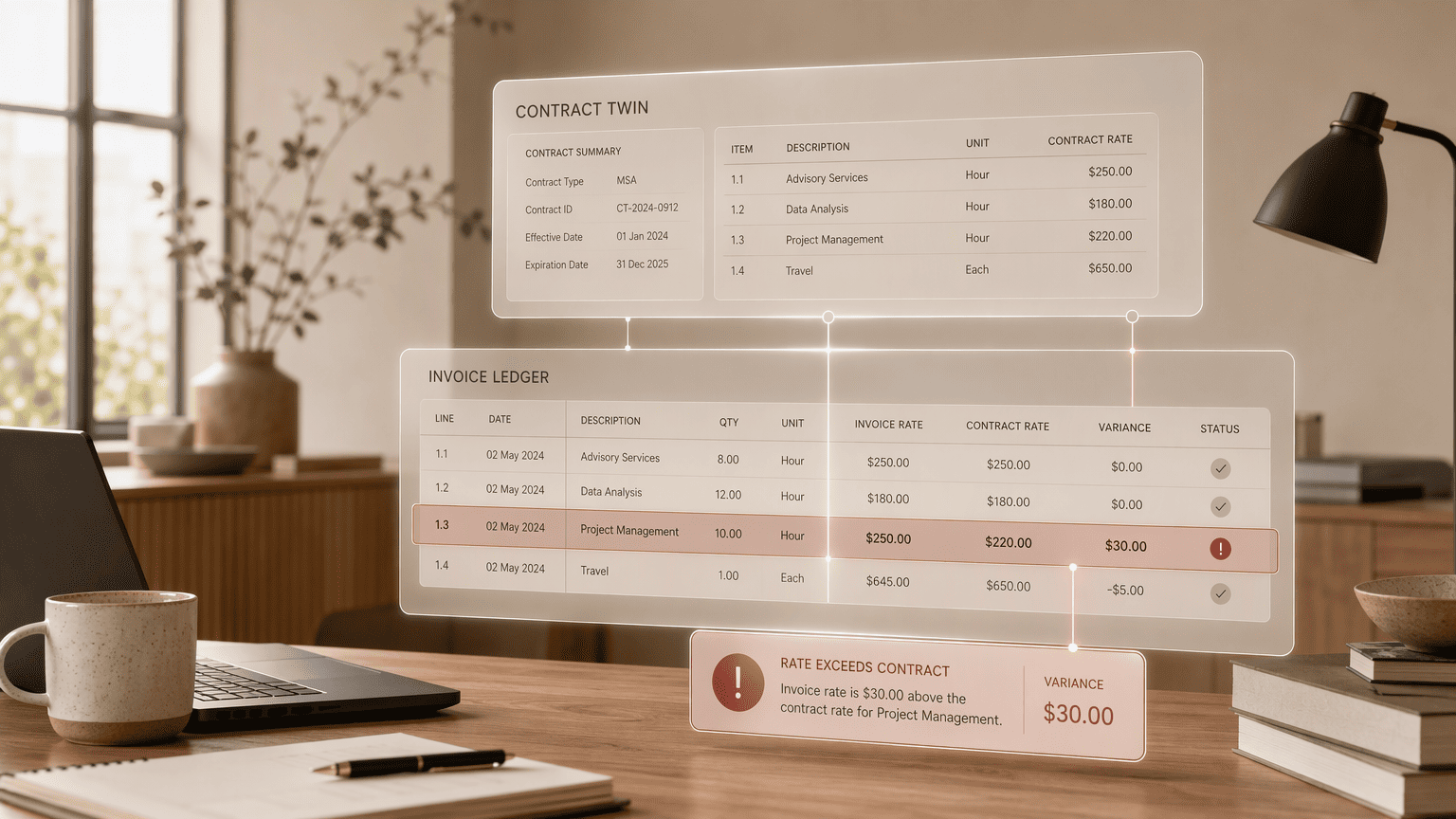
Manual matching catches what your team has time to check. AI-powered contract intelligence catches everything, and it does it before the payment file ever leaves your system. These platforms perform invoice-to-contract reconciliation in real time by comparing every line-item rate, quantity, and term against a digital contract twin that mirrors the executed agreement’s pricing, discounts, and volume thresholds. When the billed rate exceeds the contract rate, the system flags it immediately.
You can use a tool like Contracts.ai, an intelligence layer for executed agreements, to share that structured insight across finance and procurement without ripping out your existing ERP. Its platform extracts data at accuracy levels greater than 99% and links every answer to source contract language, making each flag auditable in seconds rather than hours.
Step 5: Structure contract data fields to enable automated compliance auditing
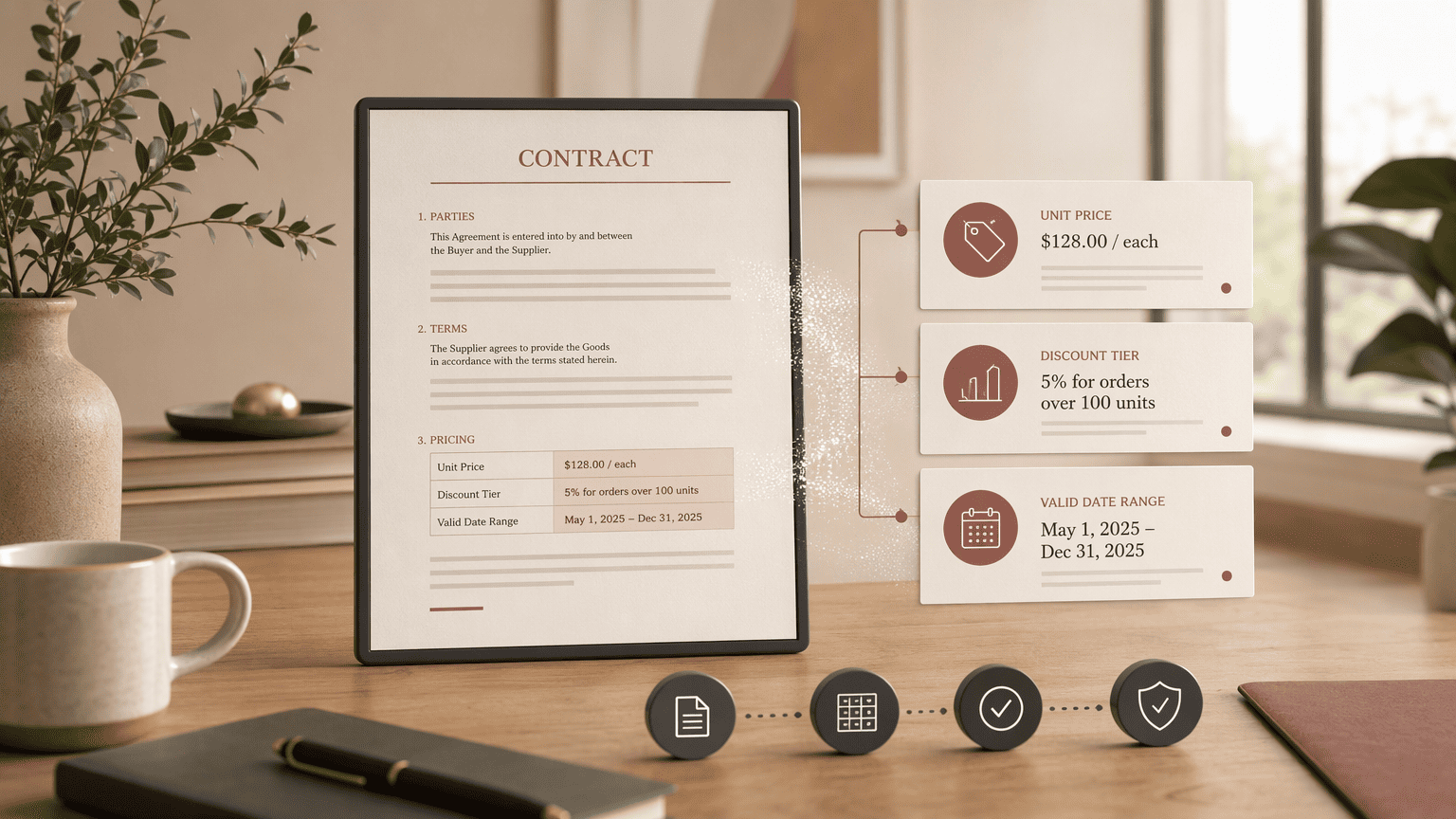
AI reconciliation works only as well as the data you feed it. If your contracts live as static PDFs in a shared drive, the software has to interpret prose instead of reading discrete fields. That introduces ambiguity you can avoid entirely by capturing commercial terms as machine-readable data points the moment the contract is executed. At minimum, every active agreement in your contract management system needs three discrete fields:
- Unit prices as exact numeric values, not phrases like “per the attached schedule.”
- Discount tiers with the volume breakpoints that trigger them and the thresholds that reset pricing bands. A missed step-down in unit cost on a high-volume quarter can create a six-figure overcharge in a single invoice run.
- Service dates and payment terms as discrete fields. A rate that escalates on an anniversary date will bill incorrectly if your system has no way to track that date against the invoice period. Payment terms like “2/10 net 30” affect the total when early-payment discounts are contractually owed but not applied by the supplier’s billing system.
Structuring these fields lets a compliance engine run a real-time audit on every invoice received and flag any deviation before the approval workflow advances. This closes the most persistent data-quality gap in procure-to-pay: the negotiated deal lives in a document, but the numbers that arrive in the ERP share no technical connection to it.
Step 6: Formalize an immediate overcharge resolution workflow with suppliers
When a billing discrepancy surfaces, your first move is simple: freeze the invoice. Place it on hold inside your AP system so no payment goes out while you review what happened. Many finance teams worry this will upset a vendor, but the alternative is worse. Paying an overcharge once teaches the supplier that your audit process can be skipped, and the error will show up again on the next bill. Then follow three steps:
- Notify the supplier in writing. Attach the contract rate schedule, point to the exact billing line that went off track, and give them the dollar amount of the overcharge. Ask for a corrected credit note and a revised invoice with a clear deadline. A short email with attachments works better than a phone call because it creates a timestamped record you can pull up later.
- Approve the revised invoice only after you log the resolution in your contract management system. Record the original error, the evidence you supplied, and the fix. This entry speeds up the next audit and builds a fact base you can use when the same supplier trips the same trigger again.
- Analyze the pattern over time. That pattern file is how you stop chasing individual mistakes and start fixing the billing habits behind them.
Step 7: Perform root-cause analysis to harden future contract governance

Recovering an overcharge closes one transaction. Understanding why it happened prevents the next one. After you resolve a billing dispute, run a brief post-resolution analysis that maps the overcharge back to its origin in your contract governance.
Each finding should trigger a template update. If a freight surcharge landed on your invoice without contractual authorization, add language stating that no surcharge or fee outside the enumerated schedule is payable. If a volume discount was missed because the threshold sat buried in an appendix, restructure your template so discount tiers become discrete, bolded fields a contract management system can read.
You stop being reactive when your next contract cycle carries fewer leak points by design. The UK’s Single Source Regulations Office reported that in 2025/26, only 3 per cent of reports contained active compliance issues as of 31 May 2026, outperforming the KPI target of 5 per cent.
That result isn’t a lucky audit. It’s governance written into the contract before the first invoice ever reaches your desk.
Conclusion
Supplier overcharging will not self-correct. Vendors billing at list price instead of your negotiated rate default to their own engine’s numbers, and AP spot-checks miss enough leakage to skew your budgets. Fixing it takes a layered approach: three-way matching for immediate control, AI-powered reconciliation to make verification continuous, and structured contract data that turns compliance auditing into business as usual.
Each step feeds the next. Manual matching builds discipline. AI systems expand coverage.
Structured contract fields close the interpretation gap that lets overcharges through. Formalized resolution workflows recover cash and keep supplier relationships intact. Root-cause analysis stops leakage before it starts.
Stack these controls and your procure-to-pay process shifts from overcharge-prone to predictable. Start with the invoice in front of you right now and match it against the contract rate and the goods receipt. The first discrepancy you catch pays for the rigor.
Frequently Asked Questions
What is contract leakage and how does it happen through supplier overbilling?
Contract leakage is the dollar gap between a signed agreement’s rates and terms and what a supplier actually invoices. It happens when negotiated pricing, discount tiers, or volume thresholds never reach the vendor’s billing system, or when manual processes duplicate, inflate, or add unauthorized charges.
What specific manual and automated methods are used to detect when a supplier invoice exceeds the agreed contract rate?
Manually, you perform three-way matching: compare each invoice line against the purchase order, goods receipt, and contract rate schedule. Automated methods use AI contract intelligence that reconciles invoice line items against a digital contract twin in real time and flags any rate, quantity, or term deviation.
What are the most common types of supplier billing discrepancies that businesses encounter?
Eight patterns dominate: price discrepancies (list price vs. negotiated rate), quantity mismatches, duplicate invoices, missing PO numbers, charges for damaged or rejected goods, data entry errors, tax and regulatory mistakes, and fraudulent invoices.
How can AI or contract intelligence software perform automated invoice-to-contract reconciliation to catch overcharges?
The platform extracts line-item rates, quantities, and payment terms from the invoice and compares them in real time against the executed contract’s structured data. Any mismatch triggers a flag and links the finding to the source contract language so an auditor can validate the overcharge.
What steps should a procurement or finance team take immediately after discovering a supplier has overcharged them?
Place the invoice on hold to block payment. Then complete three steps:
- Notify the supplier with specific evidence: the contract clause, the billed rate, and the dollar amount of the overcharge.
- Request a corrected credit note and revised invoice.
- Approve payment only after the correction is documented in your system.
What key data and contract terms must be structured to enable real-time price-compliance auditing?
Unit prices, discount tiers with volume breakpoints, volume thresholds, effective dates, escalation schedules, and payment terms all need to be captured as discrete machine-readable fields inside your contract management system. Prose in a PDF will not drive automated compliance checks.
Sources
- Invoice Discrepancies: Types, Causes & How to Resolve Them – ramp.com
- Annual qualifying defence contract statistics: 2025/26 – Single Source Regulations Office – www.ssro.gov.uk
- AI-powered contract auditing – Cloudfront.net – d2uars7xkdmztq.cloudfront.net