








Introduction
Your budget leaks through a thousand tiny cuts. Your team swipes corporate cards for unapproved software subscriptions, office supplies from random websites, and services that bypass every carefully negotiated contract. This underground economy is maverick spend, and it can account for up to 20% of indirect spend.
Traditional manual audits fail because they arrive too late. An employee uses a corporate card to buy equipment, and the transaction bypasses procurement entirely. By the time a spreadsheet flags it three months later, the money is gone, the relationship is entrenched, and nobody remembers why the right supplier wasn’t used.
Unifying fractured procurement data and applying AI transforms this. Instead of chasing ghosts through quarterly reports, you build a system that sees every transaction as it happens and guides behavior before the purchase completes. This guide maps the practical steps to build that system, moving from scattered data to real-time spend governance.
Key Takeaways
Here are the six highest-use actions to convert maverick spend losses into controlled, governed procurement:
- Centralize first: AI-driven spend control is impossible without pulling ERP, P-card, and e-invoicing data into a single governed source of truth.
- Detect what rules miss: Machine learning anomaly detection and NLP on line-item descriptions surface non-compliance that keyword-based systems overlook.
- Overlay contracts without disruption: A contract intelligence layer maps supplier terms to live transactions without ripping out the existing ERP.
- Map the informal networks: Supplier clustering by tax ID and address reveals organized rogue buying patterns within departments.
- Fix the root cause, not the behavior: AI links maverick transactions to broken workflows; companies integrating behavioral insight typically reduce off-contract purchases by 30% in the first year.
- Intervene in real time: Soft blocks and directed alerts inside the P2P process prevent non-compliant spend the moment it is initiated.
Step 1: Integrate and Centralize Disparate Procurement Data
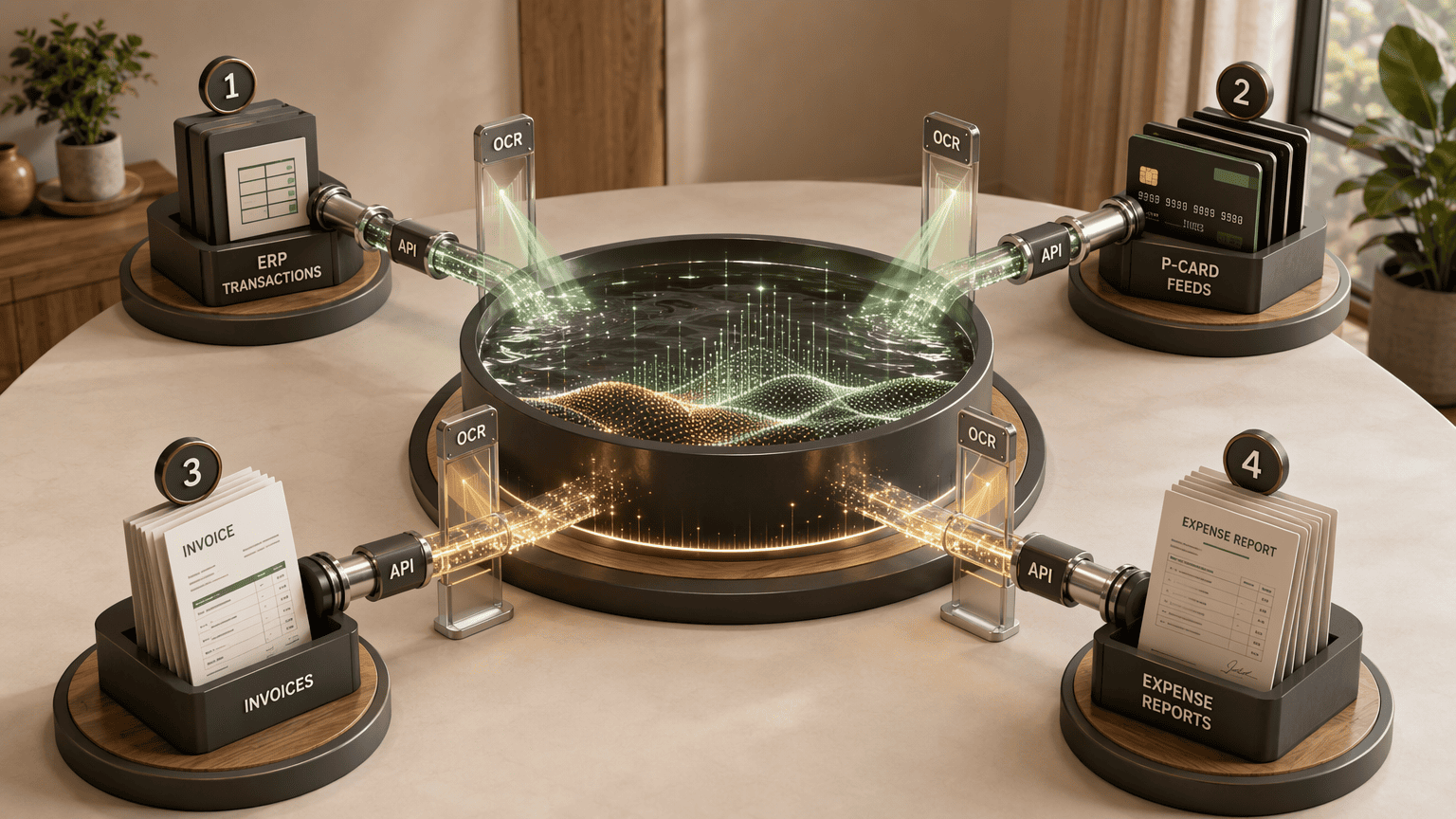
AI cannot police what it cannot see. Your spend data lives in silos:
- ERP transactions in SAP Ariba or Oracle
- P-card feeds from the bank
- Invoices flowing through AP automation
- Expense reports sitting in a separate SaaS tool
Until these streams merge into a governed data lake, you are auditing fragments.
The integration demands both plumbing and governance. APIs pull structured transaction records; OCR captures line-item detail from paper and PDF invoices. Once ingested, every supplier name must map to a master vendor record and every commodity code to a UNSPSC taxonomy. A transaction for ‘Lenovo laptop’ in one system and ‘ThinkPad’ in another collapses into a single spend category under IT hardware. Without this normalization, AI runs on dirty fuel, flagging false positives and genuine leakage, and 60% of enterprises that use AI in spend analytics still have to rely on manual follow-ups to interpret results.
Organizational silos are the harder obstacle. AP typically ‘owns’ invoice data, procurement manages the ERP, and individual departments control P-card usage. Breaking these down means securing executive sponsorship from the CFO or CPO to mandate cross-functional data sharing. A tool like Contracts.ai, designed as an intelligence layer that shares structured data across finance and procurement, can serve as the integration point rather than replacing any system of record. The output is a single pane of glass showing every dollar moving through the enterprise, tagged by supplier, category, cost center, and contract status.
Step 2: Build an AI Engine to Detect Off-Contract Purchase Patterns
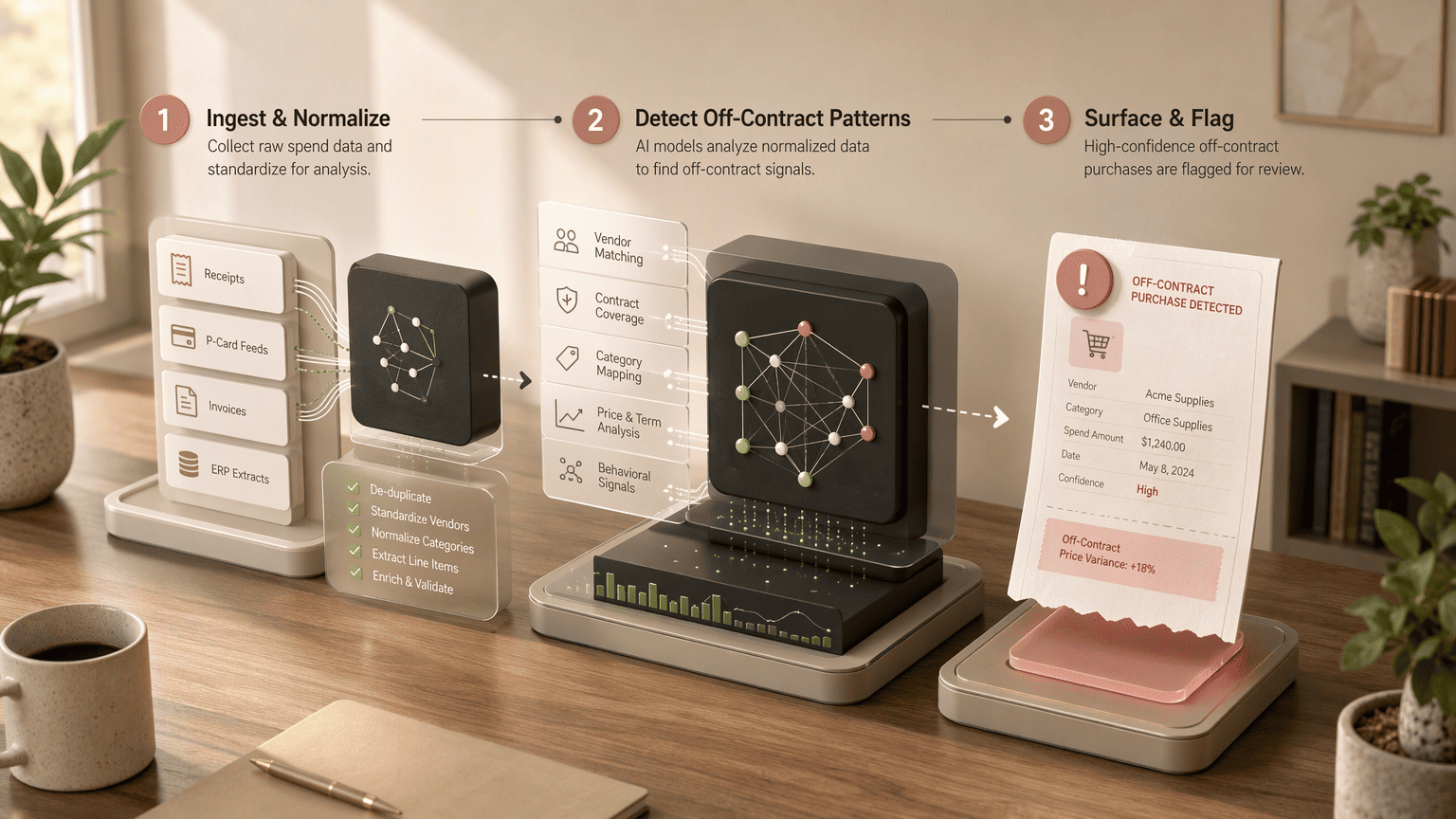
Once your data lake is normalized, machine learning finds the leaks you missed. Here is the systematic detection engine you deploy against that consolidated spend repository:
- Deploy NLP on line-item descriptions: Natural language processing scans free-text purchase descriptions for unauthorized vendor names, brands that don’t match preferred catalogs, and keywords suggesting personal purchases.
- Run anomaly detection algorithms: Random Forest and clustering models compare each transaction to historical patterns for that department, category, and time period, flagging unusual amounts, frequencies, or suppliers.
- Execute duplicate payment and vendor checks: The engine cross-references invoice amounts, dates, and vendor identifiers against past payments to catch double-pays and split POs designed to skirt approval thresholds.
- Shift from retroactive to predictive flagging: Agentic AI doesn’t just process transactions. It issues early-warning signals while requisitions are still in draft, before the money leaves the account.
Step 3: Deploy a Contract Intelligence Layer Without Replacing Your ERP
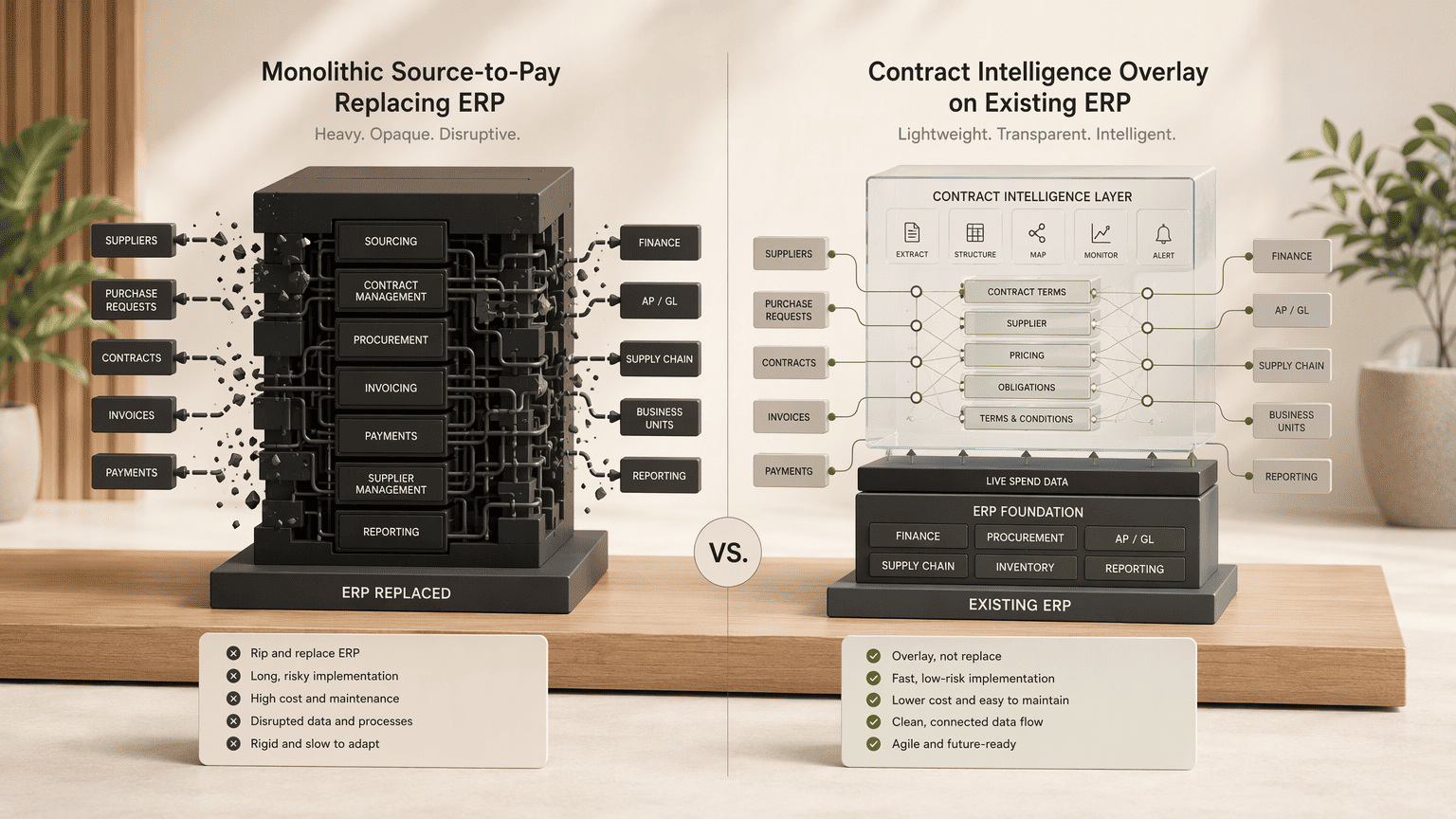
Flagging a transaction as off-contract is useful. Knowing instantly what the correct contract says is transformative. A contract intelligence layer sits on top of your existing systems and maps structured terms directly to live spend data. Here is how the two architectures compare:
| Implementation Approach | Rip-and-Replace (New Source-to-Pay) | Contract Intelligence Overlay |
|---|---|---|
| ERP disruption | Complete system migration; 12 to 18 month timeline | No ERP replacement; deploys in weeks |
| Buy-in resistance | High; requires retraining every stakeholder | Low; users stay in familiar systems while receiving real-time guidance |
| Price-matching accuracy | Depends on manual catalog maintenance | AI extracts pricing schedules and discount tiers from each contract and matches them to each invoice line |
| Pilot feasibility | Difficult; requires full commitment up front | A pilot can run with a limited contract set without migrating the full repository |
You can use Contracts.ai, for instance, to extract supplier pricing tables, minimum order quantities, and renewal thresholds across thousands of agreements, then layer that structured intelligence onto flagged transactions. The system answers one critical question inside the existing P2P workflow: at the moment of purchase, is this price, this supplier, and this quantity actually covered by an active contract?
Step 4: Categorize Suppliers and Spot Rogue Buying Networks
Individual maverick purchases look like random noise. Zoom out, and patterns emerge that look suspiciously organized. AI-driven entity resolution clusters suppliers by tax ID, physical address, or naming variants such as ‘Acme Corp’ and ‘Acme Corporation LLC’ into a single verified entity.
Once duplicates collapse, you can map the informal supply chains that department managers build outside procurement’s view:
- A marketing team buys promotional swag from three unauthorized vendors that all share the same warehouse address.
- Engineering orders specialty components from a gray-market distributor because the approved catalog takes six extra clicks to find the right part.
These aren’t isolated incidents.
Graph database architectures make this visible by linking supplier nodes to department nodes by transaction weight. You see a cluster of 14 shadow IT vendors serving only the sales organization. A separate cluster of facility maintenance suppliers operates entirely outside the facilities management budget. The insight flips the conversation from ‘you broke the policy’ to ‘why does a whole department need a parallel supplier network to get its work done?’
This step also cleans the vendor master, merging duplicates and flagging inactive records. A clean master is a prerequisite for every downstream AI control, because you cannot enforce contract compliance when your system thinks you have three different suppliers named ‘Staples’.
Step 5: Surface Root Causes by Linking Spend to Broken Workflows

Most maverick spend isn’t malice. Procurement psychology research shows employees bypass contracts when the compliant channel feels harder than the workaround.
AI links rogue transactions to process bottlenecks by correlating spend events with operational cycle data. When the IT hardware requisition takes 12 days through the approved catalog but Amazon delivers tomorrow, your engineers pick Amazon. When the legal services catalog uses category codes nobody can navigate, your department heads call the firm they already know. Process mining tools pull cycle-time data from your P2P systems, and AI overlays it onto maverick spend patterns to surface the specific workflows driving most of the non-compliance.
The result is a precise action list:
- Shorten approval chains for low-risk categories.
- Fix the internal catalog’s search UX.
- Add guided buying paths for complex services.
The frame shifts from policing people to removing the friction that made the compliant path the slowest path.
Step 6: Implement Real-Time Controls and Actionable Dashboards
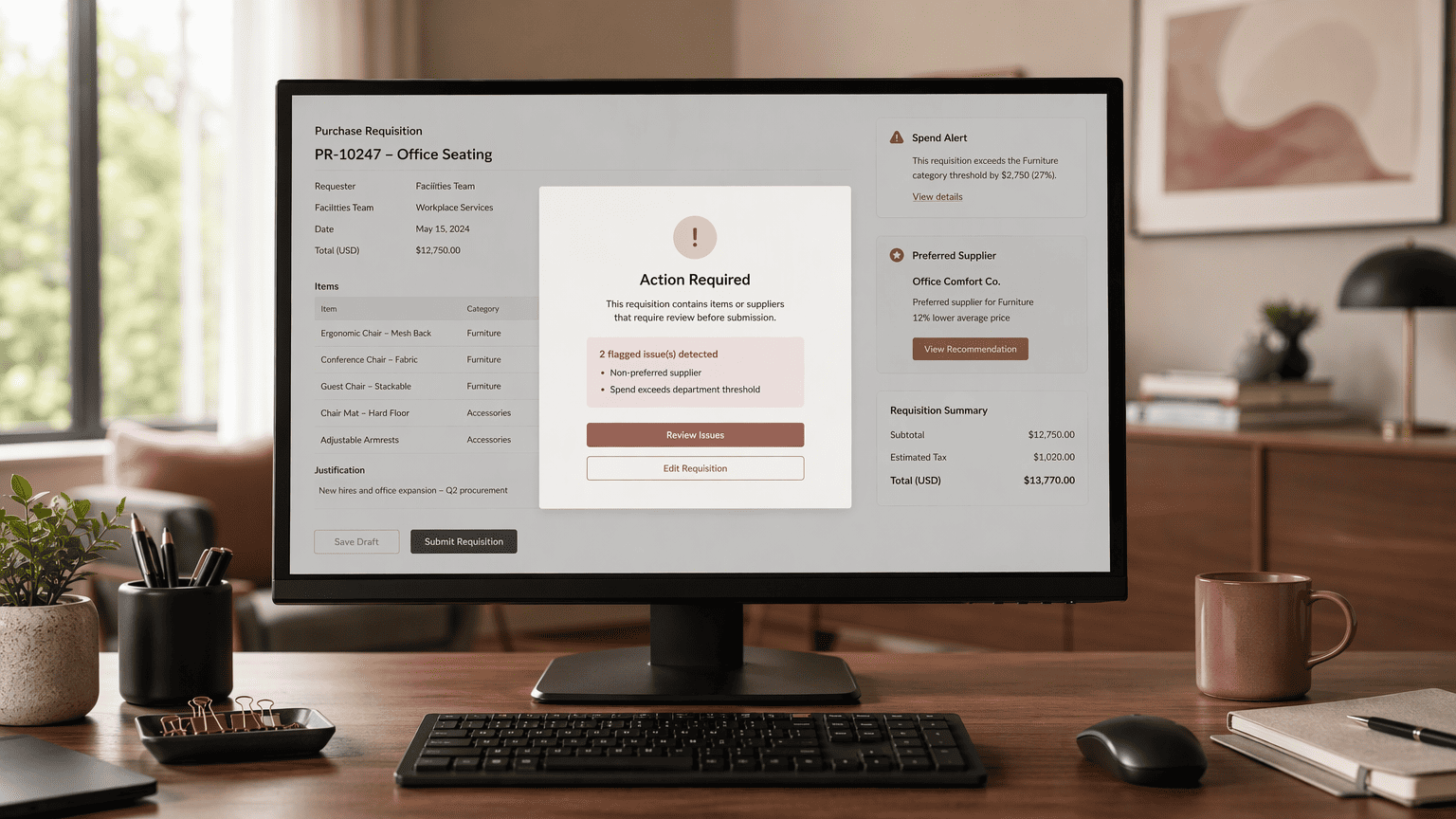
Insight without intervention is just a more expensive retrospective audit. The final step wires AI detection directly into the P2P process via API-based controls that guide behavior at the point of requisition, not after the invoice clears.
The mechanism is a soft block: when a user initiates a purchase that the AI flags as likely off-contract, the system pauses and surfaces a prompt. ‘This supplier is not on the preferred list. The contracted alternative is available at 15% less, next-day delivery. Open a cart with the preferred supplier instead?’ The user can still proceed by documenting a justification, but that friction typically redirects 30% of would-be maverick transactions in year one.
Dashboard design completes the feedback loop. The CPO sees a real-time compliance-rate scorecard trending toward target, with top-line maverick-spend-as-percentage-of-total metrics. Category managers receive alerts when a supplier in their portfolio loses contract adherence in a specific cost center. AP gets automated duplicate-invoice flags and contract-pricing mismatch warnings before payment runs execute. Each role gets the signal relevant to its authority.
Soft blocks at requisition, combined with role-specific dashboards that update in real time, close the cycle. Spend that once leaked silently now encounters governance at the point of entry.
Conclusion
Controlling maverick spend with procurement data and AI is not about catching people. It is about building a control tower that sees every transaction, understands every contract, and guides every buyer to the path that protects margin. You move from a reactive compliance function running quarterly audits to a strategic team with real-time intelligence. The procurement function drops manual reconciliation and steps into its real role: protecting enterprise spend and enabling supplier innovation at speed.
Frequently Asked Questions
What is maverick spend and why is it a problem for procurement teams?
Maverick spend is any purchase made outside an organization’s established procurement policies, approved contracts, or preferred supplier lists. It is inherently noncompliant and distinct from tail spend, which may be compliant but unmanaged. It erodes negotiated discounts, increases risk, and fragments spend data.
How can procurement data identify and measure maverick spend?
To identify off-contract transactions:
- Consolidate data from ERPs, P-cards, and AP systems into a centralized data lake.
- Normalize supplier names and categorize spend using a taxonomy like UNSPSC.
- Compare each purchase to active contracts and preferred supplier lists.
What role does AI play in detecting and preventing maverick spend?
AI uses NLP to scan line-item descriptions for unauthorized vendors and anomaly detection algorithms to flag unusual patterns. Agentic AI moves beyond retroactive auditing to intervene in real time, understanding purchase intent and guiding buyers toward compliant alternatives before the transaction completes.
How can an AI-powered contract intelligence layer help control maverick spend without replacing existing systems?
A contract intelligence layer extracts structured terms like pricing and supplier lists from executed contracts and overlays them onto live transactions inside your existing ERP. It flags out-of-policy purchases at the moment of requisition without requiring a system migration.
What are the practical steps to implement AI-driven controls for maverick spend?
Centralize and normalize procurement data, deploy AI anomaly detection and NLP models, overlay a contract intelligence layer to validate transactions against terms, use supplier clustering to map rogue buying networks, and implement real-time soft blocks and role-based dashboards inside the P2P process.
Sources
- Maverick Spend Detection with AI | GEP Blog – www.gep.com
- What Is Maverick Spend? Definition, Causes, and Prevention – www.esker.com






