








Introduction
Your CFO sees the savings number Procurement negotiated. Your P&L tells a different story. The gap is maverick spend. It is the purchase that slips outside the contract, the renewal you never approved, the tail-spend supplier nobody vetted.
The instinct is to blame undisciplined employees. But a 30% maverick rate leaks 30% of your negotiated savings because your internal processes are harder to navigate than simply swiping a corporate card.
This article strips away the blame narrative and replaces it with a friction-first diagnosis and a six-step sequence. You will see how procurement data and AI turn unmanaged leakage into a systematic savings-recapture program, without slowing down the business.
Key Takeaways
You solve maverick spend by making the right path easier than the wrong one, then locking the gates. Here is the campaign plan, proven to claw back up to 70% of leaked cash:
- Maverick spend is a friction problem, not a discipline problem: Employees bypass procurement because contracts are invisible, approval chains are slow, or catalogues lack the needed SKU.
- Measure leakage in hard numbers first: Track % off-contract, % off-PO, and % off-catalogue by category. You cannot fix what you cannot quantify.
- Apply AI to find payments that hurt you: Post-signature contract intelligence flags invoices that mirror a negotiated rate but never hit the approved agreement, patterns manual audits miss every time.
- Fix the catalogue before you enforce the rulebook: Match what people actually bought against what you offered. If the compliant path lacks the item, rogue spend is a design failure.
- Sequence effortlessness ahead of enforcement: Deploy guided buying and controlled P-cards. Introduce no-PO-no-pay only after the friction disappears. This sequence recaptures 50 to 70% of leaked savings in 12 to 18 months.
Step 1: Understand the Real Cost of Maverick Spend, It’s Not a Discipline Problem, It’s a Friction Problem

Most organizations misdiagnose maverick spend as a behavioral failure. The real root cause hides in the daily friction your stakeholders face. Follow this logic chain to see the actual P&L damage:
- The label is wrong: Maverick spend is not rebellion. It is any purchasing that happens outside agreed contracts, preferred suppliers, or proper process. Stakeholders sidestep Procurement when the process asks them to wait three days for a requisition approval that a marketplace checkout completes in sixty seconds.
- Friction drives the behavior: Gartner research confirms unmanaged tail spend creates compliance, risk, and financial leakage. The single biggest challenge on the indirect side is getting your hands around the data. Stakeholders cannot comply with a contract they cannot find, or a catalogue they cannot search.
- The leak matches the rate: The arithmetic is brutal. The leak equals the maverick rate: 30% of spend off-contract leaks 30% of your savings. Every dollar negotiated but not enforced lands on the P&L as pure margin erosion.
- Reframe the fix: Stop writing stricter policy memos. Deere cut its work glove varieties from 424 to two dozen. That project reduced glove costs by 50% by attacking variety, not by blaming factory supervisors.
Step 2: Quantify the Leakage with Core Procurement Data Metrics

Before you change a single process or introduce an AI model, you must size the enemy. Most CPOs are shocked to discover their intuition about leakage hotspots is wrong. The data paints a different, colder picture. Start by pulling three core metrics, sliced by category and by business unit.
- % spend off-preferred-supplier: reveals who is taking your negotiated volume elsewhere, often to the same supplier under a worse rate.
- % off-PO transactions: each invoice without a PO signals that Purchasing never saw the commitment until the bill arrived, a direct pipeline for duplicate payments and missed SLA penalties.
- % off-catalogue purchases: where the approved list fails to meet demand, you see a purchase-order line item that should have been a three-click reorder.
These three KPIs, cross-sectioned by department, give you a heatmap. You stop chasing symptoms and start knowing exactly which business unit and which category to attack first. A facility services bucket with a 45% off-PO rate suggests an approval-chain failure; a 70% off-catalogue rate in IT consumables suggests the catalogue itself is junk. Leadership will listen to a dollarized leakage figure. Use a tool like Contracts.ai to run this analysis across your ERP and P-card feeds simultaneously. Converting raw transaction lines into structured, post-signature data infrastructure surfaces the leakage at a supplier level that manual spend cubes never reach.
Step 3: Deploy AI-Powered Contract Intelligence to Audit Spend Post-Signature
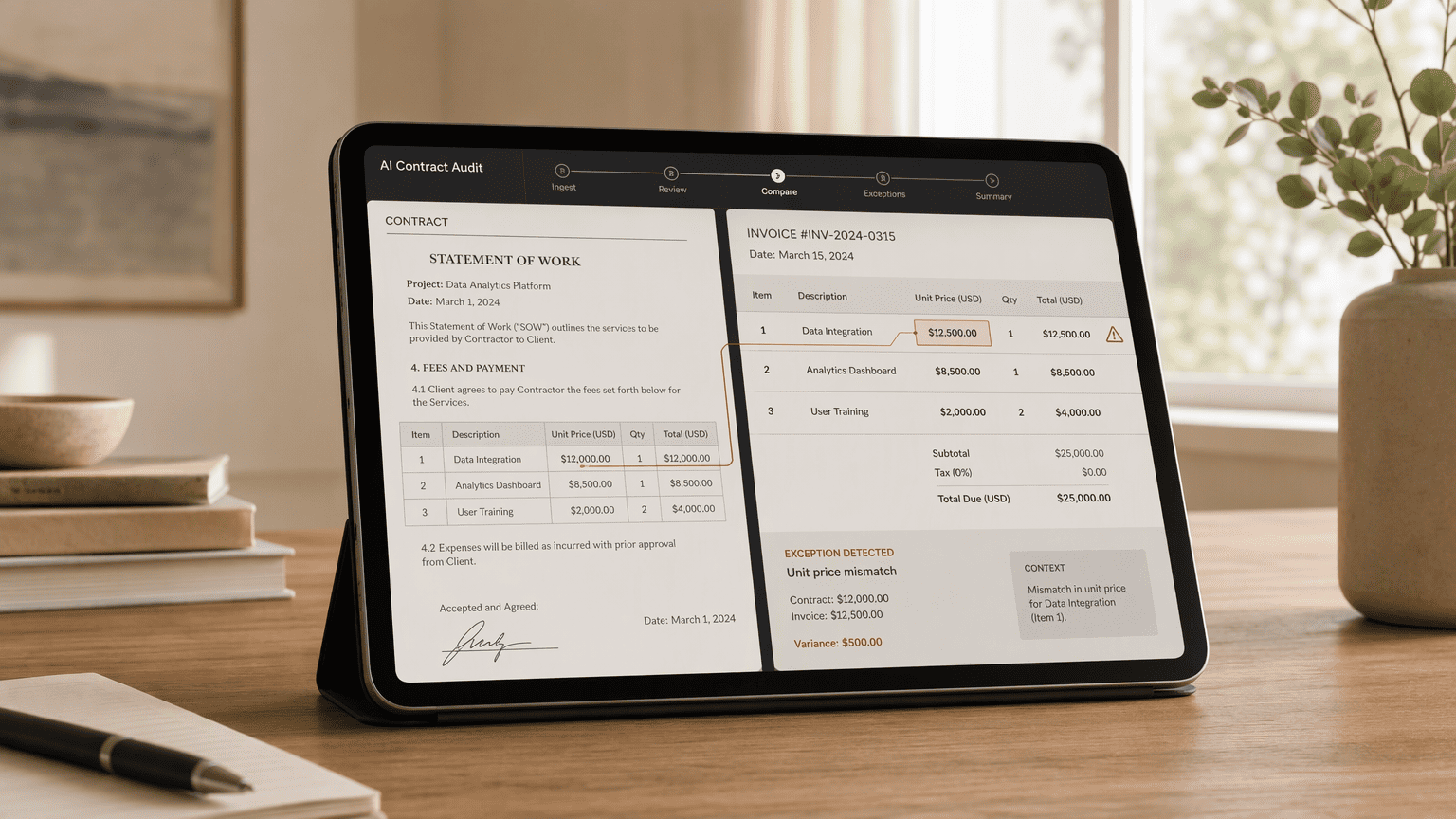
The most dangerous maverick spend looks completely legitimate. Your AP system processes an invoice from Acme Corp for widgets at $12.75. The transaction clears all matching rules. The price sits within departmental limits. No human flags it.
AI contract intelligence subverts this hidden bleed by working from the actual legal agreement. It reads the contract clause, extracts the $9.40 unit price you locked in, and then compares it against every single transaction line in your payment feed. When it finds $12.75 payments to the same supplier for the identical widget, it flags the off-contract pattern automatically. You get a notification of the breach. The AI pattern-matches across vendors, regions, and deal types, spotting lookalike items and duplicate agreements that signal maverick behavior.
Veezoo’s procurement agents and Esker’s contract-intelligence modules now deliver this audit at scale. Instead of sampling 5% of invoices randomly, you audit 100% of spend systematically. The machine flags exceptions; your team investigates them. This layer pays for itself within the first post-signature audit cycle.
Step 4: Close the Catalogue Gap by Matching Bought vs. Available Items
A blank catalogue entry is a direct invitation to buy outside the system. If your punchout catalogue lacks a 24-inch monitor arm and Amazon delivers one tomorrow, your employee chooses Amazon every time. Fixing this gap stops maverick spend at its largest source.
Run a direct comparison: match every transaction line item from the prior six months against your current catalogue master file. This audit surfaces the specific items your people need but can’t find through compliant channels. Procurement Magazine’s analysis confirms that identifying these high-frequency missing items is the single most powerful lever to prevent out-of-process purchasing.
The table below shows the mapping logic:
| Matching Analysis | Purchased Item | Catalogue Response | Action Required |
|---|---|---|---|
| Exact Match | Item X appears on contract, price aligns | Catalogue contains item at negotiated price | No action; process worked |
| Near Match | Item X bought off-contract at higher price | Similar item exists but employee could not find it | Fix search taxonomy and item descriptions |
| Missing Authority | Item X bought from preferred supplier but not via catalogue | Supplier is under contract but SKU not loaded | Load SKU into catalogue; enable guided-buying route |
| True Gap | Item X bought from non-preferred supplier | No contracted equivalent exists | Source, negotiate, and load item; convert tail spend to managed spend |
Each time you close a gap, you remove another reason for a stakeholder to leave the compliant path.
Step 5: Make the Compliant Path Effortless (Guided Buying, P-Cards, and Training)

The following approaches reduce rogue spending by embedding policy into the purchasing workflow, so compliance becomes the easiest path:
- Guided buying interfaces: Present a pre-approved catalogue inside the purchasing workflow, so when a marketing manager needs a design subscription, the system shows three pre-contracted options with pricing and turnaround instead of a blank requisition form, letting them check out with minimal friction.
- P-cards with embedded controls: Load purchasing policy directly onto the card via MCC blocks, single-transaction limits, and monthly spend caps configured per department. The employee buys what they need without a PO, and transaction data flows into an AI monitoring layer. According to SDI’s research, this reduces low-dollar rogue purchases by an order of magnitude because the card declines violations at the point of sale.
- Micro-training delivered just in time: When a user searches for something not on contract, a pop-up says, ‘You searched for X. Here is the approved equivalent.’ This nudge closes the behavior gap in real time, avoiding a mandatory quarterly webinar.
Step 6: Enforce the Rules with Automated Controls and Budget-Holder Visibility
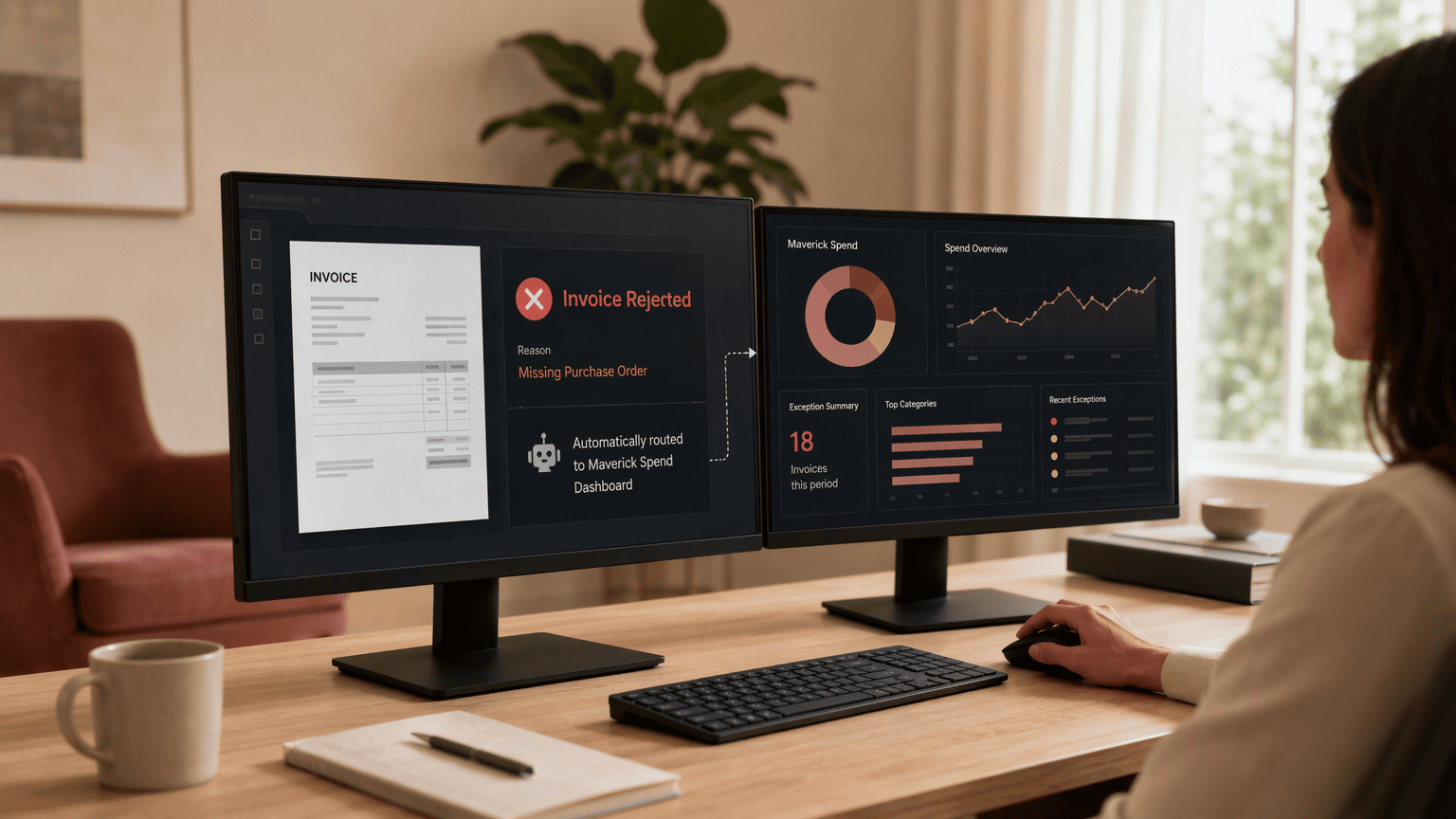
Now you lock the compliant path. Enforcement lands smoothly because you removed the friction first.
Start with a no-PO-no-pay policy, but automate it. The ERP should reject any non-payroll invoice that lacks a purchase order reference. Delphi’s experience confirms you can catch 80% or more of the maverick spend this way. Combine this rule with a real-time maverick-spend dashboard for every budget holder. When a department VP sees their off-contract percentage climbing against a target, they self-correct faster than Procurement ever could.
Gartner’s hybrid-governance model supports this precisely: you balance corporate oversight with streamlined stakeholder buying cycles, cutting out the third-party markups that hide when no one watches. Exception-handling workflows provide the pressure-release valve. A stakeholder can request a legitimate one-off buy via a simple form. Procurement approves or routes to a contracted alternative within four hours.
The result holds over 12 to 18 months. Organizations that follow the full sequence, diagnose friction, quantify leakage, audit contracts with AI, fix catalogues, simplify the path, then enforce, recapture 50 to 70% of leaked savings. They close the gap between what Procurement negotiated and what the P&L actually sees.
Conclusion
Maverick spend isn’t a mystery. It’s a design failure you can fix with a clear sequence of data, AI, and process redesign. Start by accepting that the root cause is friction, not reckless employees.
Quantify the leakage with three hard metrics. Deploy AI-powered contract intelligence to find the payments your manual audits never see. Match every bought item against your catalogue and close every gap you find.
Build a guided-buying experience that works like a consumer checkout. After that foundation is in place, enforce a no-PO-no-pay wall. Companies that execute this progression turn a silent margin killer into a managed, measurable program with savings rates that stick.
Frequently Asked Questions
What is maverick spend and why is it a problem for procurement teams?
Maverick spend is any purchasing that happens outside agreed contracts, preferred suppliers, or proper procurement process. It erodes negotiated savings directly: a 30% maverick rate leaks roughly 30% of the savings you negotiated, hitting the P&L as pure margin erosion.
How can procurement data help identify and quantify maverick spend inside an organization?
Procurement data quantifies leakage by tracking % off-contract spend, % off-PO transactions, and % off-catalogue purchases segmented by category and business unit. These metrics turn invisible rogue purchases into a dollarized heatmap that pinpoints exactly where savings are bleeding.
What role does artificial intelligence play in detecting and controlling maverick spend?
Artificial intelligence scans actual transaction records against contract terms post-signature. It automatically flags invoices where the price is higher than the negotiated rate or the supplier was not authorized, detecting patterns that manual audits consistently miss.
How does post-signature contract analysis with AI close the gap between negotiated terms and actual purchasing behavior?
It extracts key clauses and rates from signed agreements and compares them directly against AP line items. When a payment matches a contracted item but carries a worse price, the AI surfaces the discrepancy immediately, turning after-the-fact reporting into real-time compliance intelligence.
What are the practical steps to implement a data- and AI-driven maverick spend control program?
To eliminate maverick spend, implement these steps in sequence:
- Measure leakage with core KPIs.
- Deploy AI contract intelligence to audit actual spend.
- Close catalogue gaps by matching purchased vs. available items.
- Build guided buying and controlled P-cards.
- Enforce no-PO-no-pay and provide budget-holder dashboards only after the friction disappears.
What results can organizations expect from using procurement data and AI to reduce maverick spend?
Organizations that sequence effortlessness before enforcement typically recapture 50 to 70% of leaked savings within 12 to 18 months. AI-powered post-signature audits alone can catch over 80% of maverick spending that previously went undetected.
Sources
- Managing Maverick Spend at Deere and Delphi – An Interview with Jon Stegner | Supply Chain Resource Cooperative – scm.ncsu.edu
- What is maverick spend? How to identify — and how to reduce it | Mercury – mercury.com
- Tackling Maverick Spend in Procurement – info.sdi.com
- Maverick Spend: Why It Happens and How to Bring It Under Control – Procurement Academy – procurement.academy
- Eliminate Maverick Buying Without Sacrificing Agility – www.gartner.com






