








Introduction
A procurement director for a mid-market manufacturer with a $500 million spend recently discovered that two key suppliers had been billing at pre-negotiation rates for nine months. The overcharge was discovered by accident, buried in a quarterly spreadsheet reconciliation. For large enterprises, McKinsey research suggests that unfulfilled supplier obligations can leak roughly 2 percent of spend. On a $2 billion spend, that is $40 million evaporating annually through missed discounts and unenforced price caps.
The traditional fix, a periodic manual audit of sampled invoices, cannot keep pace. By the time a pricing error is found, the window for recovery often narrows, and the next quarter brings a fresh stack of unchecked invoices. The MOART Vendor Sentiment Index Q2 2026 captures the organizational response: compliance budgets are up 22 percent year over year, signaling that leadership teams view vendor margin compression as structural, not cyclical.
The shift now underway moves from retrospective sampling to real-time contract intelligence. Rather than replacing an existing ERP or procure-to-pay system, a discrete AI intelligence layer overlays the current stack. It reads every contract, amendment, and price schedule, then continuously compares those extracted terms against live transaction data. When a supplier invoice deviates, the system flags it immediately. This article maps the specific steps for building that real-time discount monitoring capability, from quantifying your leakage exposure to activating an audit-ready recovery framework.
Key Takeaways
- Real-time discount visibility moves procurement from reactive recovery to continuous margin protection.
- Large enterprises bleed roughly 2 percent of total spend to unfulfilled supplier obligations. On a $2 billion spend base, that is $40 million a year.
- A dedicated AI layer can extract discount clauses from legacy contracts and cross-check every invoice. It does not replace your ERP or contract repository.
- Companies that actively manage disputes recover 55 to 70 percent of disputed amounts. The industry average is 38 percent.
- A single compliance dashboard shared by procurement and finance eliminates spreadsheet handoffs and turns negotiated savings into enforced dollars.
- You can run a pilot on a limited contract set. No full-repository migration, no workflow disruption. Prove the value, then scale.
At a Glance
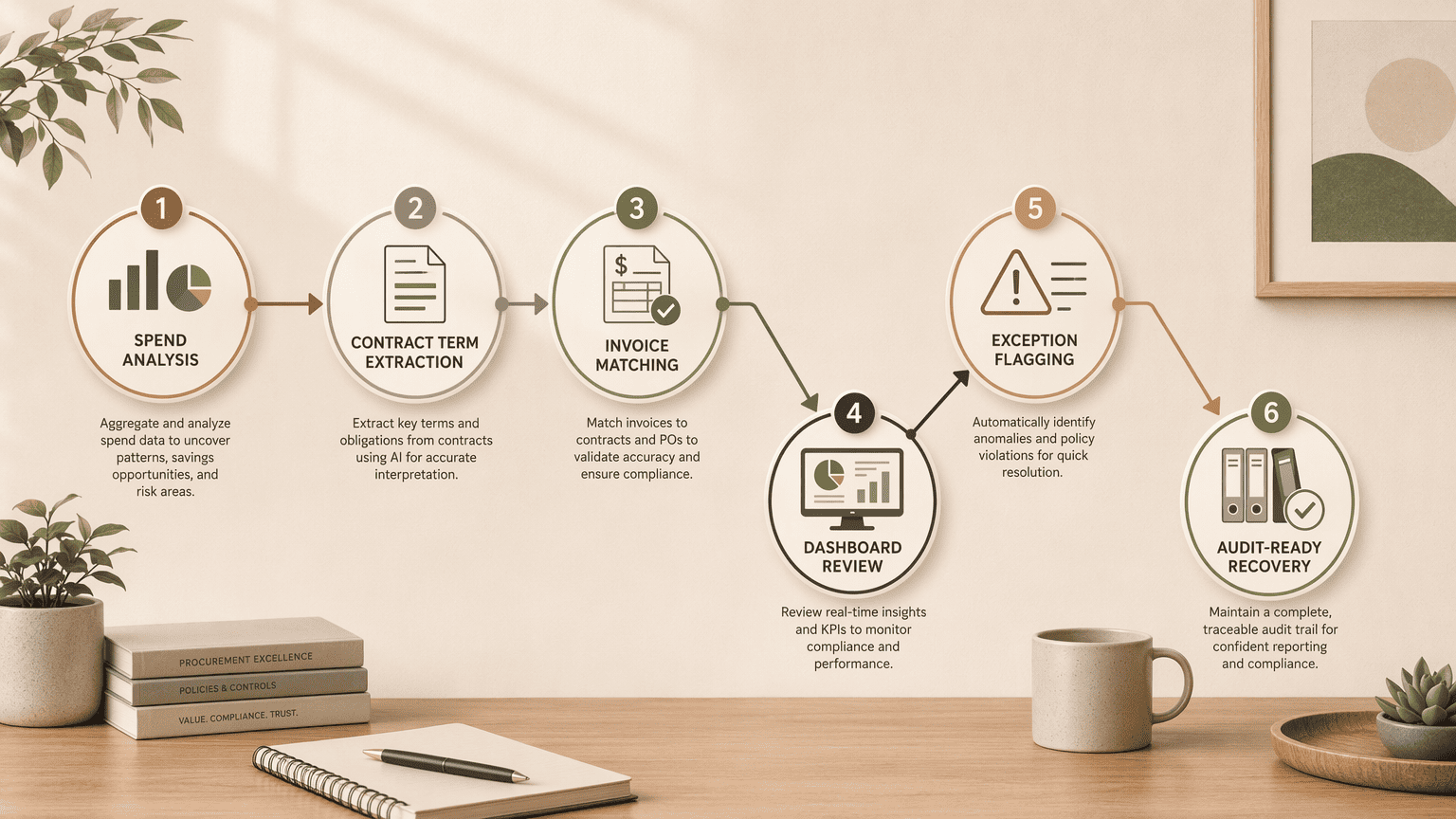
Here is how the options compare across the dimensions that matter most.
| Step | Action | Key Activity | Output |
|---|---|---|---|
| 1 | Map discount leakage landscape | Analyze 12 months of spend by vendor and contract type; sample high-complexity contracts | Baseline leakage estimate for high-risk suppliers |
| 2 | Extract discount terms from contracts | Import contracts into AI ingestion layer that parses discount clauses, price caps, and rebates | Structured term library per contract |
| 3 | Connect AI layer to live transaction data | Integrate with ERP or procure-to-pay system to stream purchase orders and invoices | Continuous invoice-to-term comparison |
| 4 | Configure real-time alerting rules | Set deviation thresholds (e.g., >2% variance) and assign notification routing to procurement team | Instant alerts on non-compliant invoices |
| 5 | Activate dispute and recovery workflow | Link alerts to a case management system; track rejection, negotiation, or credit request | Audit-ready recovery trail with 55 to 70% recovery rate |
| 6 | Monitor compliance dashboard | Share a single dashboard with procurement and finance showing discount adherence by vendor | Enforced savings visible to both teams |
| 7 | Run a pilot on limited contracts | Test on 10 to 20 high-complexity contracts before full rollout | Proven value without full migration |
Step 1: Map the Discount Leakage Landscape in Your Procurement Spend
Start with a cold-eyed diagnostic of where your money is leaking, before any technology conversation. Pull 12 months of spend data from your ERP and bucket it by vendor and contract type. Focus first on suppliers where pricing is complex: tiered volume discounts, quarterly rebate schedules, price caps tied to commodity indices, and category-specific promotional terms. These are the contracts where manual oversight fails most often, because a single invoice deviation hides inside dense, multi-line billing.
Calculate a rough baseline leakage estimate by sampling high-complexity contracts. For each one, manually compare the last three invoices against the negotiated rate card or price book. Even a hand-check of 20 contracts often surfaces enough deviation to build a compelling business case. McKinsey’s benchmark, that roughly 2 percent of spend leaks through unfulfilled obligations, gives you a defensible yardstick. Extrapolate your sample finding against total addressable spend: an enterprise with $1 billion in vendor outlay that confirms a 1.7 percent leakage rate has just identified $17 million in potential recovery.
That single number is what earns the investment in AI.
Do not stop at spend data. Overlay a vendor risk lens by assessing how deeply you understand your supplier ecosystem. 95 percent of companies understand only up to tier-one supply chain risks, and just 42 percent understand risks at tier two.
The suppliers whose discounts you are missing are often the same suppliers whose broader compliance posture you have never systematically evaluated. A tool like ContractsAI can ingest this fragmented picture and publish a structured index of active terms and compliance status. That diagnostic output becomes the foundation for everything that follows.
Step 2: Deploy a Non-Disruptive AI Intelligence Layer Over Existing ERPs and Contract Repositories

The biggest barrier procurement leaders cite is the prospect of ripping out SAP or Oracle. An overlay architecture removes that obstacle entirely by sitting above the systems you already run, ingesting data and returning structured intelligence without touching transactional flows.
Here is the deployment sequence:
- Connect the intelligence layer to your ERP via API: Pull real-time invoice and purchase order data from systems like SAP Ariba or Oracle Fusion without modifying any procure-to-pay workflow.
- Integrate your contract repositories: Ingest executed agreements and amendments directly from DocuSign CLM, Icertis, or shared network drives so the AI sees the full, current contract picture.
- Process unstructured text into a structured compliance dataset: The AI reads every PDF, email amendment, and legacy scan, then extracts discount clauses, price caps, and rebate schedules into a machine-readable taxonomy.
- Surface deviations through alerts and dashboards: Once the live contract index is built, every inbound invoice is compared to its governing terms. A mismatch triggers an alert for procurement and finance within minutes, not weeks.
Step 3: Automate the Extraction of Every Discount Clause, Rebate Schedule, and Price Cap

The critical capability that makes real-time monitoring possible is turning static, unstructured documents into a living, queryable index of commercial terms. Most supplier discounts live in PDFs, scanned pages, and email threads that no ERP can parse. Large language models change that calculus. They read a legacy supplier agreement the way an experienced contract analyst would, identifying discount percentages and volume-based rebate triggers, then structuring each as a tagged data point.
A platform like ContractsAI extracts those entities at accuracy levels above 99 percent, linking each extracted term directly to its source language so you can validate the AI’s read against the original contract. That source-linkage is key for audit defense. You can run a pilot on a limited contract set without migrating your full repository, testing extraction fidelity on your most complex agreements before scaling. The output is a ‘living index’ of active terms that stays current. When a supplier sends an amendment adjusting the rebate threshold, the index updates, and every subsequent invoice cross-check reflects the new trigger immediately.
Step 4: Activate Real-Time Invoice-to-Contract Matching for Instant Deviation Alerts
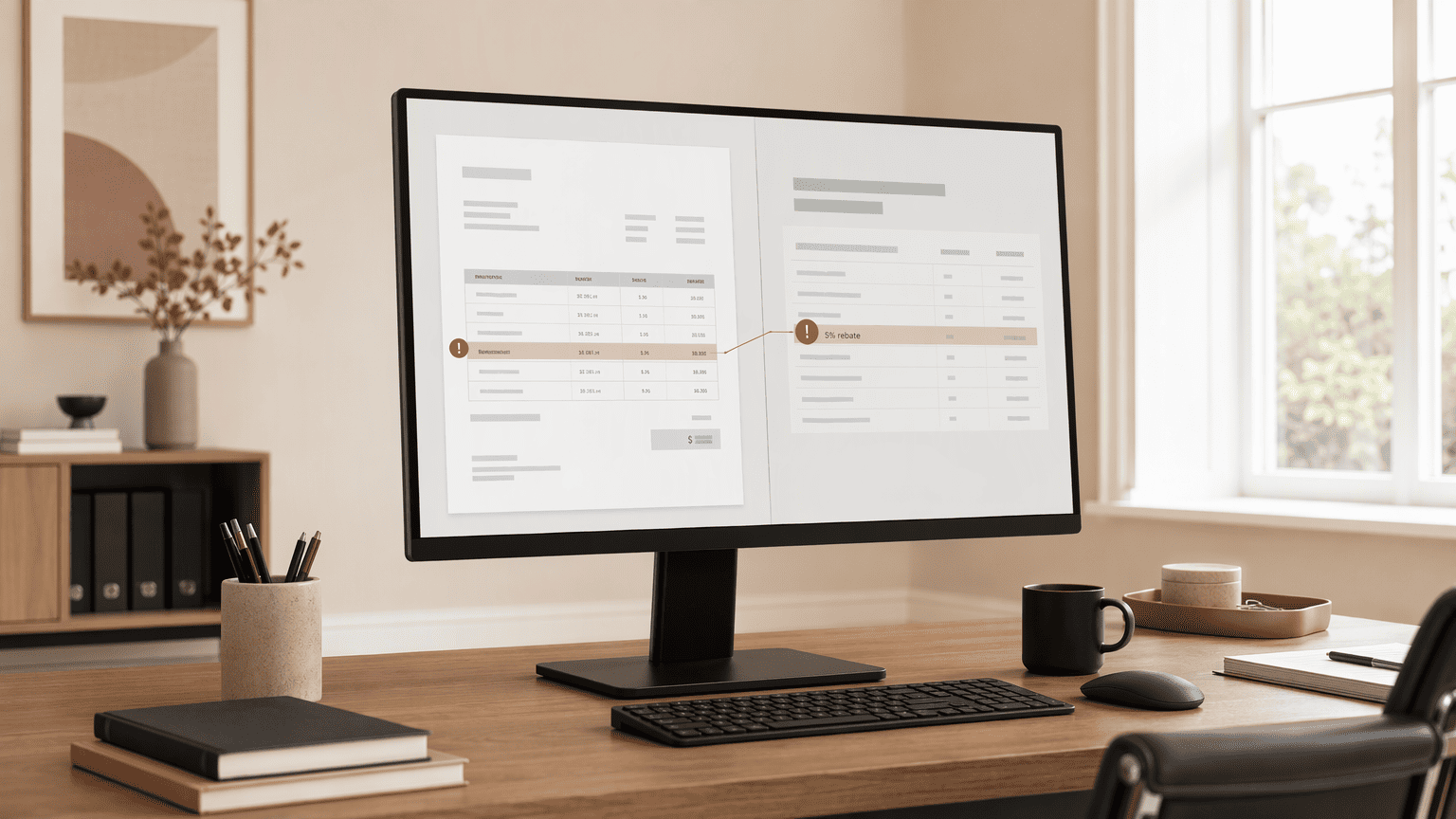
With your structured discount terms indexed, you shift the core compliance workflow from retrospective sampling to continuous, line-level validation. Every invoice that lands in your ERP is automatically matched against the extracted pricing terms from the governing contract. The AI compares the unit price, volume tier applied, any applicable rebate, and the final line total. If a supplier invoices at a pre-discount rate while the contract mandates a 5 percent volume rebate, the system flags it instantly.
This changes the recovery timeline materially.
Instead of discovering an overcharge during a quarterly audit and then negotiating a credit memo weeks later, procurement receives an alert the moment the invoice posts. The specificity matters: the alert cites the exact contract clause in violation, the disputed amount, and the source paragraph for reference. Teams using this approach can act within a 30-day payment window, converting what was once a negotiation into a straightforward correction.
Continuous matching also reveals patterns that manual audits miss. One enterprise using automated billing analysis discovered over $10 million in duplicate payments to suppliers that had never surfaced in a sampled review. Duplicate billing, misapplied tier pricing, and missed early-payment discounts become visible because every single transaction undergoes scrutiny, not just the 5 percent pulled for audit.
Step 5: Unify Procurement and Finance with a Single Compliance Dashboard and Shared Intelligence
The organizational silo is where negotiated savings go to die. Procurement negotiates a 3 percent annual rebate. Finance, working from its own reconciliation spreadsheets, never applies it at invoice time because the rebate schedule lives in a scanned PDF that no one on the AP team can locate. A shared compliance interface fixes that by rendering the same structured discount data to both teams simultaneously.
That sounds like an IT architecture pitch. Boil it down, and you get four capabilities that turn the dashboard from a report card into a recovery tool.
- Single-pane dashboard that surfaces contract and invoice data, giving procurement and finance identical real-time discount status, deviation alerts, and recovery metrics without emailing spreadsheets or hunting through document repositories.
- Compliance KPIs tied to recovery dollars that track total discounts captured, deviations flagged, recovery amounts confirmed, and aging of unresolved disputes for both teams.
- Automatic routing of deviation alerts to the accountable owner, firing a notification to the category manager who negotiated the contract and the AP specialist processing the invoice, closing the accountability loop.
- Structured recovery workflow built on shared intelligence, where a flagged deviation generates a pre-populated dispute letter that cites the specific contract language, cutting time from detection to correction.
Step 6: Build an Audit-Ready Framework for Sustainable Vendor Compliance and Recovery
A single alert recovery is a win. A documented, repeatable recovery process that improves with each cycle is a structural margin advantage.
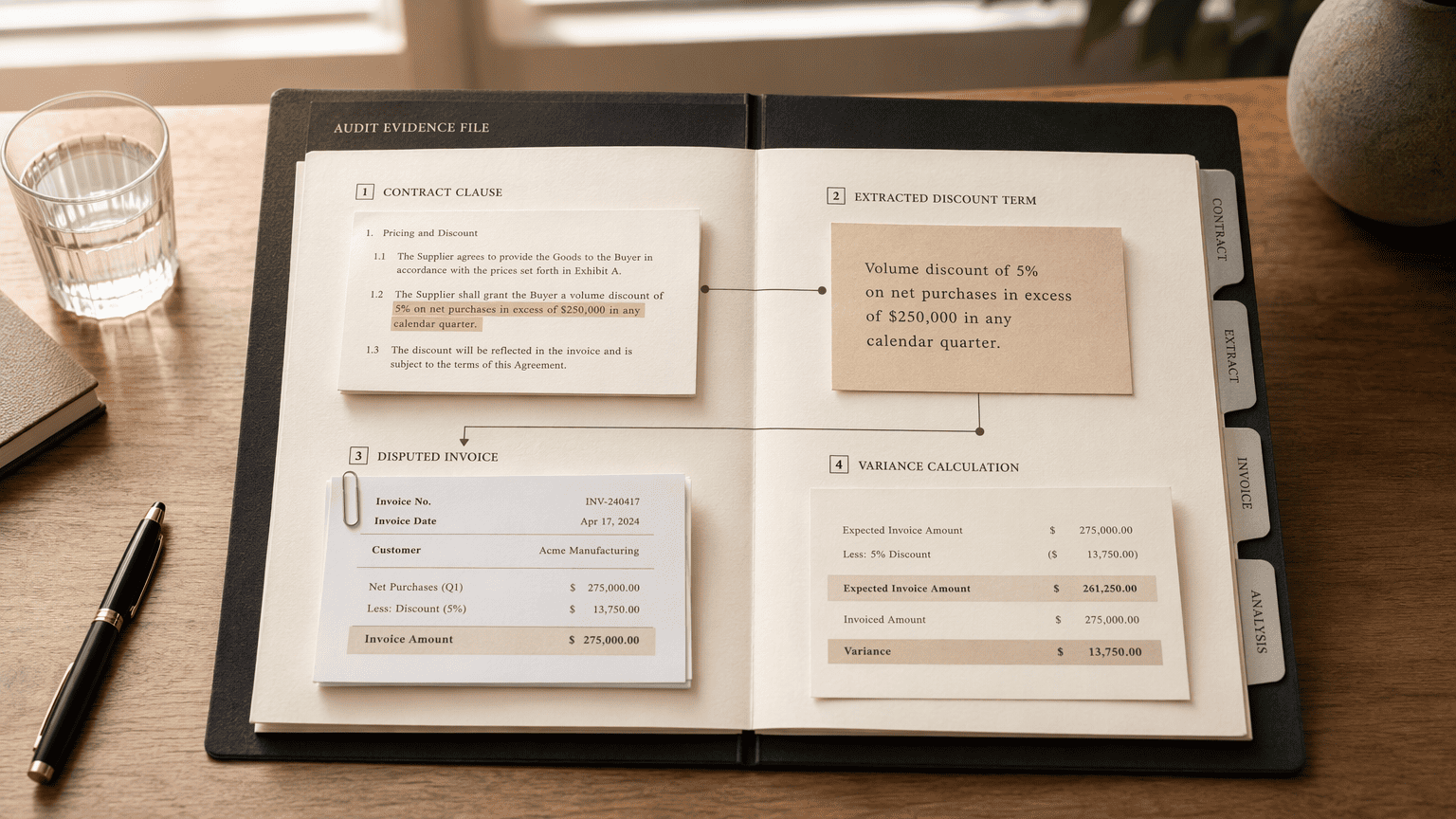
Construct audit trails that attach every deviation detection to its source evidence without manual assembly. When a supplier disputes a flag, the system produces an evidence package containing the original contract clause, the extracted discount term, the invoice in question, and the variance calculation. This defensible paper trail matters because McKinsey data shows that companies with active dispute management programs recover 55 to 70 percent of disputed amounts, versus an industry average of only 38 percent. Automation closes that gap.
Make contract updating part of the same continuous loop. When a renegotiation produces a new price cap, the AI extracts it, indexes it, and applies it to the next invoice cycle with zero lag. Over time, your compliance framework becomes more precise because every resolved dispute refines the extraction models and the matching rules. You are not just recovering lost discounts. You are building a self-reinforcing system where each cycle of detection, recovery, and contract updating makes future leakage measurably smaller.
Conclusion
Real-time vendor discount visibility turns procurement into a continuous compliance engine, not a periodic audit. The technology that makes this work, an AI layer sitting on top of your existing ERPs and contract repositories, is mature enough for a contained pilot. Run one. Prove the recovery impact, then scale.
The single action worth taking this quarter: map your own leakage landscape and check it against the McKinsey 2 percent benchmark. That number tells you, in dollars, how much margin you are leaving uncollected.
Time to stop sampling and start monitoring.
Frequently Asked Questions
What is vendor discount compliance monitoring and why is it important?
Vendor discount compliance monitoring is the continuous process of verifying that every supplier invoice matches the pricing terms, rebates, and discount schedules in the governing contract. It matters because manual sampling allows leakage to go undetected for quarters, costing large enterprises up to 2 percent of total annual spend.
How does an AI-powered contract intelligence layer provide real-time discount visibility?
It ingests contracts and amendments from your repositories, uses large language models to extract every discount clause and price cap into a structured index, then continuously compares incoming ERP invoice data against those extracted terms. Any deviation triggers an instant alert rather than waiting for a manual audit cycle.
How can I track and validate supplier pricing without replacing my ERP or procure-to-pay system?
A non-disruptive AI intelligence layer overlays your existing SAP, Oracle, or other ERP. It connects via API to pull transaction data and reads contracts from your current repositories without modifying any live workflow. You get real-time matching and alerts layered on top of the systems you already run.
What is the process for auditing supplier invoices against contracted rates at scale?
The compliance process follows three sequential steps:
- The AI extracts every discount clause, rebate schedule, and price cap from the full contract repository into a structured index.
- Every invoice line item is matched against those terms.
- Any deviation in unit price, volume tier, or rebate application generates an alert with the specific contract clause cited, enabling immediate correction.
How can procurement and finance teams share structured discount intelligence without spreadsheet handoffs?
A single compliance dashboard surfaces the identical discount status, deviation alerts, and recovery KPIs to both teams. When a noncompliant invoice triggers an alert, both the category manager and the AP specialist see it simultaneously, removing the handoff friction that traditionally delays recovery.
What are the common barriers to real-time vendor compliance and how do solutions like ContractsAI address them?
The main barriers are unstructured contract data in PDFs and emails that resists rule-based matching, and organizational silos where procurement negotiates terms finance never enforces. ContractsAI applies large language models to extract terms from those legacy documents at high accuracy and surfaces the results in a shared index accessible to both teams.
Sources
- McKinsey Direct Mitigating procurement value leakage with … – www.mckinsey.com
- Vendor compliance: 2026 guide and best practices – business.amazon.com






