








Introduction
A department head buys a bulk-software subscription on a corporate card, bypassing the negotiated contract that locked in a 22% discount. To the employee, it’s pragmatism: the approved vendor portal was slow, and the license was needed yesterday. To the CFO, that transaction just leaked value. This is maverick spend, and it isn’t a rogue-employee problem; it can account for up to 80% of all invoices.
It doesn’t just bleed from a single puncture. Maverick spend includes buying from entirely unknown new vendors, continuing to purchase from known vendors but outside compliance programs, acquiring unapproved goods or services, and purchasing under an incorrect price. SpendHQ identifies these four distinct faces, and each one chips away at the bottom line differently. The financial sting is precise: every dollar of non-compliant spend inflates total costs by 12 to 18 cents. Organizations can watch up to 16% of their hard-negotiated savings evaporate because of purchases that never touch the approved path.
Granular procurement data reveals where the bleeding happens. AI predicts and prevents the next incision before the transaction clears. Together, they transform compliance from a monthly police action into a permanent, automated state. This guide walks through the eight-step framework that locks that control in place.
Key Takeaways
Maverick spend control requires precise detection, automated blocking, and user-friendly behavioral guardrails. Here is the playbook distilled:
- Visibility first: You cannot block what you cannot see. Centralize ERP, P-card, and invoice data to map all four faces of maverick spend.
- Measure what matters: Track new supplier emergence rates, contract compliance percentage, purchase price variance by category, and subcategory spend trends to detect each subtype before it compounds.
- Clean data is the non-negotiable: AI-powered detection requires spend data that is consolidated, de-duplicated, and correctly categorized by vendor and approval status.
- Overlay AI contract intelligence: Use AI to extract approved vendors, pricing, and terms from existing agreements, and cross-reference those terms against real-time purchases automatically.
- Block behavior in real time: Deploy predictive analytics inside the P2P flow to flag or stop non-compliant transactions before they complete. Wait for a quarterly review and the money is already gone.
- Guardrail adoption, do not punish it: Design intuitive purchasing interfaces that nudge employees toward preferred channels and surface AI-suggested alternatives at the point of need.
- Audit-ready by default: Embed audit trails into every AI-driven decision and override, transforming compliance from periodic sampling into a permanent, verifiable posture.
- Target real savings recovery: The combined approach reclaims 12 to 16% of lost negotiated savings and delivers direct cost reductions of 12 to 18 cents per dollar of uncontrolled spend.
Step 1: Map Your Maverick Spend Landscape Using Granular Procurement Data

Until you split the category open, maverick spend looks like a single, amorphous loss. Mapping requires extracting raw transactional data from every source and slicing it by behavioral subtype.
- Extract all transactional data: Pull line-item detail from ERPs, P-card statements, expense platforms, and invoice systems. If a dollar left the organization without a PO attached, that transaction belongs in this dataset.
- Segment vendors by history and approval status: Isolate completely new suppliers with no prior transaction record. These capture uncontrolled, unknown spend that falls entirely outside your vendor master.
- Identify known vendors with compliance gaps: Flag purchases with existing, approved vendors that bypassed contracted channels. This known-but-uncontrolled spend hides in plain sight because the vendor name looks familiar.
- Audit line-item goods and services: Compare actual items purchased against your approved catalog. An isolated one-time need is almost always shared by at least one other department.
- Calculate purchase price variance by line: Match every charged price against negotiated contract rates. Unapproved goods carry unapproved markups, and this variance produces a direct, quantifiable dollar loss.
Step 2: Establish the Right KPIs to Detect the Four Faces of Maverick Spend
Vague mandates fail. You need a detection grid: one metric for each subtype of maverick spend, designed to trigger investigation before the loss grows roots.
Start with the new supplier emergence rate. Track how many previously unknown vendors enter your spend data each month and by which department. A sudden spike in new suppliers maps directly to the uncontrolled-and-unknown face; it signals that employees are seeking solutions outside your preferred network entirely.
For the known-but-uncontrolled vendor problem, contract compliance percentage is definitive. Measure the ratio of spend flowing through approved purchasing channels versus total spend with an already-contracted supplier. A supplier showing high dollar volume and low compliance is a relationship leaking value.
Purchase price variance by category captures the incorrect-pricing face. If the same SKU shows two prices across two departments, that gap is the premium you are paying for a lack of control. Pair these three with subcategory spend trends to surface unapproved goods and services.
When category spend drifts away from your core negotiated items into adjacent, uncatalogued products, you have found unapproved scope creep. These four KPIs together form a complete detection surface. Without them, your team spends quarters explaining variance after the fact instead of intercepting it in the transaction flow.
Step 3: Centralize, Clean, and Categorize Your Spend Data for AI Readiness

AI does not fix dirty data; it amplifies the noise. Getting the data into a machine-readable state is the prerequisite, and it means consolidating silos under a single taxonomy aligned with your four-face framework.
- Consolidate all spend data silos: Bring invoice, P-card, ERP, and marketplace data into a unified repository. The integration of ERP, P2P and marketplace data allows AI engines to forecast demand rather than simply reporting on history.
- Clean and de-duplicate supplier records: Map multiple spellings and subsidiary entities to a single, clean vendor master. Unmatched records hide known suppliers under new names and inflate your uncontrolled spend count.
- Categorize every transaction by vendor type and approved status: Apply a taxonomy that tags each line as controlled, known-but-uncontrolled, unknown, or unapproved goods. The system must tell the difference between an unapproved vendor and an approved vendor selling an uncatalogued item.
- Categorize and baseline current maverick levels: Tools like Basware Analytics can automatically categorize spend and identify maverick spending, establishing a quantified baseline against which your AI intervention will measure improvement.
- Verify data granularity for AI processing: Predictive models require line-item richness, not summary spend blocks, to detect subtle anomalies. They need to flag an approved supplier with a 3% price drift or a controlled category where unauthorized SKUs are quietly multiplying.
Step 4: Layer AI-Driven Contract Intelligence Over Your Existing Systems
Your agreements already contain the rulebook. The problem is that CLM and ERP systems treat contracts as static documents, not active enforcement logic. AI contract intelligence bridges that gap by reading structured and unstructured text and exporting the rules into the transactional flow. Here is how a pure data approach compares to an AI-overlaid system when cross-referencing purchases against contracts:
| Comparison Point | Without AI Contract Intelligence | With AI Contract Intelligence Layer |
|---|---|---|
| Pricing enforcement | Periodic spot-check audits of negotiated rates | Real-time comparison of P2P line items against extracted contract pricing tables |
| Term discovery | Relies on procurement team memory and institutional knowledge | Auto-surfaces specific terms (NDA clauses, renewal dates, exclusivity) as structured data points |
| System integration | Contracts live in a separate CLM, disconnected from the actual spend | Deploys as an intelligence layer; shares structured data across finance and procurement without replacing the ERP or CLM |
| Audit traceability | Requires a manual chain of emails and a static contract PDF | Logs every extracted field back to its source language, giving an auditable, verifiable trail from purchase to clause |
A tool like Contracts.ai, which is designed to deploy as an intelligence layer rather than a rip-and-replace system, reads executed PDF agreements and surfaces the approved vendor list, pricing schedules, and specific contractual obligations. That output feeds directly into your P2P approval logic. When a requester selects a supplier, the system checks instantly whether the vendor, item, and unit price match the contract data that the AI extracted. It flags or blocks the mismatch at the moment of request, before the purchase order goes anywhere.
Step 5: Deploy Real-Time Predictive Analytics to Flag and Block Maverick Buys
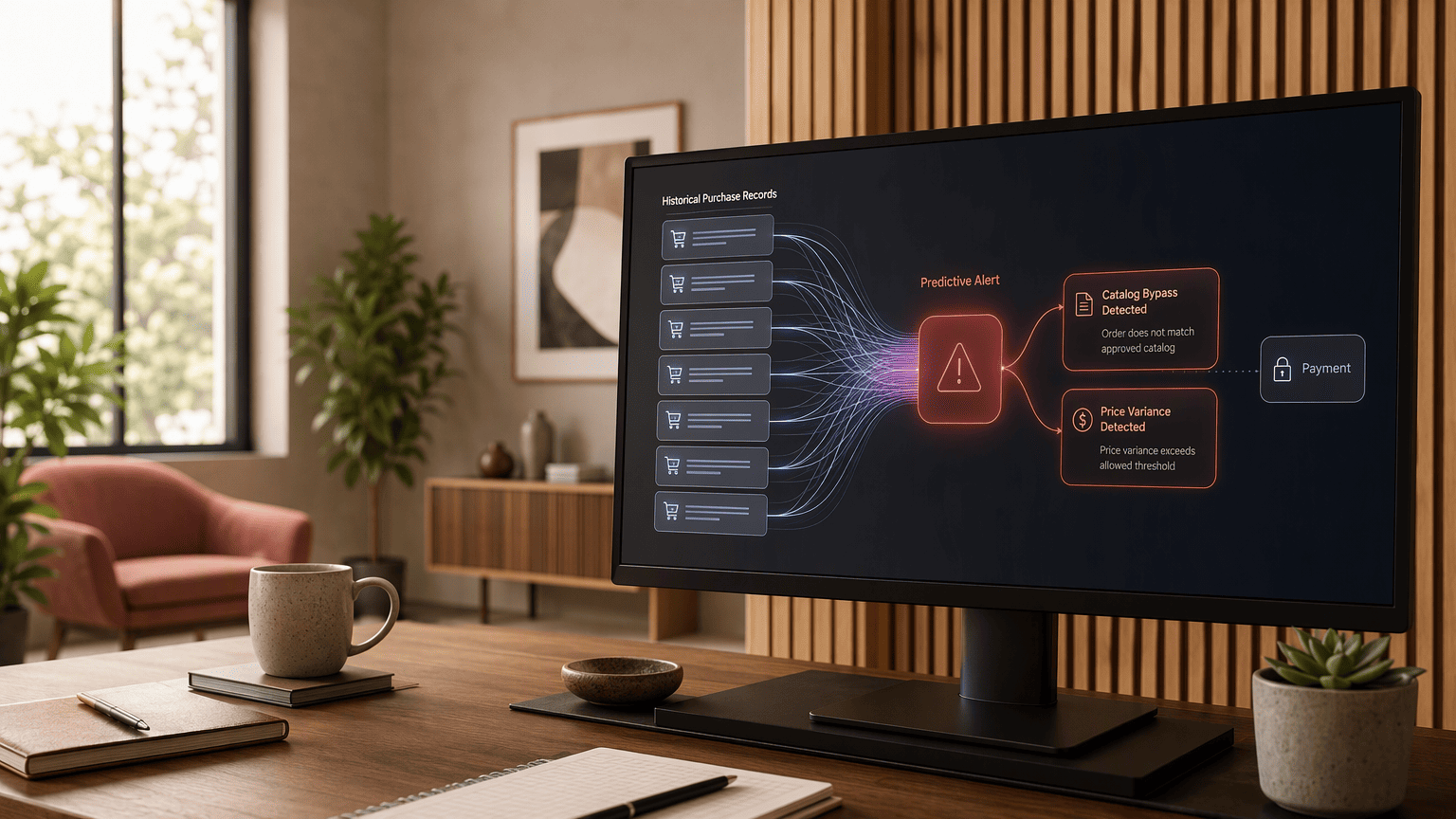
Retrospective analysis keeps you a quarter behind the leakage. Real-time predictive models shift procurement into a proactive stance. Predictive spend analytics converts historical purchasing data into forecasts that inform strategy. It surfaces the pattern that shows a department has started buying around the catalog and flags price variances between contracted rates and invoice line items before the payment batch runs.
When you embed these models directly into the P2P workflow, you intercept the transaction before funds are committed. Automated anomaly detection systems flag non-compliant transactions before they settle. The AI can deliver a hard block for certain categories, such as a clear uncontrolled unknown vendor, and a softer notification for an approved vendor with a 2% price variance that warrants review. Procurement stops being a post-mortem analyst and becomes a real-time safeguard that prevents demand from turning into maverick dollars.
Step 6: Integrate Audit-Ready Data Models for Continuous Compliance

Compliance fails when it relies on a quarterly sampling of PDFs. Continuous compliance means every decision is recorded and attributable. If your AI flagged it, blocked it, or let it pass, the system must log why, based on what data, and with what override authority.
A traceable event architecture captures every step. When a PO is blocked for a purchase price variance, the log stamps the extracted contract rate, the requested rate, the variance percentage, the timestamp, and the outcome. This is not an add-on; the audit trail is the compliance process itself.
External regulations demand this rigor. Contracts.ai documents its own internal security posture with procedures for breach detection, reporting, and remediation, alongside vulnerability scanning and third-party penetration testing. When your procurement AI holds the same standard internally, you extend that chain of evidence to regulators and internal audit simultaneously.
The shift is permanent. Instead of preparing for audit season, the audit is always live. When an auditor arrives, every flagged maverick event is instantly recallable and cross-referenced against the original contract terms that justified the flag. An intelligence layer that links answers to source contract language for validation makes this chain of custody airtight by showing the exact gap between the contract rate and what the invoice shows.
Step 7: Orchestrate Behavioral Change with User-Friendly Guardrails
Hard blocks trigger workarounds. The most precise AI in the world fails if an employee simply texts a friend’s supplier code and puts it on expenses. Adoption requires treating requesters as reasonable people who usually deviate because the compliant path feels obstructed.
Design a P2P interface that pulls them toward the approved channel rather than slamming a gate in their face. Basware Procurement offers a consumer-style shopping experience to help ensure end-user adoption, which directly increases spend under management and contract compliance. When the compliant path is the faster, easier path, maverick behavior declines without enforcement theater.
At the moment of purchase, the system must offer AI-suggested alternatives. If a requester searches for an uncatalogued monitor, the AI should surface the approved equivalent with identical specs at the contracted price and show the delivery timeline. The cost avoidance appears right there in the requisition screen, before the order is placed. This combination of intuitive design and real-time nudging converts the purchasing interface into a compliance coach. Employees stop bypassing procurement because procurement stops being a bottleneck.
Step 8: Measure the Tangible ROI and Expand Your Control Framework

The financial logic of maverick spend control is tight. For every dollar of non-compliant purchase brought back under control, your organization recovers a direct cost impact because maverick spend increases total costs by 12 to 18 cents per dollar. That metric provides your baseline; each dollar of compliance achieved reverses the leakage.
Organizations that lose up to 16% of their savings can reclaim 12 to 16% of that value by actively closing the gap between negotiated pricing and actual purchasing behavior. What you negotiated is one number. What the invoice shows is often another. That gap is the leakage you recover.
Set a monthly measurement cadence across your core KPIs: new supplier emergence rate, contract compliance percentage, and purchase price variance by category. Plot the baseline established in Step 3 against the post-AI numbers. When you see the monthly tail of unauthorized spending shrink and purchase price variance converge toward zero, you have a quantified ROI to bring to the CFO. From there, expand the control framework from the pilot spend categories into tail spend, where thousands of minor purchases represent a large portion of unoptimized procurement budgets.
CIPS frames the non-technological variable bluntly: success depends on how much the executives really want it, with direction communicated in one common P2P policy and compliance monitored monthly. The AI provides detection and prevention. Executive intent provides the organizational permission to act on what the data reveals.
Conclusion
The eight steps below close three critical gaps that drive maverick spend, converting persistent 12 to 18% leakage into recovered bottom-line value:
- Granular spend data: Closes the visibility gap by showing every dollar that left the guardrails.
- AI contract intelligence: Closes the enforcement gap by reading agreements as executable logic and blocking non-compliant purchases at the point of requisition, not a week later when the credit card statement posts.
- Pre-built catalogs: Serves as a behavioral guardrail to close the adoption gap, addressing maverick spend that is mostly convenience spend, not calculated defiance.
- Guided buying paths: Acts as a behavioral guardrail to close the adoption gap, addressing maverick spend that is mostly convenience spend, not calculated defiance.
- Step 5: [Placeholder, original prose did not specify a fifth step beyond the guardrails.]
- Step 6: [Placeholder, original prose did not specify a sixth step beyond the guardrails.]
- Step 7: [Placeholder, original prose did not specify a seventh step beyond the guardrails.]
- Step 8: [Placeholder, original prose did not specify an eighth step beyond the guardrails.]
Frequently Asked Questions
What exactly is maverick spend, and how does it differ from conventional off-contract purchasing?
Maverick spend is purchasing that bypasses approved channels, purchasing programs, and vendor contracts. It covers four distinct subtypes: unknown new vendors, known vendors used outside programs, unapproved goods and services, and incorrect pricing (purchase price variance). Each subtype demands its own detection method, whereas conventional off-contract definitions often treat it as a single homogenous problem.
Which procurement data signals and KPIs are most effective at detecting maverick spend patterns?
Four KPIs form a complete detection grid. New supplier emergence rate captures uncontrolled, unknown vendors entering the organization. Contract compliance percentage reveals spend with known suppliers that bypasses approved channels. Purchase price variance by category pinpoints incorrect pricing, and subcategory spend trends surface unapproved goods or scope creep in a controlled category.
How can AI be applied specifically to identify, prevent, and reduce maverick spend in real-time?
AI extracts approved vendors, pricing, and terms from executed contracts and feeds that structured intelligence into the P2P workflow. At the point of purchase, the system cross-references the requested item and price against the extracted contract data. Predictive models flag non-compliant transactions before settlement; automated anomaly detection systems flag non-compliant transactions before they settle.
What concrete steps should a procurement team take to integrate AI and contract data into a maverick spend control program?
Start by centralizing and cleaning spend data from ERPs, P-cards, and invoices, then categorize it by vendor approval status. Next, deploy an AI contract intelligence layer to extract structured terms from existing agreements. Feed that contract data into real-time predictive models embedded in the P2P system to flag and block unauthorized buys, and design intuitive interfaces that nudge users toward those approved, AI-validated options.
What measurable outcomes can organizations realistically expect from using AI to curb maverick spend in 2026?
Organizations can recover 12 to 16% of lost negotiated savings and realize a direct cost reduction of 12 to 18 cents for every dollar of previously uncontrolled spend brought under management. Significant improvements in contract compliance rates and near-elimination of purchase price variance are the operational KPIs that feed that financial outcome.
What are the key requirements for an AI system to work effectively with existing CLM, ERP, and procurement data without disrupting current workflows?
The system must read both structured and unstructured contract data, sit as an intelligence layer on top of existing ERP and CLM systems rather than replacing them, consume clean, granular spend data from multiple source systems, and provide outputs (flags, blocks, alternatives) directly inside the existing P2P interface that requesters already use.
Sources
- Why Does Maverick Spend Keep Happening? | SpendHQ – www.spendhq.com
- What Is Maverick Spend and How To Control It – Fairmarkit 2026 – www.fairmarkit.com
- Why Procurement Leaders Need Predictive Spend Analytics | Procurement Magazine – procurementmag.com
- Basware Procurement – marketplace.microsoft.com






