








Introduction
Your finance team just processed an invoice for $84.50 per unit. The approved contract rate is $72.00. That $12.50 delta, repeated across hundreds of line items every quarter, represents a silent drain on your P&L that compounds faster than almost any operational mistake. This is not a hypothetical edge case; it is a systematic leakage that costs enterprises 0.8% to over 2% of annual vendor spend every single year.
Suppliers rely on procurement disorganization to slide through unauthorized price escalators, apply broad ‘average’ percentage increases that hide larger product-specific hikes, or enforce retroactive pricing before the contract’s effective date. These patterns thrive inside PDFs locked in shared drives and decentralized email threads where no one compares invoice line items against the actual negotiated terms. One common example is a supplier announcing a 5% increase across a full product range when the contract explicitly caps annual escalations at 3%.
Fixing this does not require hiring an army of forensic auditors. In 2026, a structured, tech-enabled audit framework can shift your verification from a quarterly post-payment scramble to a real-time, pre-payment barrier. We will walk through a six-step method to centralize your contracts, digitize granular pricing data, and use automated intelligence to catch overcharges before a single dollar leaves your account.
Key Takeaways
Supplier overcharging isn’t bad luck. It’s a process failure, and it’s fixable.
- Here are the core principles to stop supplier overcharging before it chips away at your margins:
- Centralize contracts in a searchable repository: Consolidate agreements from siloed drives and emails into a single audit-ready index. Contracts that are scattered across inboxes and shared drives fail silently when renewal dates pass.
- Digitize granular pricing data: Extract unit prices, escalation caps, and effective dates using AI extraction, so you can validate every line item. Aggregate spend summaries skip the detail that hides the leak.
- Enforce a no-payment-without-validation gateway: Validate every invoice line item against the contracted rate in real time before payment authorization. Waiting until after the check clears makes recovery harder and more expensive.
- Automate pattern detection for overcharge schemes: Deploy automated rules to flag specific attacks like early escalators, retroactive pricing, and cap breaches instantly.
- Benchmark sibling agreements against each other: Use cross-contract intelligence to surface identical items priced inconsistently across different contracts with the same supplier.
- Establish a self-serve governance cadence: Assign clear audit owners and set a recurring review rhythm with dashboards that let non-technical stakeholders monitor compliance directly.
Step 1: Centralize and Index Every Active Contract to Create an Audit-Ready Foundation

A fragmented contract landscape is the single biggest enabler of overcharging. You cannot enforce terms you cannot find. Most organizations discover they have been overpaying for months before anyone notices because the agreement that capped the rate sat unread in a procurement manager’s inbox. Building a searchable repository where every agreement is accessible and machine-readable stops the silent failures where renewal dates pass unnoticed or rate caps are ignored. Here is the practical path to consolidation:
- Collect raw documents from all silos: Pull contracts from shared drives, departmental folders, individual email inboxes, and legacy CLM systems into a single staging area.
- Normalize file formats: Convert legacy scans and image-based PDFs into searchable, machine-readable text using optical character recognition (OCR) technology.
- Index structured metadata: Tag each contract with key fields including party names, effective dates, expiry dates, and jurisdiction. This turns a static document into a record that a system can act on.
- Set automated alerts: Configure the system to trigger automatic notifications for critical milestones and known price-adjustment windows, so you stop relying on manual calendar reminders.
- Control access by role: Implement granular, role-based permissions so that category managers and audit leads see the data relevant to their spend while maintaining security boundaries.
When every active agreement lives in one indexed, searchable environment, the ‘I didn’t know the contract said that’ defense disappears. Automated validations run against actual terms line by line.
Step 2: Capture and Digitize the Granular Data Points That Matter Most
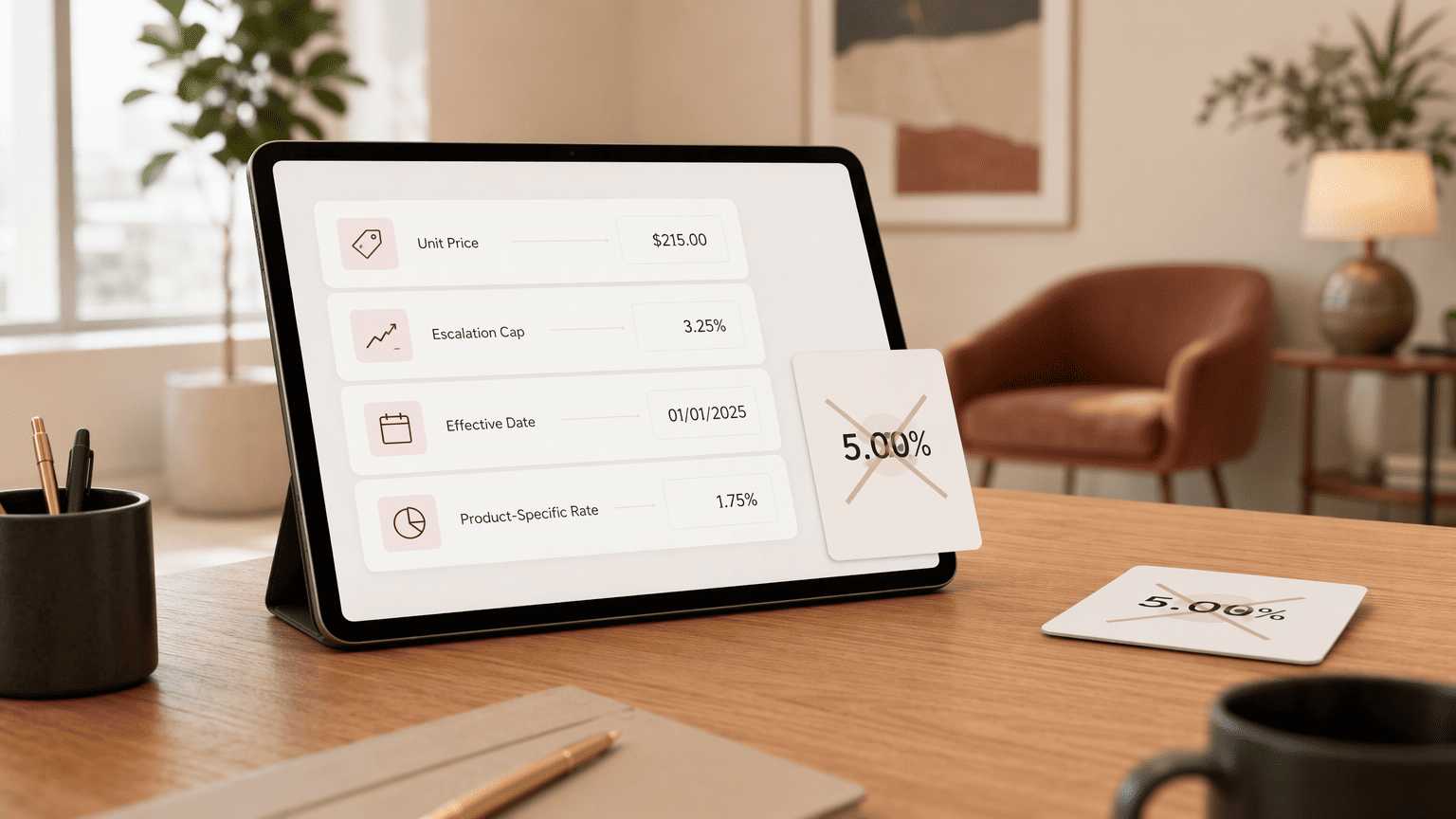
Monitoring only aggregate ‘increase indication’ percentages is a losing game. A supplier can legally apply a 3% weighted average increase by raising your high-volume core SKU by 8% and dropping low-volume accessories by 1%, completely distorting your actual cost base while remaining technically compliant with a loose headline cap. The specific structured data points you need to digitize are unit prices, price escalation caps, effective dates, and product-specific rates as they exist inside the contract.
Modern contract intelligence software extracts these fields from legacy scans and complex PDFs with accuracy levels the company says exceed 99%. This transformation of unstructured language into structured data is the only way to enable an automated line-level match. When you have the contracted rate for every SKU isolated as a discrete, queryable field, you can move past statistical sampling of invoices into a world where every line is a check, and every deviation generates an alert before the payment run is complete.
Step 3: Establish a No-Payment-Without-Validation Workflow on Every Invoice Line
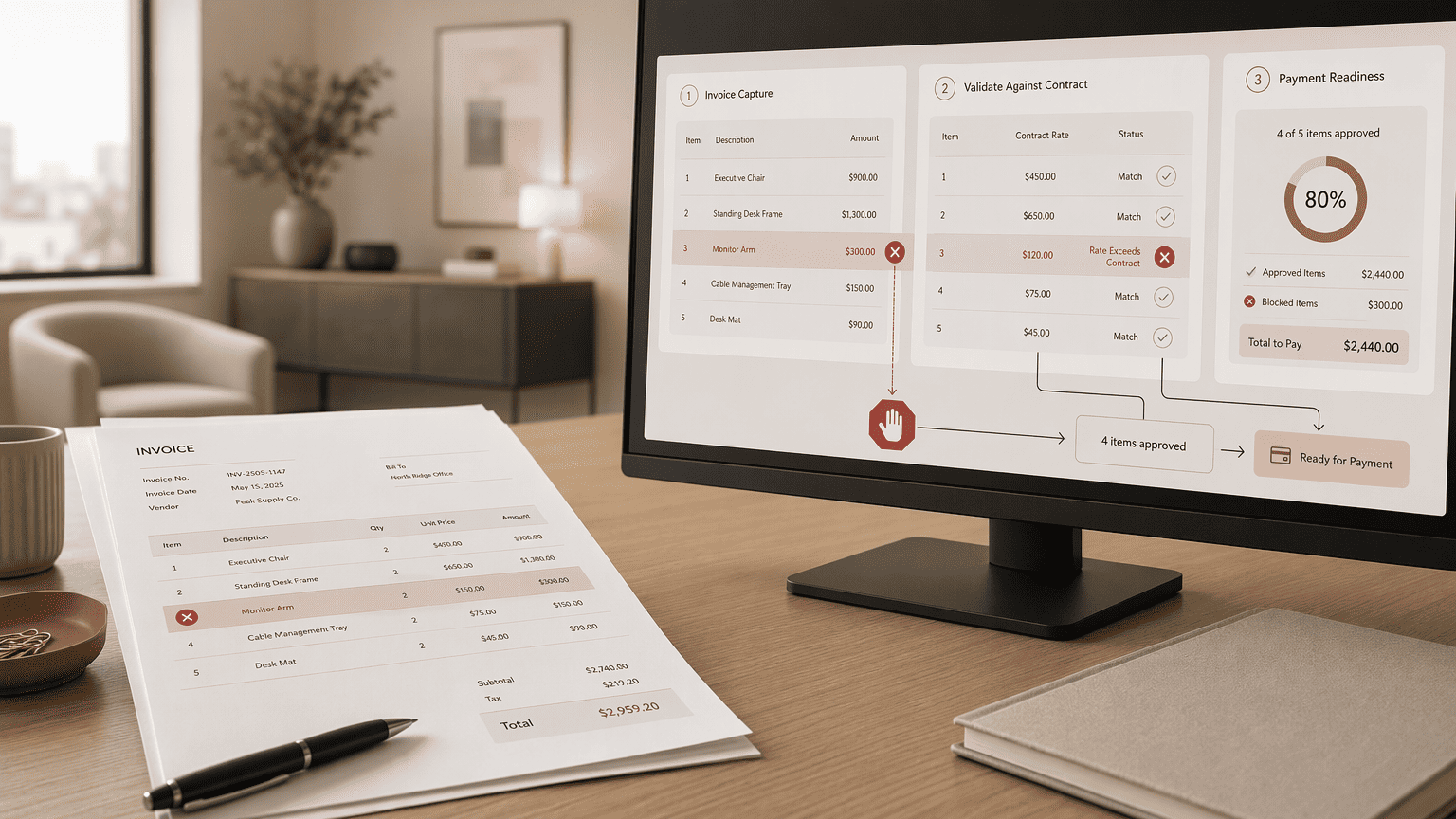
The most expensive audit is the one that happens after the cash has already been wired. You need to shift your control point from a periodic, post-payment recovery effort to a pre-payment, hard block.
Your procure-to-pay (P2P) process should force a line-item-level match between the invoice and the digitized contract rate for every single transaction before the system can register it as payable. This is two-way matching on steroids. For items involving tangible goods, layer on a three-way match where a goods receipt confirms you actually received what you are about to pay for. Tools like GEP QUANTUM INTELLIGENCE now validate purchase orders against contract terms before they are submitted and match invoices against contracted rates automatically, locking the compliance check into the financial workflow.
Any line item that fails this validation, an invoice charging $84.50 when the contract rate is $72.00, must not be allowed to proceed to the payment file. The exception triggers an immediate flag, routing the line back to the procurement owner and the supplier for justification or correction. You are refusing to pay a penny more than the contract stipulates; this is not a request for a future credit memo.
The result is a process where the cost of non-compliance lands on the supplier at the moment of billing. Your AP team does not carry it months later during a quarter-end scramble.
Step 4: Deploy Automated Pattern Detection for Common Overcharge Schemes
Suppliers count on a few billing tricks that slip through when nobody is checking dates or caps with any rigor. Map each scheme to a specific detection rule, and you catch the overcharge while the invoice is still in the approval queue.
Here is how the most common overcharge schemes map to specific detection rules:
| Scheme Pattern | Detection Logic | Example Trigger |
|---|---|---|
| Unauthorised Early Escalators | Date-validity check that blocks any line with a rate change scheduled before the contract’s effective date. | A 5% surcharge applied in August when the escalation clause activates in October. |
| Cap Breaches | An inflation-cap ceiling rule that flags any increase exceeding the explicit contract percentage, regardless of supplier justification. | A supplier passes through a 5.2% raw material hike when the contract caps annual adjustments at 3%. |
| Retroactive Pricing | A service-period alignment rule that rejects invoice line dates preceding the agreed billing start, preventing charges for periods before the contract was signed. | A services retainer includes fees for activity dated two weeks before the statement of work’s commencement. |
| Vague ‘Avg’ Increases | A parsing algorithm that flags supplier communications containing the words ‘various’ or ‘avg’ without a line-item breakdown, forcing a manual audit before payment. | A blanket letter that applies a ‘4% average’ price movement that actually hides 7%+ hikes on strategic components. |
These rules are binary: either the charge date falls after the effective date or it does not. Run them continuously and errors surface the moment they occur, surfacing variances the moment they occur rather than at the next quarterly review.
Step 5: Use Cross-Contract Intelligence to Surface Inconsistent Pricing Across Sibling Agreements
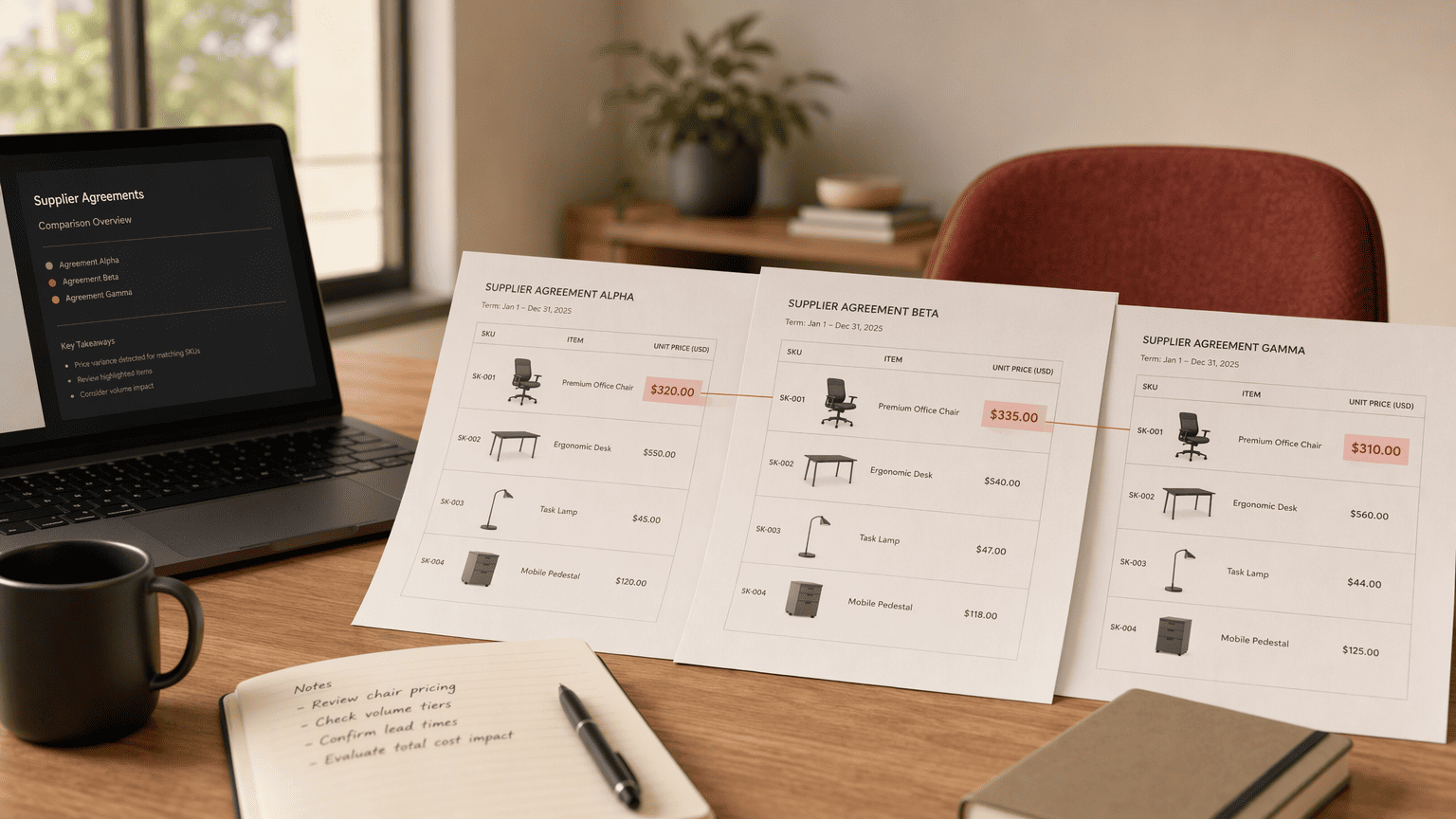
Line-item matching inside one document catches the obvious theft. The more expensive leakage happens across the relationship.
When you manage a vendor with multiple active agreements, subsidiaries, or related entities, identical items routinely get assigned different unit prices because nobody on your side compared the two deals. A platform performing cross-contract intelligence groups those related agreements, aligns shared terms, and flags every instance where the same supplier charges different rates for the same unit under sibling contracts. It surfaces the lowest contracted rate for an identical SKU and benchmarks non-compliant charges against it.
Your category managers get the use to enforce most-favored-customer clauses or simply harmonize pricing across the enterprise. This is a dashboard query that flags variance and turns a hidden margin loss into a concrete negotiation asset. Cross-contract matching shifts the work from forensic reconstruction to real-time oversight.
It eliminates the manual spreadsheet reconciliation that procurement teams dread and surfaces price discrepancies while there is still time to act. Every duplicate payment or pricing discrepancy spotted before it compounds across a quarter pays for the tool.
Step 6: Assign Clear Governance and Build a Self-Serve Internal Audit Cadence

Technology without ownership is just shelfware. Every active contract needs a named owner responsible for its commercial performance, and an explicit audit role, whether that is a dedicated compliance lead or the finance business partner for that category, must own the validation cadence. For contracts involving high volumes or complex pricing schedules, perform quarterly pricing reviews as your baseline. Lower-risk agreements can operate on a semi-annual compliance check, but the rhythm must be locked into a recurring calendar, not run ad-hoc.
These owners cannot depend on data engineering queues to get their information. A self-serve contract compliance dashboard should expose real-time price variance alerts, contract utilization tracking, and exception status without requiring a single SQL query. It should show exactly where category managers spend 60% of their time on manual data prep and replace that grind with a pre-built view that prioritizes the biggest dollar overcharges first.
To lock this in, implement a hard payment policy. The payment run holds for any invoice line flagged as an exception. Only a designated finance approver, not the original procurement requestor, can override the hold with a documented reason. This separation of duties stops friendly supplier relationships from bypassing the contractual limits you negotiated.
Conclusion
You negotiate hard. You set the terms. Watching those terms dissolve during invoicing is a preventable failure of process. The shift from centralized, digitized contract data, through real-time line-level validation and cross-contract intelligence, to a governed audit cadence is the difference between losing 0.8% to over 2% of your annual vendor spend and capturing every negotiated dollar.
A solution like Contracts.ai acts as an intelligence layer that deploys against your existing contract portfolio and ERP stack. It groups related agreements automatically and enforces your standards without a full repository rip-and-replace. The mandate for 2026 is clear: stop hunting for overcharges after the fact and start blocking them at the payment gate.
Frequently Asked Questions
What are the most common ways suppliers overcharge against contracted rates, and what patterns should procurement watch for?
Watch for these common pricing violations:
- Unauthorized early escalators applied before the contract’s effective date
- Cap breaches where increases exceed your negotiated inflation ceiling
- Retroactive pricing that backdates charges before the start of service
- Vague ‘average’ or ‘various’ increase letters that quietly hide higher product-specific hikes without a detailed line-item breakdown
How can I set up a systematic invoice-to-contract audit process using technology or manual checks in 2026?
Follow these steps to automate contract compliance:
- Consolidate all contracts into a single, searchable repository with automated renewal alerts
- Digitize the specific unit prices and escalation caps
- Run a line-item invoice-to-contract match before every payment run, using automated rules to flag any deviation instantly instead of sampling invoices after payment
What specific contract data points must be captured and monitored to catch pricing discrepancies before payment?
You must digitize these contract data points:
- Exact unit prices
- Product-specific rates
- Explicit price escalation caps as percentages
- Precise effective dates for any price changes
Monitoring only headline spend categories is insufficient because a broad ‘3% average’ increase can legally mask a damaging spike in your most critical high-volume SKUs.
What are the financial and operational consequences of chronic supplier overbilling in US enterprises?
Chronic overbilling typically drains 0.8% to over 2% of total annual vendor spend, easily reaching millions in large enterprises. Beyond the direct cash loss, it erodes trust in procurement data, corrupts budget forecasting, and can invite regulatory scrutiny if unchallenged billing inflates government-submitted cost bases or violates pricing clauses.
How do AI-powered contract intelligence platforms compare to traditional manual audits for detecting billing errors and rate violations?
Traditional audits catch errors after payment by sampling transactions, leaving most line items unexamined. AI contract intelligence validates 100% of invoices in real time by automatically matching digitized contract terms against billing data, surfacing discrepancies the moment they occur. This eliminates the manual data-prep burden where category managers often spend 60% of their time.
Sources
- 17.9504 Post award actions and management oversight. – www.acquisition.gov
- AI-Native Enterprise Contract Management Software Solutions | GEP Quantum Intelligence – www.gep.com
- Manage Contracts with Intelligence, Not Folders | suplari – suplari.com






