







Introduction
A large multinational signs a three-year SaaS deal. Buried in the fine print is an auto-renewal clause, a scheduled 4% annual price escalation tied to CPI, and volume discounts that expire after the first 12 months. Twenty-three months later, the contract silently renews at the inflated rate without the discount, and the finance team never notices.
That single oversight costs the company $1.2 million in preventable overpayments. Multiply this across thousands of contracts, and the aggregate loss is staggering.
Research from 2026 identifies an average contract value erosion figure of 8.6% across organizations (IACCM Benchmark Study, 2026). For a $500 million-revenue enterprise, that approaches $43 million in annual profit vaporized by contractual neglect.
The root cause is a systematic failure that begins the moment an agreement is executed. Post-signature contract management remains a largely manual discipline of spreadsheet trackers, calendar reminders, and static digital filing cabinets. These traditional CLM systems were architected for pre-signature workflow.
Post-signature oversight was an afterthought. They record final versions and log amendments. They cannot read, interpret, and continuously monitor the commercial obligations locked inside those documents.
This is where AI-driven contract intelligence changes the equation. Instead of counting on a procurement manager to remember an escalation date or an account executive to notice that a discount window has closed, software now ingests every executed contract, extracts the commercial terms at the clause level, and watches them against a live stream of triggers. For the first time, the technology stack can close the post-signature monitoring gap that costs companies roughly 9% of their annual revenue. What follows maps the problem, the solution architecture, and how to adopt it within your existing infrastructure.
Key Takeaways
Contract negligence is a silent, systematic drain on revenue that traditional tools were never built to prevent. Here is what you need to know before investing in a solution:
- The scale of the problem: Organizations lose an estimated 8.6% of total contract value after signature through missed obligations, compliance failures, and performance deviations (IACCM Benchmark Study, 2026).
- How AI solves it: NLP-driven extraction identifies auto-renewals, price escalations, expiring discounts, and billing inconsistencies; then a continuous monitoring engine flags revenue-risking events before they create loss.
- The architectural shift: You move from a reactive model of periodic manual audits to a proactive model where obligations are under real-time surveillance and alerts fire automatically when terms are breached.
- ROI that justifies action: Enterprises deploying AI oversight typically recover 1 to 5% of recurring revenue in the first year, with organizations reporting nearly 99% on-time obligation compliance once a contract intelligence layer is operational.
- What to demand: Non-negotiable capabilities include automated obligation extraction, native integration with your billing and CRM stack, cross-agreement alignment, a privacy-first architecture, and the ability to deploy as an overlay, not a rip-and-replace migration.
The Measurable Cost of Contract Negligence

Leakage is not an abstraction. Every missed auto-renewal, every un-applied price escalation, and every expired discount is a direct deduction from net income.
Consider a hypothetical company with $500 million in revenue and a standard portfolio of several thousand active customer and supplier agreements. If 8 to 9% of total contract value leaks after execution, the dollar figure quickly reaches $40 to $45 million. This is not a suspicion; it is a finding surfaced consistently across enterprise audits. Gartner and the IACCM have both benchmarked the leakage rate in that range. A separate study from Bain sharpens the point by showing that poorly governed contracts routinely underperform their negotiated economics by multiple percentage points, year after year.
What makes this especially painful is the compounding effect. A 2% annual escalation clause that sits dormant for three years does not just cost you the missing 2% for one period; it permanently resets your baseline revenue lower for every subsequent year of the relationship. The true cost of contract negligence is an accumulating distortion of the P&L that finance teams are not instrumented to measure.
Mapping the Leakage: Where Revenue Drains After Signature
Leakage follows predictable patterns. Based on audit findings from Genpact, RevRecovery.org, and enterprise deployments by Icertis and Sirion.ai, four vectors account for the overwhelming majority of post-signature value erosion:
- Auto-renewal oversights: Contracts roll forward at legacy terms without competitive benchmarking because no one receives an alert 90 days before the renewal window closes. The company remains locked into pricing that is 15 to 20% above market.
- Untriggered price adjustments: Escalation clauses tied to CPI, index rates, or annual schedules are simply forgotten. When commercial terms are stored as unstructured text in a PDF, a calendar reminder is the only enforcement mechanism, and calendar reminders fail at scale.
- Unapplied discount expirations: Volume or term-based discounts introduced during negotiation expire on a defined date written into a single clause. Usage continues, invoices arrive at the full rate, and the billing team never correlates the invoice line item back to the contract clause.
- Billing-term inconsistencies: An amendment reduces the per-unit rate on a specific SKU, but the master agreement’s escalation clause still fires across the entire account. The result is a contradictory set of commercial terms that human reviewers routinely reconcile in the vendor’s favor.
The AI Answer: How Continuous Contract Intelligence Works
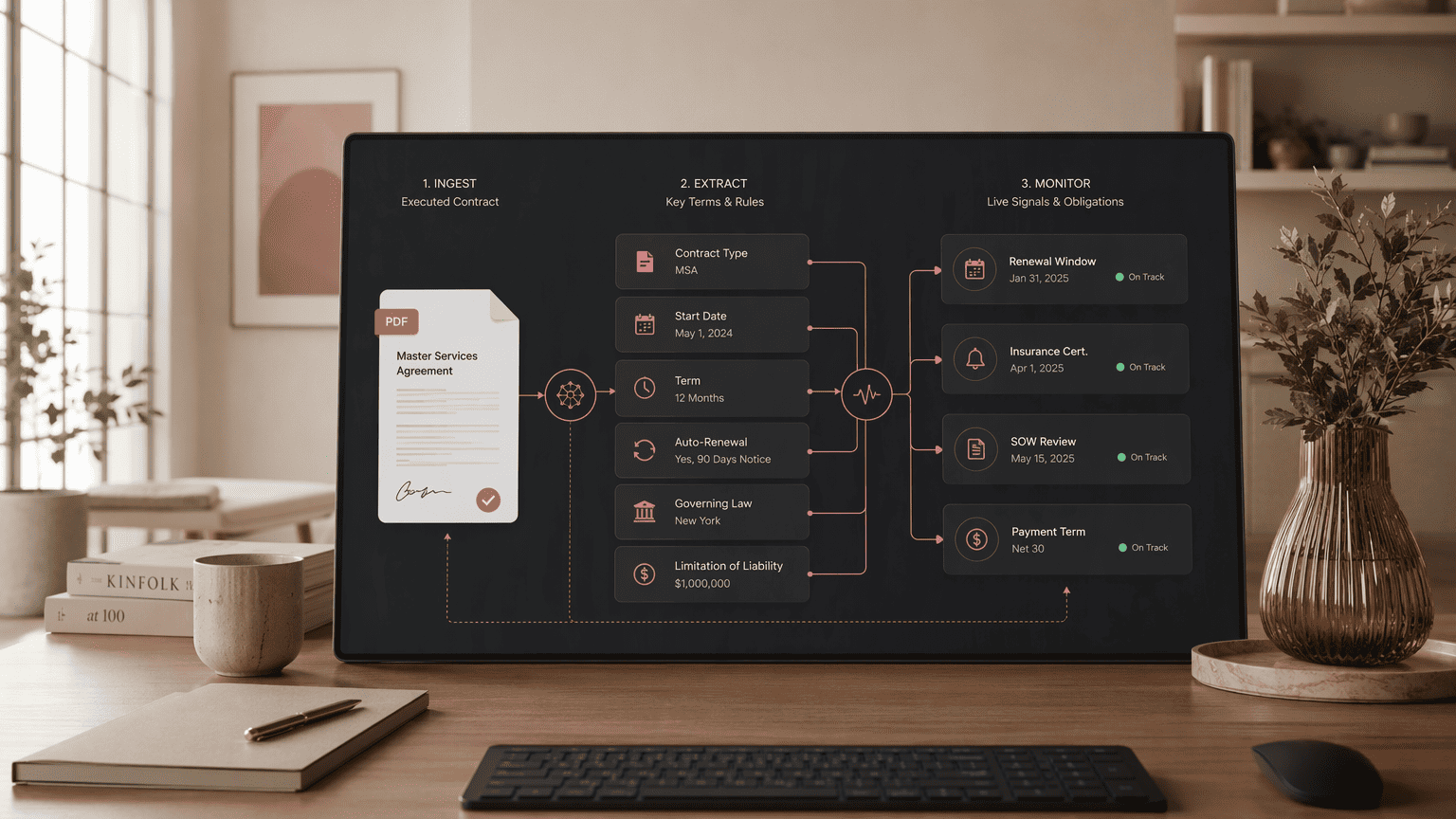
The mechanism is straightforward once you see the architecture. A contract intelligence layer ingests every executed PDF, scans it with a natural language processing engine trained to identify commercial clauses, and extracts structured data: renewal dates, pricing schedules, discount triggers, and billing formulas. This is not a one-time exercise. The software reads each contract as a set of executable rules rather than as a static document, then connects those rules to real-time signals from your calendar, your CRM deal records, and your billing system.
The moment the environment diverges from the contract terms, the engine fires an alert. For example, if a customer’s usage volume crosses a discount threshold specified in Section 3.2 of the MSA, the system flags the billing team to apply the adjusted rate on the next invoice. If a master agreement says prices rise 3% on the first of October and the ERP still shows the old rate on October 5th, finance receives an automated notification. When organizations deploy this type of obligation tracking, they report nearly 99% on-time obligation compliance. The improvement comes from one source: the machine never forgets a date, never misreads a clause, and never gets distracted by the other 40 things a human contract manager is juggling.
From Reactive Audit to Proactive Oversight: The Architectural Shift
The gap between a traditional CLM and an AI-native contract intelligence layer is not a degree of difference, it is a difference in kind.
| Dimension | Traditional CLM | AI-Native Intelligence Layer |
|---|---|---|
| Core Posture | A reactive system of record that stores static documents and locks metadata. | A proactive oversight engine that continuously reads, interprets, and surfaces obligations. |
| Data Handling | Relies on manual data entry into structured fields during implementation. | Ingests unstructured language natively and structures it via machine reading. |
| Risk Detection | Flags pre-defined clause deviations after a human reviewer finds them. | Surfaces hidden risk patterns (missing liability caps, MFN gaps) autonomously across the portfolio. |
| Renewal Management | Sends a calendar notification based on a manually entered date field. | Tracks dynamic triggers (auto-renewal windows, volume thresholds) and alerts you before a deadline passes. |
| Revenue Impact | Passive repository; revenue leakage occurs silently in complex clause logic. | Active value-capture tool; quantifies non-compliance and identifies uncollected entitlements. |
| Implementation Speed | Project measured in quarters, dependent on template harmonization. | Deployment measured in weeks, learning your contracts without perfect upfront taxonomy. |
How Native Intelligence Automatically Aligns Related Agreements

Most contract portfolios are tangled hierarchies of amended terms, appended SLAs, parent MSAs, and purchase orders that modify one another.
When an AI engine uses native cross-agreement alignment, it connects these documents at ingestion. A tool like Contracts.ai, for instance, groups related agreements and aligns shared terms. A price reduction in Amendment 2 won’t get buried by an escalation clause still running from the original MSA. The system surfaces the contradiction to a human operator instead of letting it flow through to billing.
This capability changes the recovery equation because it targets the leakage that traditional, manual-led reviews systematically miss. Organizations that deploy AI-driven oversight for cross-agreement conflict detection report recovering value from agreements they had previously written off as too complex to audit thoroughly.
The Privacy-First Imperative in Contract Analytics
## The Privacy-First Imperative in Contract Analytics
Contract intelligence processes some of the most sensitive documents an enterprise owns. Privacy and security architecture belong on the checklist from day one.
| Dimension | What to Demand | What to Reject |
|---|---|---|
| Tenant Architecture | A strictly single-tenant deployment where your data, models, and processing run in isolation within your virtual private cloud. | Multi-tenant architectures that pool data and compute, creating cross-contamination risk between customers. |
| Model Training Policy | A zero-retention guarantee stating your contracts are never used to train, or improve, foundational models for any other customer. | Vague terms of service that grant a broad, royalty-free license to use submitted content for product improvement. |
| Data Residency | Granular data residency controls allowing you to lock processing and storage to a specific geopolitical jurisdiction. | A global, region-agnostic data lake where you cannot pin location or verify transit paths. |
| Access Control | Attribute-based access controls and data masking that hide dollar amounts or PII from specific users automatically. | A simple binary permission that gives a user full visibility into a contract or blocks them entirely. |
| Compliance Framework | Active SOC 2 Type II reports, HIPAA BAAs, and contractual commitments to EU Model Clauses. | Self-attestations, unreleased reports, or a refusal to incorporate DPAs into the master agreement. |
Key Capabilities: What to Demand in Post-Signature Tools

You can cut through most vendor claims by returning to a short, non-negotiable list of capabilities that directly close the leakage gap. The first three are foundational:
- Automated obligation extraction: reads commercial terms without requiring a human to tag every clause.
- Real-time revenue-risk alerts: connects those extracted terms to a live monitoring engine, surfacing current numbers from systems that change by the hour.
- Native integration with billing and CRM systems: lands the alert inside the tool where the team already works, whether that is Salesforce Billing, NetSuite, or a custom ERP environment.
Three more separate a serious platform from a document-management tool with an AI skin:
- Cross-agreement alignment: prevents an amendment from silently contradicting a master agreement.
- Verifiably privacy-first architecture: keeps your commercial terms from becoming someone else’s training data and enables you to pass security and legal review in weeks, not quarters.
- Audit-trail transparency: makes every alert traceable back to the specific clause and source document that generated it, eliminating the trust gap that kills enterprise adoption.
Deploying Intelligence Without a Rip-and-Replace Migration
One of the biggest misconceptions about AI contract intelligence is that it requires replacing your existing CLM or ERP. The modern deployment model layers directly onto what you already use.
An intelligence engine can ingest PDFs and exports from your current repository without asking you to restructure a decade of contract data. You do not wait for a data-cleansing project to finish.
This means the time-to-value is measured in weeks, not quarters. During a pilot, you point the engine at a subset of high-value contracts and begin surfacing revenue risks almost immediately.
Contracts.ai is built for this approach: the system extracts and structures contract data so it can feed intelligence across finance and procurement workflows. The goal is a rapid pilot that proves the recovery rate, not an 18-month implementation that exhausts organizational patience before it delivers a single dollar of reclaimed revenue.
Structuring the Adoption: From Executive Sponsorship to Phased Rollout

Technology succeeds when the organization is ready. For contract intelligence, readiness begins with a single number: 8.6% of contract value leaking after signature. That figure converts a vague concern into a CFO-visible line item. Your business case models the cost of inaction on your contract portfolio, weighs it against the 1 to 5% recovery rate documented in enterprise deployments, and frames the license cost as a rounding error relative to the reclaimed revenue.
The rollout itself follows a pragmatic sequence:
- Start with a 90-day pilot on the 100 agreements that carry the highest annual spend.
- Measure on-time obligation compliance, missed escalations flagged, and dollar value recovered.
- Publish the results internally and expand departmentally with role-specific dashboards.
Conclusion
Revenue leakage from poorly managed contracts is not a mystery. It is a measurable, structural drain that follows well-documented patterns, and the technology to stop it exists today. The leap from a 9% annual loss to nearly 99% on-time compliance is an architectural decision, not a wish. Your next step is concrete: select one high-value contract portfolio, evaluate a post-signature intelligence tool against the six-capability framework outlined here, and run a pilot that forces the question of how much revenue you are leaving on the table. The answer has a good chance of paying for the investment before the trial period ends.
Frequently Asked Questions
What are the primary causes of revenue leakage from poorly managed customer contracts?
Research from 2026 identifies revenue leaking through four main vectors, with an average erosion figure of 8.6% across organizations (IACCM Benchmark Study):
- Missed auto-renewals that lock in stale pricing
- Untriggered price escalations tied to CPI or annual schedules
- Volume discounts that expire without the billing team noticing
- Inconsistent terms between master agreements and amendments
How does AI-powered contract intelligence software prevent revenue leakage after a contract is signed?
The system ingests executed contracts, uses NLP to extract commercial terms as structured data, then continuously monitors those terms against these real-time triggers:
- Calendar dates
- Usage thresholds
- Billing events
When a deviation occurs, the system fires an alert before the revenue is lost, not months afterward during a manual audit.
What specific capabilities should a buyer look for in a post-signature contract management tool to protect revenue?
Demand six capabilities: automated clause-level obligation extraction, real-time alerts for revenue-risking events, native integration with billing and CRM systems, cross-agreement alignment to detect amendment conflicts, a verifiable privacy-first architecture, and audit-trail transparency that links every alert back to source contract language.
How do you build a business case for investing in contract analytics to close revenue leakage gaps?
Start with the 8.6% leakage benchmark against your annual contract value to quantify the cost of inaction. Model a conservative 1 to 5% recovery rate from AI oversight. Compare that dollar figure against the license cost. A 90-day pilot on your highest-spend contracts provides the internal proof to justify an organization-wide rollout.
What are the key differences between a traditional CLM and an AI-native contract intelligence layer?
Traditional CLMs store static documents for pre-signature workflow; they do not read or monitor commercial terms after execution. An AI-native layer extracts clause-level obligations, watches them in real time, connects related agreements to detect conflicts, and fires proactive alerts, shifting the model from reactive audit to continuous surveillance.
What is the measurable financial impact of deploying AI-driven contract oversight versus manual contract review?
Organizations using AI obligation tracking report nearly 99% on-time obligation compliance and recovery of 1 to 5% of recurring revenue in the first year. Contract administrative costs can drop by 25 to 30%, with large enterprises achieving a 12 to 20% internal rate of return from contract lifecycle management tools (MGI Research).
Sources
- Reducing Contract Value Leakage in Financial Services 2026 – Sirion – www.sirion.ai
- Realize the Full Value of Every Contract with Contract Intelligence – engage.icertis.com