








Introduction
Your AP team just processed 300 invoices this week. Somewhere in that stack, a line item for $4,200 should have been $3,980 under the Q3 volume discount. A separate invoice is a near-exact duplicate of one paid 14 days ago.
And a third lacks the documentation your own policy requires.
It never does. The average company loses roughly $431,000 annually to manual invoice processing inefficiencies alone.
The category of tools that solves this is automated contract-compliant auditing. These are AI-powered systems that read every invoice line, pull the corresponding contract terms, and flag every discrepancy before money leaves your account.
One production system, the SimplAI Validation Agent, already delivers 99.90% accuracy on this exact task. This article breaks down how the technology works, the ROI finance leaders are reporting, and what it takes to implement it inside a real enterprise.
Key Takeaways
Five conclusions that matter most to a finance or procurement executive evaluating this category:
- Tools exist in production today: AI agents cross-reference invoice line items against executed contracts, rate cards, and statements of work, flagging discrepancies before payment.
- Core accuracy is enterprise-grade: AI extraction hits 99.5% accuracy on any invoice format, and end-to-end validation reaches 99.90% when matching against contract terms.
- Hard dollars come back fast: Documented recoveries include $156,000 from duplicate payment prevention and $245,000 in penalty avoidance; organizations commonly recapture 8% or more in cost leakage.
- No rip-and-replace required: The intelligence-layer approach integrates with existing systems like SAP Ariba, Coupa, NetSuite, and QuickBooks.
- The financial case is settled: 80 to 90% processing cost reduction, 95%+ cycle time improvement, and error rates below 0.5% make the ROI argument straightforward.
The Direct Answer: Yes, Automated Contract-Compliant Invoice Auditing Exists
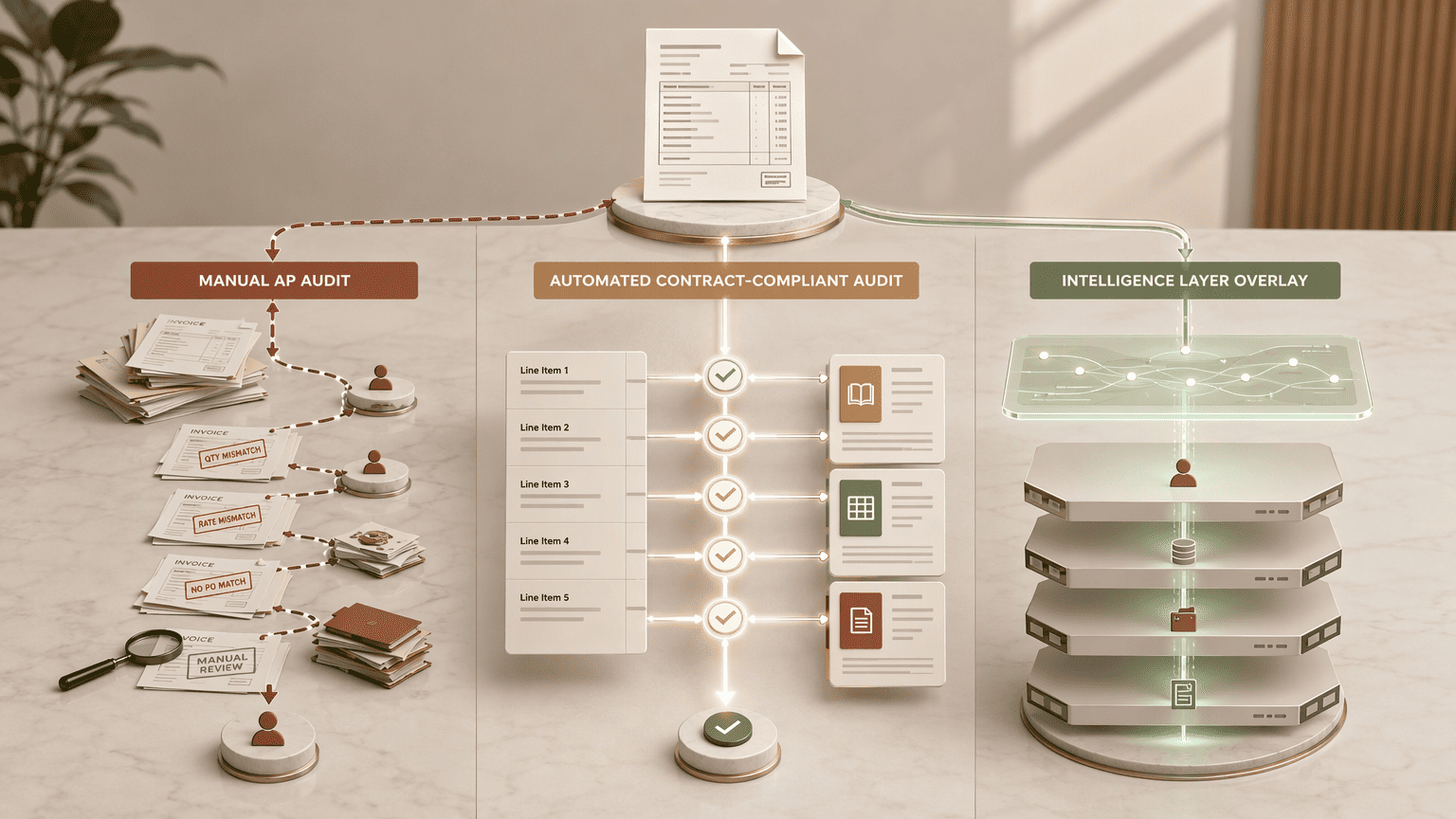
You do not need to wonder whether software can do this. It already does. That time disappears when every line item gets checked against the actual contract, rate card, and SOW automatically.
Below is a side-by-side view of how automated contract-compliant auditing compares to the manual processes most AP teams run today, and to an intelligence-layer overlay that augments your current systems.
| Dimension | Manual AP Audit | Automated Contract-Compliant Audit | Intelligence-Layer Overlay (e.g. Contracts.ai) |
|---|---|---|---|
| Line-item-to-contract matching | Sampled; relies on reviewer memory of contract terms | Every line checked against the executed contract, rate card, and SOW | Every line checked; contract library queried in real time |
| Duplicate detection | Catches obvious duplicates; misses near-matches and varied formats | Three-way matching across POs, receipts, and contract terms flags every variant | Same three-way matching, applied inside your existing systems |
| Error rate | Varies widely; misses the $12.4 million in missed cash discounts that a GAO review identified from one audit | Below 0.5% | Below 0.5% |
What Drives the Need for Automated Invoice-to-Contract Auditing
Post-signature contract management is the step most organizations simply abandon. The agreement gets filed, procurement moves on, and AP pays whatever shows up. The vendor’s invoice becomes the de facto source of truth, while the actual contract terms sit unread in a shared drive.
That gap is expensive. A GAO report examining recovery auditing found that of $19.1 million in identified overpayments, a staggering $12.4 million was related to cash discounts not taken, received, or deducted at the wrong rate. That figure represents pure margin erosion on contracts the company already negotiated and won.
The complexity of modern supplier agreements deepens the problem. A single vendor relationship might span a master services agreement, three amendments, a rate card updated annually, and a project-specific SOW with its own billing rules. No AP clerk can hold all of that in their head across hundreds of invoices per month.
The result is systematic leakage: overcharges go undetected, duplicate payments slip through, and early payment discounts expire unclaimed. One manufacturer lost 15 staff hours per week to manual verification and still incurred $245,000 in penalties before automation intervened. Your organization is almost certainly leaving money on the table in the same way.
How the Technology Works: From Data Extraction to Three-Way Matching

The process starts with AI data extraction. The system ingests invoices in any format, from emailed PDFs to EDI transmissions, and pulls structured line-item data at 99.5% accuracy.
Next, the AI parses the contract library. It does not search keywords. It reads full contract text, identifies rate tables, volume discount thresholds, payment terms, and scope definitions, and aligns them to the corresponding vendor record. A tool like Contracts.ai approaches this by grouping related agreements and aligning shared terms, so the system knows which version of which rate card governs the invoice in front of it.
Then the engine performs automated three-way matching. It cross-references the invoice against the purchase order and the goods receipt, and then layers the contract terms on top. A unit price that exceeds the contracted rate gets flagged.
A volume discount the vendor failed to apply triggers an alert. A line item for out-of-scope work gets routed to the contract owner for approval. The core recovery auditing methodology formalized by firms like Profit Recovery Group International decades ago, examine data with software to identify missed discounts, price discrepancies, and duplicate payments, is now fully automated and continuous, not a periodic consultant engagement.
Navigating Complexity: Handling Tiered Pricing, Multi-Year Agreements, and SOWs

Skeptics ask one question first: what about the complicated stuff? The answer is that today’s AI agents are built to handle exactly the contract structures that break manual processes.
Take tiered volume pricing. A contract might set a unit rate at $120 for the first 10,000 units, dropping to $98 once that threshold is crossed within the fiscal year. A human reviewer sees an invoice for $120 per unit in month four and approves it. The AI agent sees cumulative volume across prior invoices, identifies that the threshold was crossed in month three, and flags that month four should be billed at $98. It does this across multiple invoices, multiple months, and multiple tiers simultaneously.
Multi-year agreements with annual escalation clauses, mid-term amendments, and overlapping SOWs pose an even harder challenge. The system reads each amendment in sequence and understands which clauses have been superseded. An AI agent performing 49 or more contract checks that ordinary AP automation does not perform, the kind of validation AllCaps describes as catching the $515,227 in errors that typical AP tools miss across just 30 real invoices, is no longer a theoretical capability. It is production software.
Underlying all of this is the AI’s core capability: reading full contract text in context and connecting it to the financial transaction. Contracts.ai was built on the premise that contract data should structure and activate operational processes, not sit in static storage. That activation, applied to invoicing, turns a compliance checklist into a real-time financial control.
The Enterprise Choice: Rip-and-Replace Platforms vs. an Intelligence-Layer Overlay

You now face a procurement decision of your own. One path: a full-suite platform that replaces your current ERP and procurement tools outright. The friction here is enormous.
The alternative path is an intelligence-layer overlay. This approach sits on top of your existing systems and does the one thing they cannot: read contracts and enforce their terms at the invoice level. You keep your current AP workflow inside NetSuite, Coupa, or SAP Ariba. The layer intercepts invoices, performs the contract validation, and returns the results.
The practical advantage is speed. An overlay deploys without migration and without retraining your AP team on a new platform. You can run a pilot against a limited contract set to prove the ROI before expanding. A Contracts.ai deployment follows this model, ingesting executed agreements and applying structured intelligence on top of the procurement infrastructure you already have. That is the difference between a six-month implementation and a six-week one.
The overlay path also preserves the integrations your finance stack depends on. Native compatibility with SAP Ariba, Coupa, NetSuite, and QuickBooks means the audit intelligence flows into the screens your AP team already uses. The technology layer changes. The user experience does not.
Calculating the Business Case: Quantifiable ROI, Time Savings, and Error Reduction
Build the model around three hard-dollar buckets.
- Processing cost. Leading organizations report invoice processing cost reductions of 80 to 90 percent. A team that spends $250,000 annually on AP labor, overhead, and exception handling can cut that to roughly $50,000. The savings materialize within the first full quarter after go-live.
- Leakage recapture. A healthcare network achieved a 98 percent reduction in billing errors and recovered $156,000 through duplicate payment prevention alone. A manufacturing facility that automated its review captured early payment discounts on 82 percent of invoices, up from 8 percent, while preventing $245,000 in annual penalties. Across an enterprise portfolio, recapturing 8 percent or more in cost leakage can translate to mid-six-figure annual recoveries even at modest invoice volumes. Those recoveries come from overcharges, missed discounts, and duplicate payments.
- Cycle time. Invoices that once took weeks to approve now clear in roughly 24 hours, unlocking early payment discounts that previously expired before anyone looked at the bill. Error rates drop below 0.5 percent. The combined effect turns AP from a cost center into a financial control function that actively protects margin.
The Operational Blueprint for Audit-Ready Post-Signature Compliance
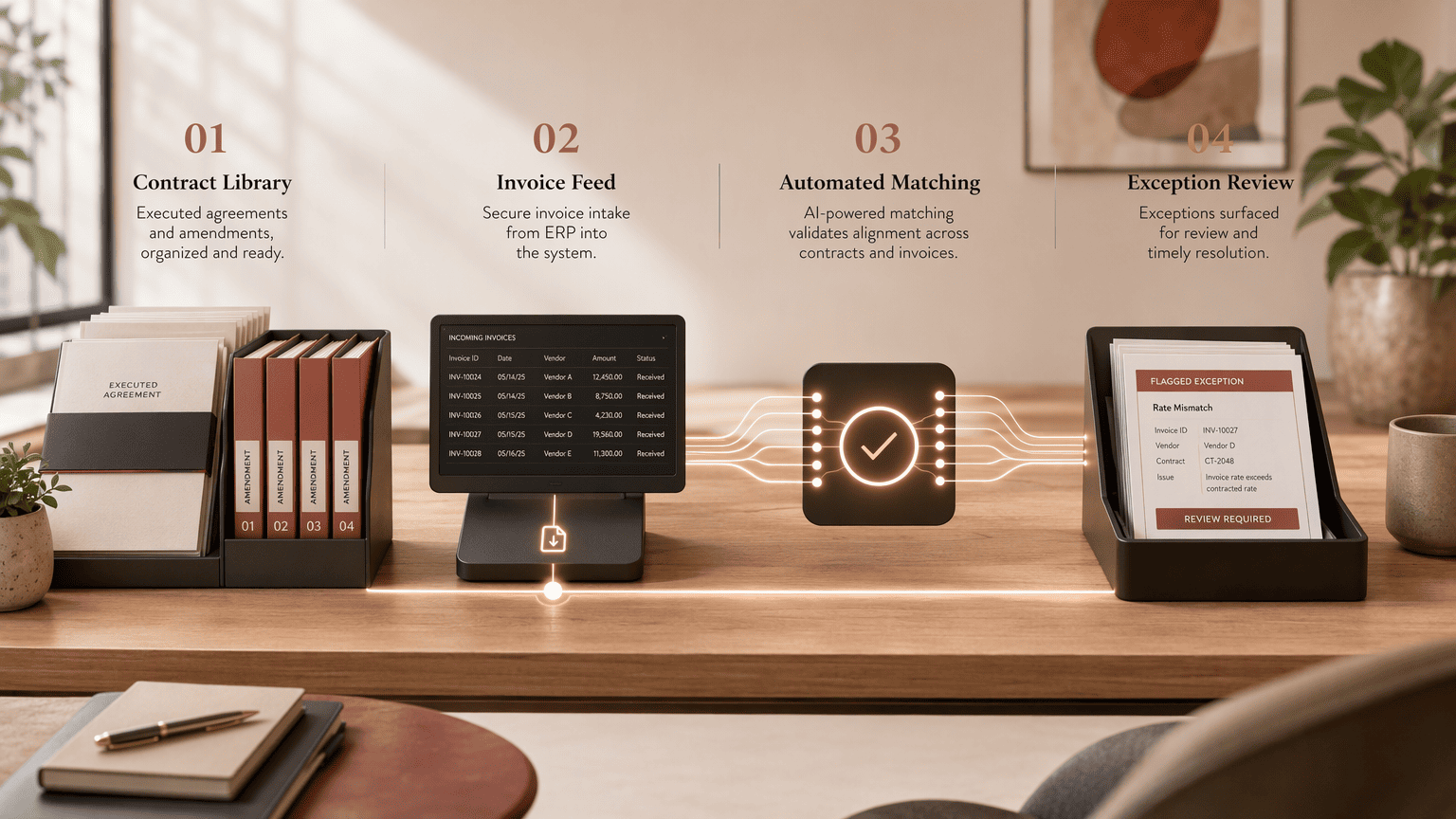
Moving from manual chaos to continuous, automated compliance follows a repeatable sequence. Here is the operational path:
- Achieve data hygiene on the contract side: Ingest every executed agreement into a searchable contract library. Resolve version conflicts and align amendments to their parent agreements. The AI needs clean source material before it can validate invoices against terms.
- Connect the invoice feed: Integrate the AI layer with your AP or ERP system, whether that is SAP Ariba, Coupa, NetSuite, or QuickBooks. The goal is real-time invoice intercept as each invoice arrives.
- Configure validation rules against the contract library: Map each vendor record to its governing contracts, rate cards, and SOWs. Define the checks that matter: contracted rates, volume discount thresholds, scope compliance, duplicate detection, and required supporting documentation.
- Route flagged discrepancies to the contract owner with the specific contract clause and the invoice line item shown side by side. Set escalation paths for disputes that stall.
- Shift the team’s role from data entry to strategic analysis: When approval times drop to roughly 24 hours and errors fall below 0.5 percent, your AP staff stops keying data and starts managing vendor performance, negotiating payment terms, and analyzing leakage patterns. The tool handles the audit. The team handles the relationships.
Conclusion
The tools exist and they work. Organizations using AI invoice-to-contract validation are recapturing 8 percent or more in cost leakage that manual processes simply miss, with matching accuracy reaching 99.90 percent. The technology operates at enterprise scale now. An intelligence-layer model means you reach that capability without a full platform migration.
The remaining barrier is organizational will, not a gap in the tooling.
Frame the conversation internally as a financial control imperative. Put it in terms the CFO already cares about: every invoice paid without validation is a decision to leave negotiated savings on the table. This is how post-signature contract compliance shifts from a once-a-quarter hope into a continuously audited, margin-protecting reality.
Frequently Asked Questions
How do automated vendor invoice audit tools work to compare invoices against contract terms?
They follow a three-step sequence. First, AI extraction pulls structured line-item data from any invoice format at 99.5% accuracy. Second, the system parses your contract library digitally, reading rate cards, discount thresholds, and scope definitions in full context instead of keyword-searching. Third, it cross-references every invoice line against the purchase order, the goods receipt, and the specific contract provisions, flagging discrepancies such as non-contracted rates or unapplied volume discounts before payment runs.
What features should enterprises look for in a tool that automatically audits vendor invoices?
Look for line-item-to-contract matching that handles the full range of pricing structures: tiered volume discounts, multi-year escalation clauses, and SOW-specific billing rules. Require three-way matching across invoices, POs, and receipts. Confirm native integration with your current ERP or procurement platform so no replacement is required. Prioritize tools that route flagged exceptions to the contract owner with the source language attached, not just an error code, so your team can resolve disputes quickly.
Can AI-powered contract intelligence platforms reduce overpayments and billing errors from vendors?
Yes, and the documented recoveries are substantial. A healthcare network achieved a 98% reduction in billing errors and recovered $156,000 in duplicate payments. One manufacturer prevented $245,000 in annual penalties and boosted early payment discount capture from 8% to 82% of invoices. Organizations commonly recapture 8% or more in cost leakage once every invoice is systematically validated against the executed contract rather than paid as-submitted.
How does invoice auditing software handle complex pricing structures or multi-year agreements?
The AI reads agreements in full context, tracking amendments and escalations across the life of the contract. For tiered pricing, it calculates cumulative volume across multiple prior invoices and checks whether the correct rate was applied when a threshold was crossed. For multi-year agreements with annual rate changes and mid-term amendments, the system understands which clauses are current and which have been superseded, validating each invoice against the governing version of the contract.
What is the typical ROI or cost savings from automating vendor invoice audits?
Leading organizations report invoice processing cost reductions of 80 to 90 percent and cycle time improvements of 95 percent or more. Error rates drop below 0.5 percent. Hard-dollar recoveries come from three sources: recaptured cost leakage from overcharges and missed discounts (commonly 8% or more), prevented duplicate payments, and early payment discounts captured on a far higher percentage of invoices once approvals clear in roughly 24 hours instead of weeks.
Does using an AI layer for invoice reconciliation require replacing existing ERP or procurement systems?
No. An intelligence-layer overlay integrates with your current systems, including SAP Ariba, Coupa, NetSuite, and QuickBooks, without a rip-and-replace migration. The AI intercepts invoices, performs contract validation, and returns results into the screens your AP team already uses. You can run a pilot against a limited contract set to prove ROI before expanding, with no platform disruption during the evaluation.
Sources
- Invoice & Contract Validation Agent – simplai.ai – simplai.ai
- Audit Every Vendor Invoice Against the Contract | AllCaps – www.allcaps.ai
- [PDF] NSIAD-99-12 Contract Management: Recovery Auditing Offers Potential to Identify Overpayments – Government Accountability Office (GAO) – www.gao.gov
- AI Invoice Processing Solutions – Automated AP | Ademero – www.ademero.com






