







Introduction
A stack of 400 supplier invoices lands on your AP team’s desk Monday morning. Somewhere in that pile, a long-term vendor billed you $0.47 per unit on a deal you negotiated at $0.39. Another kept charging a freight surcharge that expired last quarter. Nobody catches either one until the quarterly variance report, and by then you have funded three months of overbilling.
The Association for Financial Professionals has found that organizations implementing automated AP solutions recover significant leakage, yet most enterprises still rely on a manual spot-check of perhaps 5 to 10 percent of invoices. An audit sample that thin misses nearly everything.
A crop of AI-powered audit tools built specifically for the post-signature world changes the math. Platforms like Joya and PostSig compare billed line items against the actual contract terms, rate cards, and quotes that govern them, flagging dollar differences before they stack up across billing cycles. This article walks through how automated invoice-to-contract auditing works, why spreadsheets leave recoverable cash on the table, and what matters when you evaluate a tool for your procurement stack.
Key Takeaways
Here is what you need to know before evaluating an automated audit solution:
- Automated invoice-to-contract auditing: Software that reads vendor invoices and the source agreements, then flags mismatches in rates, units, discounts, and terms before the next payment cycle.
- Hidden overpayments are the norm: Small errors recur monthly across dozens of suppliers; manual spot-checks catch only a fraction, leaving meaningful dollars unrecovered.
- AI extracts and normalizes terms: Natural language processing and large language models pull structured data from PDFs, Word files, and spreadsheets, enabling fuzzy matching even when line-item descriptions do not align exactly.
- Integration does not require a rip-and-replace: Leading tools read native file exports or email forwards, so you can pilot audit intelligence without touching your ERP.
- Privacy architecture is a buying criterion: How a vendor handles sensitive rate cards, processing location, retention, encryption, and model-training policy, should be scrutinized before procurement signs off.
- The feature checklist is concrete: Multi-document analysis, rate card extraction, automated discrepancy reports, contract memory, role-based access, and a complete audit trail are the table stakes for enterprise readiness.
What Automated Invoice-to-Contract Auditing Actually Is
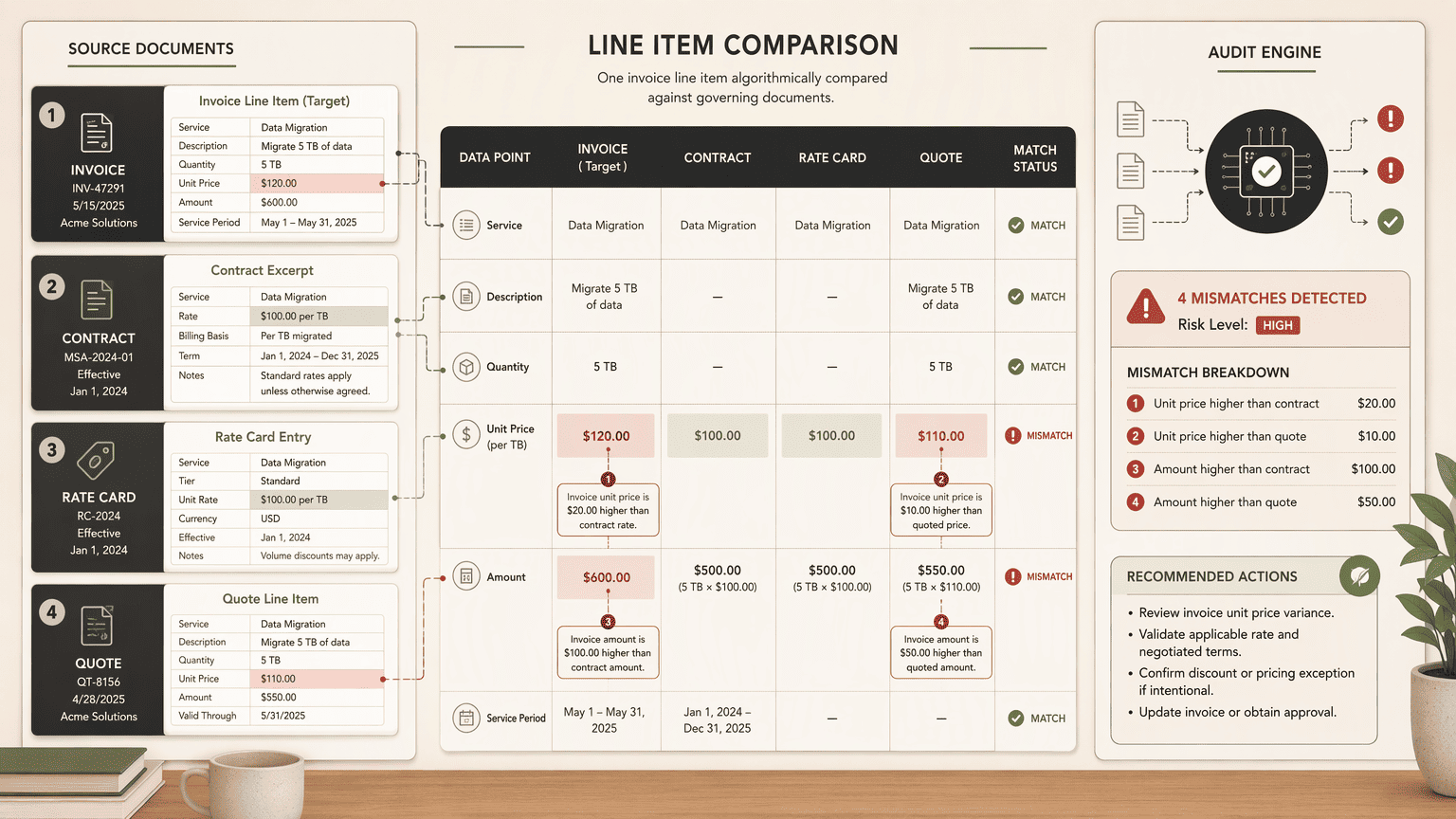
Automated invoice-to-contract auditing is the practice of using software to algorithmically compare each line item on a vendor invoice against the corresponding commitments in the source contract, rate card, or quote, then flagging every deviation. It is a distinct discipline from classic AP automation, which optimizes capture and approval routing, and from OCR-only tools, which extract text without understanding commercial context.
| Capability | Invoice-to-Contract Audit Tool | Traditional AP Automation |
|---|---|---|
| Core function | Matches billed line items to negotiated terms and flags gaps | Digitizes invoice capture and routes approvals |
| Document scope | Invoice plus the governing contract, rate card, or quote | Invoice only (sometimes matched to a PO) |
| Detection logic | Rate discrepancies, missing discounts, expired terms, duplicate charges | Duplicate invoice numbers, math errors, approval violations |
| Technology foundation | NLP, LLMs, and fuzzy matching trained on commercial documents | Template-based OCR and workflow rules |
| Primary buyer | Procurement, legal operations, and finance governance | AP shared services and finance operations |
Joya, for instance, checks your invoices against your contracts, rate cards, and quotes, flagging what does not match. PostSig approaches the problem from the legal side, translating contract clauses into executable compliance checks that stay live across the agreement’s life. Both depart from the capture-and-file model that dominates AP software.
Why Spreadsheets and Spot-Checks Leave Money on the Table
The arithmetic is unforgiving. A $200 monthly overcharge on a facilities management contract, unnoticed for 18 months, becomes $3,600 in pure leakage. Now multiply that by the 400 active suppliers in a typical mid-market procurement portfolio. Even a skilled analyst working inside a spreadsheet cannot perform a full contract-to-invoice reconciliation at that scale; the best they can do is sample high-dollar invoices and hope the small ones are clean.
IOFM benchmarks have pegged the fully loaded cost of manually processing a single invoice at several dollars, a figure that balloons when you add the rework triggered by a disputed line item. The real risk, however, is the invoice you never dispute because the error was invisible. Contract terms evolve across amendments, yet the AP team often works from the version saved at onboarding. When a discount tier expires or a pricing floor shifts, the spreadsheet audit simply cannot know.
Two control gaps cascade from this disconnect: version confusion across amendments and an audit gap because manual reviews leave no structured trail. Each gap is a quiet permission for overpayment.
Auditoria’s SmartBots, which automate data extraction from vendor invoices and check lines against purchase orders and contracts, address exactly this fragmentation. But a bot is only as good as the source of truth it references, and in most organizations the contract repository itself is the weak link.
How AI Extracts, Normalizes, and Matches Terms Across Documents
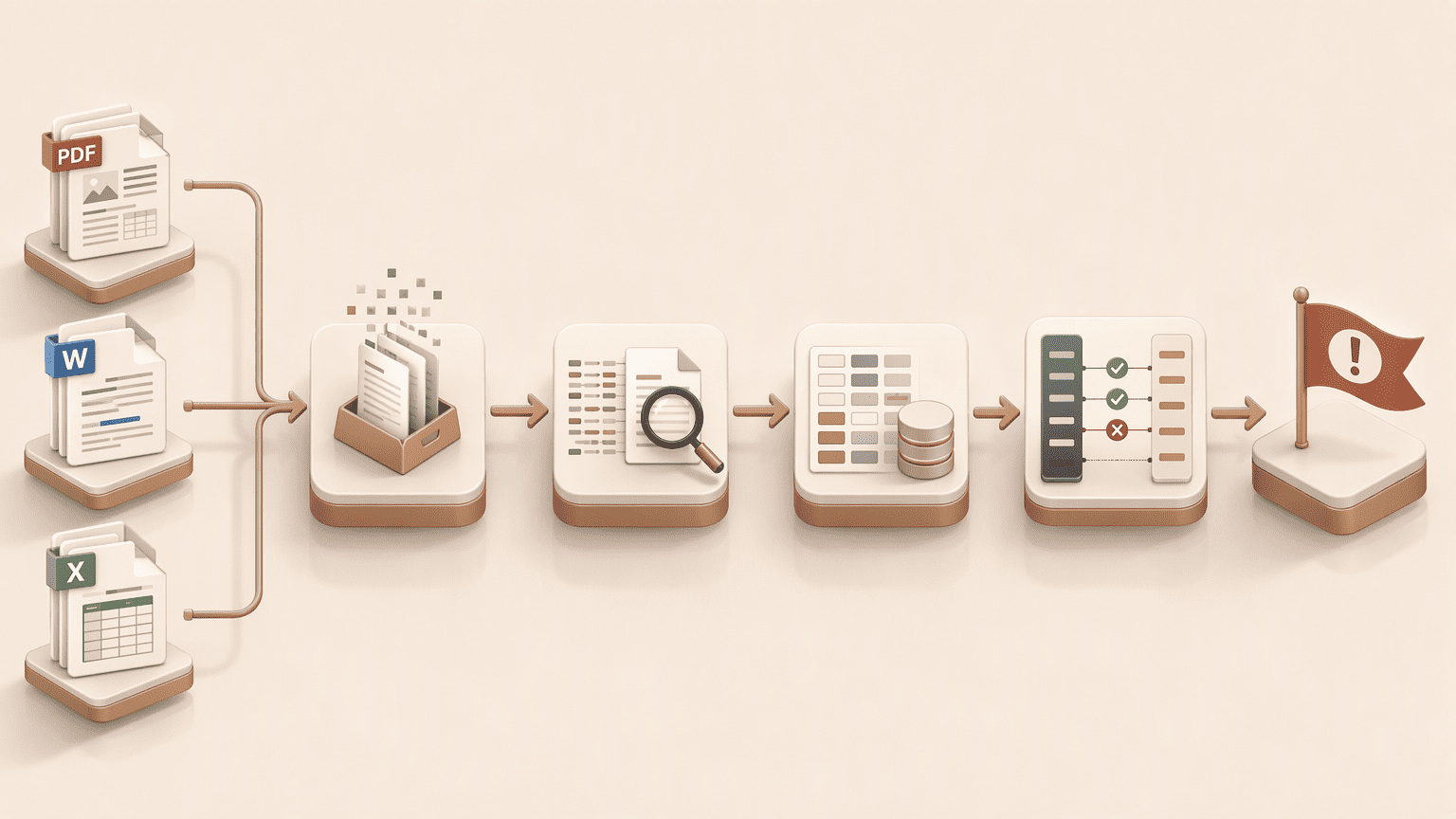
The workflow operates as a pipeline. Documents arrive as PDFs, Word files, or Excel sheets, and the AI ingests them without requiring a fixed template. Joya, for example, reads content from whatever export your systems already produce, accepting PDFs up to 100 pages and Office files up to 15 MB. The ingestion layer is format-agnostic, which is critical when supplier documentation arrives in wildly inconsistent layouts.
| Stage | What happens | Technology in play |
|---|---|---|
| Ingestion | PDF, Word, and Excel files are parsed natively; no template or EDI mapping is required. | Document parsing, OCR fallback for image-based PDFs |
| Entity extraction | The AI identifies rates, tiers, dates, SKUs, discount schedules, and obligation clauses. | NLP and LLM-based extraction (transformer models, not regex) |
| Normalization | Extracted terms are mapped into a structured schema (e.g., “unit price,” “effective date,” “volume band”). | Schema mapping, unit standardization, currency normalization |
| Fuzzy matching | Billed line items are aligned with contract clauses even when descriptions differ. | Embedding-based similarity, confidence scoring |
| Discrepancy flagging | Mismatched rates, missing volume discounts, and expired terms are surfaced. | Rules engine plus AI-driven anomaly detection |
This triage is what lets the system scale across thousands of invoices without overwhelming the AP team in false positives.
Post-Signature Compliance: From Filed-Away PDF to Active Guardrail
Most contracts, once signed, become dormant artifacts. PostSig turns them into live compliance instruments, translating legal clauses into laymen’s terminology for consistent application of contract requirements and terms. A procurement manager sees that a volume rebate clause has been triggered or a service-level penalty should have been applied this quarter, without parsing legalese.
The tool maintains “contract memory,” so an amendment that changes a rate or extends a term updates every compliance check downstream. The next invoice gets measured against the amended language. Esker’s platform connects contract terms with invoice schedules, payment terms, and supplier commitments so AP can process contract-based invoices with better context. The result is a continuous audit loop that replaces the annual reconciliation scramble.
Integration Without the Rip-and-Replace: The Overlay Model

The most common objection to deploying an AI audit tool is the perceived need to integrate with a legacy ERP. That fear is often unfounded. Joya sidesteps the issue entirely: no integration is required. You upload whatever export your systems already produce, and the platform reads the content directly.
For organizations that want a deeper connection, PostSig offers an API-based architecture that plugs into finance and procurement stacks. But the overlay model delivers the fastest time-to-value. The platform reads native file exports, email forwards, or SFTP drops and turns a multi-quarter IT project into a pilot you can stand up with a limited contract set, without migrating the full repository or disrupting existing workflows. A platform like Contracts.ai functions as an intelligence layer that shares structured data across finance and procurement from the contracts you already have. That architecture matters when you are trying to prove value in weeks, not fiscal years.
Data Privacy Architecture as a Market Differentiator

Invoice audit tools sit on an extraordinarily sensitive data set: supplier pricing, volume commitments, and negotiated terms that represent a company’s commercial edge. How a vendor handles that data is a frontline buying criterion.
PostSig surfaces this transparently, offering HIPAA and SOC 2-compliant secure contract storage, with data at rest encrypted using AES-256 and data in transit via TLS. Joya takes a data-minimization approach, processing original files and discarding them after use, keeping only the extracted contract terms required to flag changes. The two approaches reflect a real strategic split: retain the full document under lock and key, or hold only the structured fingerprint and delete the rest. For enterprises evaluating any platform in this category, the privacy due diligence list should include the location of data processing, data retention and deletion policies, whether customer contract data is used to train or improve generalized models, and encryption standards for PHI and structured contract fields. A vendor that cannot produce clear answers on these points before you sign is unlikely to satisfy your security team after deployment.
The Enterprise Feature Checklist for Invoice Audit Tools
When you sit down to compare platforms, bring this checklist. It turns vague promises of “AI-powered auditing” into a structured evaluation you can run against any vendor.
- Multi-document analysis: The platform must compare a single invoice against the relevant contract, rate card, quote, and any active amendments simultaneously. A basic one-to-one document match misses too many overcharges.
- Rate card extraction and versioning: It should extract tiered pricing, volume discounts, and effective date ranges, then track changes across rate card versions so expired terms do not appear as the baseline.
- Automated discrepancy reporting: Flag mismatches in rates, quantities, missing discounts, and duplicate charges in a structured report. Each finding should link back to the source contract language for validation.
- Contract memory and amendment tracking: The system must maintain a current-state view of the agreement, absorbing amendments and renewals so compliance checks reference the latest terms.
- Repeatable workflow scheduling: Audit runs should recur against your billing cycles. If you have to remember to kick off every run manually, the tool will collect dust.
- Granular role-based access: Finance, procurement, and legal need different views; the tool should support least-privilege access that limits visibility into sensitive rate structures.
- Multi-currency and multi-entity handling: If you operate across geographies, the platform must normalize currencies and apply the correct entity’s contract terms.
Comparing Deployment Approaches and Pricing Models

Deployment models split broadly into overlay SaaS and API-deep platforms. An overlay tool such as Joya reads native file exports and requires no system integration. An API-deep platform like PostSig or Auditoria embeds the audit logic directly into your finance stack, which demands a heavier initial implementation.
Pricing follows the same logic. Overlay tools tend toward per-invoice or per-supplier pricing that scales with usage; API-deep platforms often charge a platform subscription aligned to contract volume or seat count. If you run a pilot with a limited contract set on an overlay tool, you can benchmark the financial recovery potential without committing to a long-term platform contract. That evidence base then justifies the deeper integration conversation when the numbers show it is worth the lift.
Conclusion
Sampling a thin slice of invoices against an outdated paper contract isn’t a control you can defend anymore. An automated audit reads every invoice against the live contract terms as a continuous compliance guardrail. It catches the small, recurring errors that compound into real leakage.
Start with an overlay pilot on a defined set of suppliers. Measure the dollars recovered against the cost of the tool, and let that data drive the integration conversation. The technology is here. The question is whether your team is still overpaying while evaluating it.
Frequently Asked Questions
How do automated vendor invoice auditing tools work and what technologies do they use?
Contract audit platforms follow a standard workflow with two core stages:
- Ingestion and extraction: the platform ingests invoices and contracts as PDF, Word, or Excel files, then uses NLP and LLM-based extraction to pull out rates, units, dates, and terms.
- Matching and triage: a fuzzy matching engine aligns billed line items to contract clauses, and a confidence-scored triage flags high-confidence discrepancies automatically.
3.
What are the key benefits of using software to automatically audit invoices against contract terms?
It catches hidden overpayments from incorrect rates, expired discounts, and duplicate charges that manual spot-checks miss. It also builds contract memory so amendments and renewals are reflected in every audit run, turning a periodic sampling exercise into continuous, structured compliance monitoring.
What features should enterprises look for in a contract-to-invoice reconciliation solution?
Multi-document analysis, rate card extraction, automated discrepancy reports linked to source language, contract memory for amendments, schedulable audit workflows, granular role-based access, multi-currency handling, and an immutable audit trail are the enterprise table stakes.
How does AI-powered contract intelligence improve post-signature invoice compliance?
It translates dormant legal clauses into active, executable checks that run against every invoice. When a contract is amended, the compliance rules update automatically so the next billing cycle is measured against the current terms, not the original signed PDF.
What are the common challenges or limitations when deploying automated invoice audit tools?
The biggest hurdle is feeding the tool a clean source of truth for current contract terms. AI-dependent platforms need clear policies on model training against customer data. Bespoke contract language and inconsistent supplier invoice formats can also reduce extraction accuracy.
How do automated auditing platforms integrate with existing ERP and procurement systems?
Many tools use an overlay model that reads native file exports, email forwards, or SFTP drops without any ERP integration. Others offer API-based connections for deeper embedding. The overlay approach lets you pilot the technology without touching your back-end systems.
Sources
- Joya — Contract and invoice intelligence – joyacheck.com
- Post-Signature Contract Intelligence for Legal Teams | PostSig – postsig.com
- [PDF] AP Invoices – Come See Auditoria.AI at Workday Rising 2022 – info.auditoria.ai
- B2B Contract Management Automation Software | Esker – www.esker.com