







Introduction
Your sales rep can tell you, to the dollar, how much you spent year-to-date, which tier you are in, and exactly what rebate they have booked against your account. They see it on a live dashboard. Meanwhile, your procurement team is likely pulling last quarter’s spreadsheet.
This is not a technology gap. Your ERP already holds every purchase order and invoice needed for the mirror image.
What is missing is the interpretation layer that matches contract terms to transactions continuously. Across a hundred suppliers, that quiet, cumulative oversight is where the 3 to 7% margin gap between best-in-class and the middle of the market actually lives.
Closing that gap does not require ripping out existing systems. It requires a specialized intelligence layer that extracts key commercial terms from your executed agreements and checks them against the live transaction stream day by day. This seven-step framework shows how to build that capability.
Key Takeaways
A six-figure rebate capture, a tier unlocked mid-year, and a renewal backed by indisputable data, these are the outcomes of closing the information asymmetry.
- Discount leakage is a margin problem, not a process problem: The 3 to 7% margin differential separating procurement leaders from the average stems from entitlements that expire without being claimed.
- The technology layer sits on top of your ERP, not in place of it: Contract performance management tools extract structured terms and match them against live transaction feeds, without changing your AP infrastructure.
- Real-time data shifts the negotiating dynamic: When you arrive at renewal holding the same compliance data your supplier uses, multi-year agreements command an extra 2 to 3 percentage points of discount.
- Portfolio-wide anomaly detection scales without headcount: AI models scan all 100+ vendor relationships continuously for missed tiers and pricing anomalies, replacing sample-based auditing with continuous coverage.
Step 1: Quantify the Discount Leakage, The Data Asymmetry That’s Costing Margin Points

Before automating anything, put a dollar figure on the gap. Start with your top ten vendor contracts. For each, pull the negotiated tier rates, rebate formulas, and bonus triggers from the executed agreement.
Then pull twelve months of actual invoices from your ERP. The spread between what the contract says and what the invoices reflect is your leakage number. In SaaS categories, that leakage has accelerated: the average negotiated discount fell to 7% in Q2 2023, down from 11% a year earlier, even as best-prepared buyers land 20 to 35% below list price.
Every point of that spread represents a supplier’s real-time account view winning over your quarterly reconciliation cycle. The gap is biggest in consumption-based categories, where unit economics swing 20 to 40% depending on how sharply terms are enforced.
Step 2: Digitize and Structure Your Contract Portfolio for Computability
A static PDF in a shared drive cannot be matched against an invoice. You need machine-readable terms.
This is distinct from what a broad contract lifecycle management platform delivers. A CLM handles approvals and the central repository. An intelligence layer like Contracts.ai does the harder work: it pulls out the specific commercial levers (tier thresholds, rebate rates, MDF balances, bonus triggers, claim-window deadlines) and turns them into computable fields a matching engine can actually read.
- Pull the top 20 supplier agreements: Start where annual spend and discount complexity are highest.
- Extract structured fields: Capture exact tier thresholds (dollar amounts), rebate percentages, and the conditions that trigger them.
- Standardize the taxonomy: Normalize payment-term language. “Net 30” and “due in 30 days” must resolve to the same computable rule.
- Validate against source language: Link every structured field back to the original clause so audit can verify it.
- Load into the intelligence platform: Feed the structured data into the CPM layer, which becomes the matching engine against live ERP transactions.
Step 3: Connect the Live ERP Transaction Stream to an Intelligence Layer

Your ERP already streams every purchase order and invoice. The CPM layer consumes that feed and runs each transaction against the structured contract terms you loaded in Step 2. When an invoice lands, the engine checks it against the contracted pricing table, flags discrepancies, and, for payments where discounts apply, can automatically deduct the discount if the invoice is within terms.
This architecture sits on top of the systems you already operate. Oracle’s AP tools, for example, display discounts in a dedicated column and route net-of-discount payments to accounting interfaces. A contract intelligence layer adds the logic that determines whether that discount should be applied.
It matches the specific tier, rebate, and claim-window rules from your digitized portfolio. The goal is not a new ERP. The goal is a live mirror of the view your supplier already has.
Step 4: Implement a Threshold-Awareness Dashboard for Proactive Tier Management
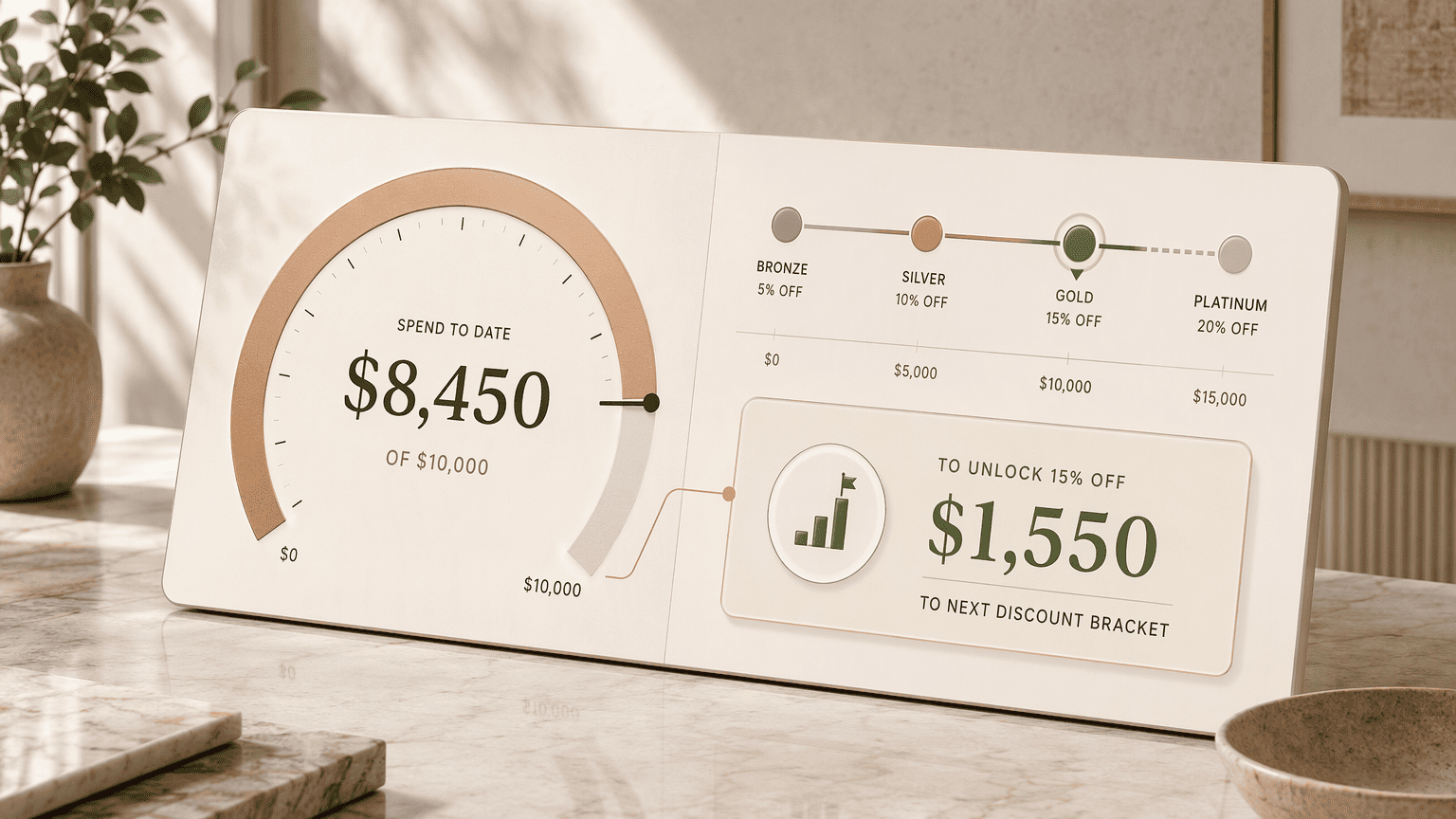
Your dashboard needs to show the exact dollar gap to the next tier. Your supplier’s system already calculates this in real time.
| Dashboard Element | Your View | Supplier’s View |
|---|---|---|
| Tier Gap Metric | Aggregate spend-to-date across all business units, displayed as a single dollar figure remaining until the next discount bracket is reached | Real-time spend ingestion from all purchase orders, automatically segmented by contract hierarchy to protect margin on every transaction |
| Forecasted Tier Attainment | Projected attainment date based on current run-rate, with a confidence band that adjusts as quarterly buying patterns shift | Probability-weighted forecast of your account hitting the next tier, used internally to set quarterly sales rep quotas and accrual rates |
| Unit-Level Contribution | Drill-down by department, cost center, or location showing which teams are overspending against plan and which have unspent budget that could be pooled | Aggregated view only; your supplier sees total account volume but cannot see internal allocation friction that might stall group purchasing initiatives |
| Savings Realization Tracker | Actual vs. committed savings, highlighting rebates earned and identifying tiers that will likely be missed without a mid-quarter intervention | Rebate liability accrual on their balance sheet, adjusted whenever your projected tier status changes in their CRM |
| Leakage Alerts | Flagged off-contract spend where a department bought from an alternate vendor, quantified as dollars that would have counted toward the tier threshold | Win-loss data showing which competitor captured that off-contract volume and at what price, often surfacing before your AP team reconciles the invoice |
Most procurement teams only discover they missed a tier when the quarter closes and the invoice lands. By then, the discount is gone.
The gap metric matters most. A single number, updated daily, that says “$47,200 to next tier.” That figure changes how your team buys in the final three weeks of a quarter. Someone in marketing holds a $52,000 PO for an analytics tool. They see the gap. They route it through the right vendor instead of the alternate they had open in another tab. The tier gets hit.
Unit-level drill-downs prevent the other common failure: one division overspends against plan while another sits on unspent budget that could push the whole account over the threshold. Your supplier cannot see this friction. You can.
Step 5: Automate Entitlement Reconciliation, From Invoice Matching to Rebate Accrual

The most damaging form of leakage is not an overcharge on a single invoice. It is the rebate that never accrues, the bonus that expires three days before anyone checks, the MDF balance that goes unclaimed across quarters. Automated reconciliation connects three streams, the invoice, the structured contract term, and the running entitlement ledger, into a single workflow.
When each invoice lands, the system compares it against contracted pricing and simultaneously updates the rebate accrual tracker. If a claim window closes in 14 days and the balance stands at $47,000, procurement sees it highlighted, not buried in a quarterly report.
The scale of what goes unclaimed is not theoretical. The GSA’s Office of Inspector General flagged 52 contracts with prompt payment discount issues representing potential overcharges of $1,769,140 in a single two-week pilot. That pilot covered 487 contractor visits and found issues on 159 contracts. Your supplier is not chasing these down for you.
Step 6: Deploy AI-Powered Anomaly Detection Across the Full Vendor Portfolio
Manual audit teams sample. AI scans continuously.
A GSA review found that MAS contractors failed to cite correct payment terms on 75 percent of selected invoices. In a sample of just 63 orders, 54 contained erroneous payment terms such as “Net 30”. Those errors, repeated across thousands of transactions, are the quiet mechanism of margin erosion. An AI-powered anomaly detection layer, such as the one within Contracts.ai, runs that comparison across your full portfolio, every supplier, every invoice, flagging mismatched payment terms, pricing that deviates from the contracted rate card, and rebate calculations that do not match the entitlement ledger.
The shift matters: Instead of auditing your top ten vendors deeply once a year, you monitor all vendors continuously.
Step 7: Operationalize Audit Findings into the Next Negotiation Cycle

The output of Steps 1 through 6 is not a report. It is use. You now hold the same real-time account data your supplier has used against you: exact spend, tier history, rebate entitlements claimed and missed, every pricing exception, and a complete audit trail of compliance failures.
Package that data into a vendor-facing scorecard. When renewal arrives, you are not asking the supplier what your spend was. You are showing them the number, plus the 14 invoices where the contracted discount was not applied, plus the $47,000 rebate that expired inside a claim window they never flagged.
That changes the conversation. Multi-year contracts command 2 to 3 percentage points more discount, and the best-prepared buyers consistently land 20 to 35% below list.
The data you gather from a running audit program does something more valuable than correct the past. It arms you for the future, moving each negotiation from “we hope we are getting a fair deal” to “we know exactly what we are owed, and here is the proof.”
Conclusion
You leave money with suppliers every quarter. Not because anyone’s dishonest. Because your contracts say one thing, your ERP recorded another, and nobody cross-checked the two at scale.
A live ERP transaction feed coupled with structured contract terms closes that loop. Add threshold monitoring and portfolio-wide anomaly detection, and you get the same real-time visibility your supplier has had for years. The 3 to 7% margin gap that accumulates across vendor relationships becomes your savings, not their cushion.
This does not replace your ERP or your procurement stack. It sits on top, pulling the contract data those systems were never designed to parse and matching it against every invoice line. The technology exists today. Your supplier’s dashboard is already live. The only remaining question is when you turn yours on.
Frequently Asked Questions
What technologies enable real-time visibility into vendor discount compliance?
Contract performance management (CPM) platforms that sit as an intelligence layer on top of your existing ERP. They structure key commercial terms from executed agreements and match them continuously against live purchase order and invoice streams, flagging discrepancies without replacing current infrastructure.
How can an enterprise automatically compare contracted prices against actual invoices without manual reconciliation?
By connecting the ERP transaction feed to a CPM layer loaded with digitized, structured contract terms. Each invoice is checked against the pricing table, tier thresholds, and rebate rules automatically, and exceptions are flagged in real time rather than discovered at quarter-end.
What are the key steps to implement an ongoing vendor discount audit program?
Quantify current leakage across top suppliers, digitize contract terms into computable fields, connect the ERP transaction stream to an intelligence layer, deploy threshold-awareness dashboards, automate entitlement reconciliation, add AI anomaly detection, and feed audit findings into the next negotiation cycle.
How does AI-powered contract intelligence identify missed discounts and overcharges across a large portfolio?
AI models scan every invoice against structured contract terms across all vendor relationships simultaneously, detecting incorrect payment terms, pricing deviations, and rebate calculation errors that sample-based audits miss. Human reviewers handle only the flagged exceptions.
What financial impact do unenforced vendor discounts typically have on enterprise organizations?
Cumulative discount leakage creates a 3 to 7% margin gap between best-in-class procurement organizations and the market average. Specific cases are stark: one federal audit found 52 contracts with discount issues totaling $1.77 million in potential overcharges in a single two-week review.
How do solutions that work as an intelligence layer differ from end-to-end CLM or AP platforms for discount verification?
CLM platforms manage contract approval and storage broadly; AP platforms process payments. An intelligence layer extracts specific commercial terms such as tier thresholds, rebate rates, and claim windows and uses them as a matching engine against live transactions, a specialized capability neither broad platform delivers natively.
Sources
- Contracts.ai – contracts.ai
- 90+ SaaS Discount Statistics (2026) | Mystery Demo – www.mysterydemo.com
- Review of Multiple Award Schedule Vendors’ Invoicing Practices Relative to Prompt Payment Discounts – www.gsaig.gov
- Your Supplier Knows. Do You? | Vendortell – vendortell.com
- Contract Discount Terms Overview – Oracle Help Center – docs.oracle.com